
Damascus – June 6, 2026
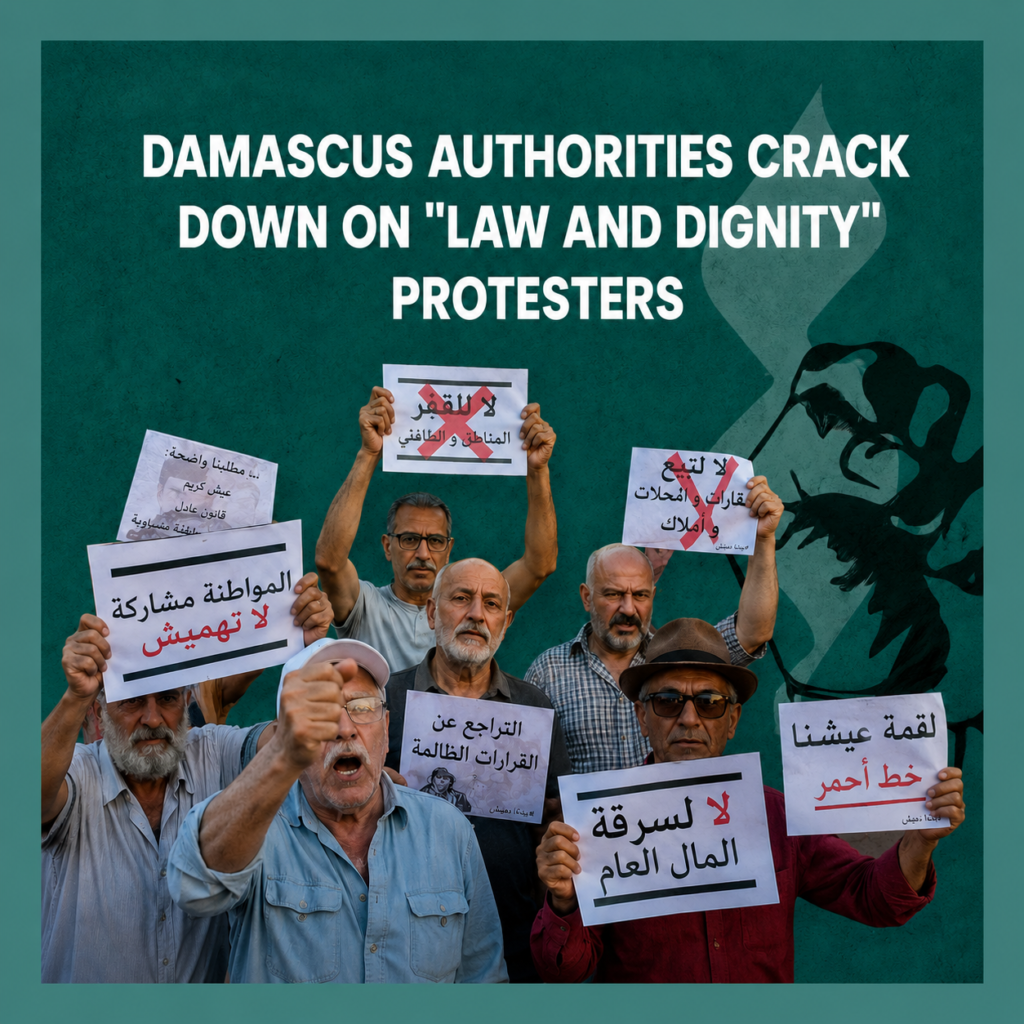
On Saturday evening, the capital Damascus witnessed a security intervention to disperse a peaceful sit-in under the slogan “Law and Dignity” in front of the People’s Assembly building, a step that reflects the continuation of the security-based approach in dealing with civil movements. The event, which occurred at a time when the Syrian street is reeling under an unprecedented economic crisis, has raised serious questions about the gap between the transitional government’s official discourse and the deteriorating living conditions.
The Gap Between Official Discourse and Economic Reality
Over the past two years, the transitional government’s official statements have been dominated by promises to end isolation, lift sanctions, and launch multi-billion-dollar projects and investments. However, the actual reality on the ground indicates a severe deterioration in citizens’ purchasing power, driven by a massive and rapid surge in the dollar exchange rate against the local currency. This financial collapse has made covering basic costs, such as food and services, a burden that exceeds the capacity of the vast majority, to the point that paying the electricity bill now requires the equivalent of four monthly salaries for an average employee.
This economic decline is accompanied by official ostentation represented by luxurious government motorcades, alongside intensive efforts directed towards propaganda campaigns on social media to polish the authorities’ image. This glaring contradiction between investment promises and the reality of hunger, and between the luxury of officials and the suffering of the streets, has deepened the crisis of trust between the citizen and the authority.
Dispersing the Sit-in: The Security Approach in the Face of Civil Demands
In an attempt to draw attention to these crises, the “April 17 Gathering” called for a sit-in demanding a political transition, the activation of transitional justice, and the criminalization of sectarian rhetoric, along with improving living conditions. However, security forces intervened very shortly after the sit-in began, issuing an ultimatum to the participants, giving them 10 minutes to evacuate or face arrest, under the pretext of lacking an “official permit.”
In this context, political activist Sawsan Zakzak, speaking from the protest site, criticized these justifications, arguing that “the underlying principle in things is permissibility, not prohibition,” and emphasizing the lack of transparency in managing state institutions. She added: “An unelected authority has no right to write a law. We do not know where public money goes, nor how appointments are made in the authority and on what basis, nor how contracts are awarded.”
Discrepancy in Security Handling and the Exploitation of the Living Crisis
The double standards in security were clearly evident in the handling of a parallel, pro-government rally by supporters of “Al-Julani,” organized on the opposite side of the sit-in. Although this gathering also lacked an official permit, it witnessed no security intervention or restriction, despite featuring sectarian chants and profanities.
The most expressive scene of detachment from reality and disregard for people’s suffering manifested when a participant in the pro-government rally mocked a woman demanding her living rights, saying: “You want electricity, you starving, honorless people?” This comment reflects an alarming trend that goes beyond shirking government responsibility, extending to direct intimidation and mocking of citizens and their rightful demands. It embodies an unprecedented state of disregard and disdain for people’s pain, using their poverty and need as material for direct ridicule and insult rather than listening to them.
Hunger Does Not Fear Arrest
Ultimately, what happened in Damascus reflects the reality that relying on the language of threats, intimidation, and virtual promises is no longer capable of containing the anger of a street that has become unable to secure its daily sustenance. Attempting to silence voices demanding the most basic necessities of life by threatening arrest—at a time when the gap is widening between an authority showing off its luxurious motorcades and a citizen crushed by currency collapse—is a reckless, uncalculated political gamble. History repeatedly proves that repression and mocking people’s pain might succeed in dispersing a sit-in for a while, but they completely fail to bury a social boiling point whose features are clearly forming under the weight of hunger and the total absence of any prospect or real rescue plan.