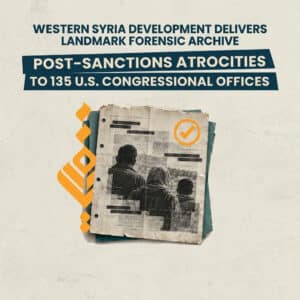
In an expanded human rights initiative aimed at providing direct evidentiary resources to international stakeholders, Western Syria Development (WSD) announced the delivery of a comprehensive forensic documentation package directly to 135 Members of the United States Congress, engaging foreign policy advisors, legislative teams, and staff across the House Foreign Affairs Committee (HFAC) and Senate Foreign Relations Committee (SFRC).
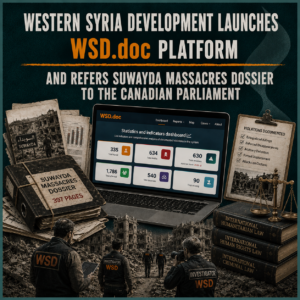
Coinciding with the launch of its bilingual digital platform, WSD.doc, for daily violation tracking, Western Syria Development submits a dossier documenting the Suwayda massacres to the Subcommittee on International Human Rights of the Canadian Parliament.
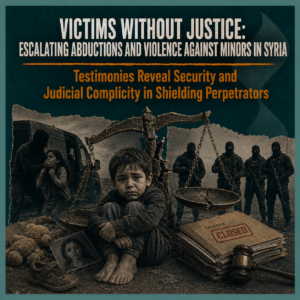
Unchecked weapons, a judiciary that legitimizes domestic abuse, and security apparatuses that intimidate victims' families—this is the reality facing young girls in Syria today within a system that grants total impunity to perpetrators.
A year of Western Syria Development’s efforts: providing relief aid, housing, medical care, and education for persecuted minorities, while advancing systematic violation documentation to support victims’ cases internationally.
Marking the first anniversary of its founding, The Foundation for the Development of Western Syria consolidates its presence as an effective institutional voice in Washington, D.C. Through its official work under the umbrella of the Foreign Agents Registration Act (FARA) and its strategic partnership with Tiger Hill Partners, the Foundation continues to open the doors of Capitol Hill to the issues of Syrian communities and the suffering of minorities, securing genuine political representation for our communities and directly defending their rights within decision-making circles.
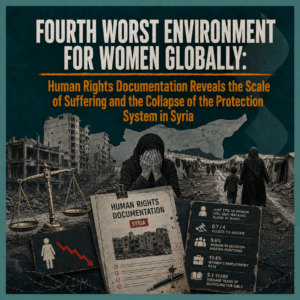
The 'Women, Peace and Security Index 2025/26' report reveals a catastrophic reality for women in Syria, ranking the country as the fourth worst globally. The report documents a systematic collapse of the judicial system and a near-total absence of community safety, highlighting the authorities' structural failure to protect civilians and their transformation of the civilian environment into a sustained arena of threat and exclusion.
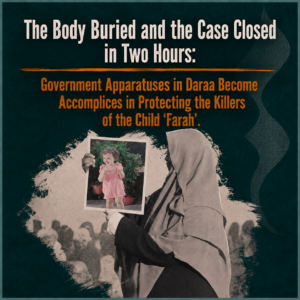
In a tragic incident that shook the town of Ghabaghib in Daraa, popular protests demanding justice are escalating following the murder of the child 'Farah Al-Hammoud,' amid explicit accusations made by her family against gold excavation networks for committing the crime, and against government security apparatuses for complicity and shielding the perpetrators by closing the case within hours, highlighting the collapse of the security system and the transformation of state institutions into partners in protecting organized crime.
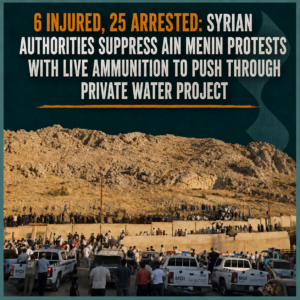
In a severe security escalation, Syrian government forces confronted civil protests in Ain Menin with live ammunition, injuring 6 civilians and arbitrarily arresting 25. The protests erupted against an illegal project aimed at empowering a private contractor, backed by figures close to the authority, to seize and trade the town's water resources, at a time when the region already experiences a water shortage. In response, the municipal council resigned en masse, and a commercial strike spread to affect commercial activity in major markets in Damascus, marking a strong civil defiance against the government's policies of repression and monopoly.
Western Syria Development provided logistical and organizational support to host a media briefing inside Congress to commemorate the first anniversary of the Swaida massacres. The briefing highlighted the sequence of violations against Syrian components, with a special focus on documenting the abducted women file, amid urgent demands for the international community to establish independent investigative mechanisms and ensure accountability.
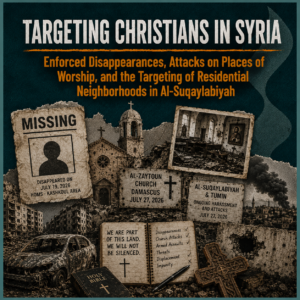
Amidst a sharp demographic decline, Christians in Syria are facing a series of escalating security violations. This report documents the incidents of July 2026, ranging from the enforced disappearance of a young woman and the vandalism of the historic Al-Zaytoun Church in Damascus, to the targeting of residential neighborhoods in Al-Suqaylabiyah, amid human rights criticisms of church leadership's silence and authorities' inaction.
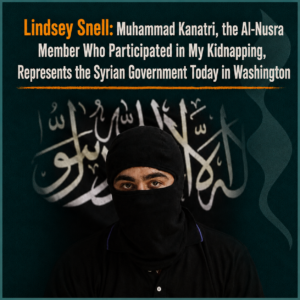
American journalist and researcher Lindsey Snell has revealed the involvement of the Syrian Chargé d'Affaires in Washington, Muhammad Kanatri, in her 2016 kidnapping, when he was a member of the "Al-Nusra Front." These video-backed revelations serve as conclusive proof of the extremist jihadist past of the current Syrian government, and its efforts to normalize radical figures under a diplomatic cover that guarantees their evasion of legal accountability.
Between US statements confirming his surrender of the Golan and an Israeli rejection describing him as a 'terrorist in a tie,' Ahmed al-Sharaa seeks to conclude a security agreement with Israel in pursuit of international legitimacy. A political path that places survival in power as an absolute priority, overriding sovereign considerations.