
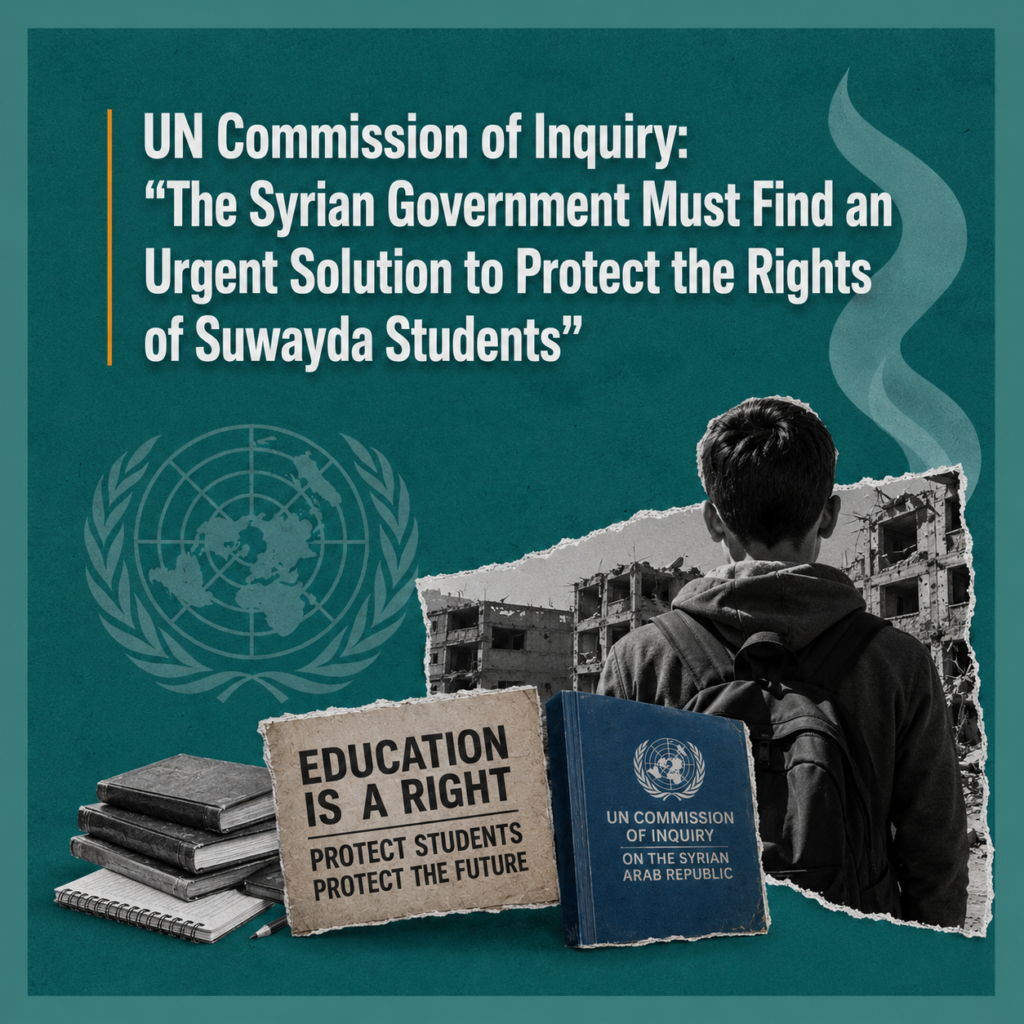
Suwayda governorate is facing an educational crisis resulting from a government decision to transfer the basic and secondary education certificate exams to the capital, Damascus. The decision has deprived thousands of students of taking their exams due to the high security risks on public roads. This prompted direct intervention by the Independent International Commission of Inquiry on Syria to emphasize the priority of the right to education and the need to isolate it from political disputes.
Resolution /1419/ and the Security Reality of the Suwayda-Damascus Road
The crisis began with the issuance of Resolution No. /1419/ by the Ministry of Education in the Syrian government on May 14, 2026, which obligated Suwayda students to take their exams in centers within Damascus and its countryside.
This decision was met with widespread local rejection, based on security assessments that consider the road connecting Suwayda and Damascus unsafe. This road, locally known as the “Road of Death,” witnesses frequent incidents including kidnappings, killings, and armed attacks targeting civilians, specifically members of the Druze community. This reality prompted residents and the “Self-Determination Movement” to organize a protest in early June in front of the UNHCR office, under the slogan “Our Exams in Our City.”
Failure of UN Mediation and Rejection of Government Security Presence
Following the protests, a UN delegation visited Suwayda to discuss the possibility of holding the exams inside the governorate under UN supervision and sponsorship.
These efforts failed to reach an agreement due to the refusal of local factions to allow ministerial delegations or government police elements to enter and supervise the exam centers. This refusal was based on explicit fears among residents regarding the potential exploitation of the government security presence to carry out arrests or repeat previous security incidents and violations targeting the governorate’s residents.
The Official Narrative on Road Safety and the “Al-Mutallah” Incident
After the negotiations faltered, the Syrian government insisted on implementing the transfer decision. This was accompanied by coverage from official state media aimed at proving the stability of the security situation and the smooth flow of traffic on the road leading to Damascus.
However, this coverage contradicted the realities on the ground. Just a few hours after the broadcast of a video report affirming the safety of the road, one of the buses featured in the exact same report was subjected to an armed attack in the “Al-Mutallah” area, a region under the control of government forces. This incident provided residents with tangible evidence of the magnitude of the security risks, confirming the impossibility of sending students to take exams in Damascus.
Position of the UN Independent International Commission of Inquiry
Based on the field developments and the deprivation of students from their exams, the Independent International Commission of Inquiry on Syria (@UNCoISyria) issued an official statement outlining its position on the crisis through the following points:
-
Need for Urgent Action: The Commission called on all actors to take immediate action to remove the barriers preventing civilians in Suwayda, and those displaced from it, from accessing education and freedom of movement, coinciding with the start of the exams.
-
Priority of Children’s Rights: It emphasized that human rights, particularly children’s rights to education, must be prioritized and isolated from any political considerations.
-
Responsibility of Authorities: The Commission held the Syrian government and local authorities responsible for finding a solution that protects the rights of the affected communities.
-
Warning Against the Repercussions of Violations: It pointed out that continuing violations of international humanitarian law in the governorate will only deepen grievances and cement divides, causing direct harm to civilian populations.