
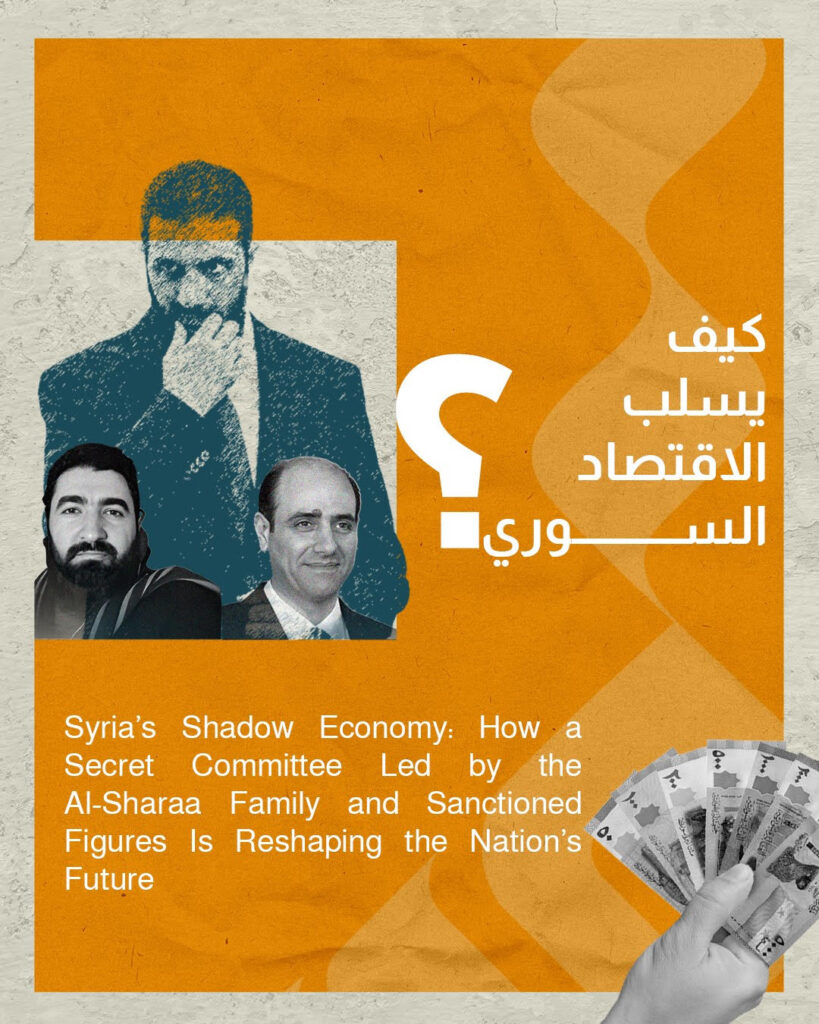
A recent Reuters investigation has uncovered a secretive, powerful committee operating outside official government channels to restructure Syria’s economy—under the direct supervision of Hazem Al-Sharaa, the brother of the de facto authority’s leader, Ahmed Al-Sharaa.
This shadowy body, whose existence has never been officially announced, is chaired by an Australian man known by the pseudonym Abu Maryam. His real name is Ibrahim Sakaria, a Brisbane-born individual of Lebanese descent who remains under Australian sanctions for terrorism financing offenses.
Operating from repurposed regime-era offices and luxury hotels, the committee has already seized or negotiated control of assets worth more than $1.6 billion, according to financial records and insider sources.
The Hidden Figures Reshaping the Economy
While Ahmed Al-Sharaa acts as the public face of the new de facto authority, his older brother Hazem—previously a PepsiCo director in Erbil—now unofficially oversees all major business and investment affairs in Syria.
The committee he supervises is led by Abu Maryam (Ibrahim Sakaria), who presents himself online as a business-loving cricket fan, but whose brothers have known ties to extremist groups. One brother became Australia’s first known suicide bomber in Syria in 2013; another was imprisoned for sending money to Jabhat al-Nusra.
Another key figure is Abu Abdelrahman (Mustafa Qadid), a former baker turned military commander who now acts as the “shadow governor” of Syria’s Central Bank, with ultimate authority over major financial decisions.
The Takeover of Syria’s Economic Infrastructure
The committee’s work began just days after opposition forces captured Damascus in December. Their mission: to untangle the complex web of Assad-era economic holdings and decide what to restructure, what to keep, and what to discard.
Their biggest success came through so-called “amnesty deals” with wealthy businessmen from the former regime. Through these agreements, the committee has gained control of:
· $1.5 billion in assets seized from just three businessmen
· Syriatel, Syria’s leading mobile telecom operator, valued at $130 million
· A rebranded airline, Fly Sham, created after its predecessor “Syrian Wings”—
sanctioned for smuggling drugs, weapons, and migrants—handed over 45% ownership
and paid $50 million in settlement
Major businessmen including Samer Foz (handing over assets worth $800 million to $1 billion) and Mohammed Hamsho (assets worth $640 million) have struck immunity deals allowing them to avoid prosecution while surrendering most of their commercial empires.
A Sovereign Wealth Fund Without Oversight
In July, Ahmed Al-Sharaa announced the creation of Syria’s first sovereign wealth fund, answering directly to the presidency. Three sources familiar with the fund’s operations confirmed it would be supervised by his brother Hazem.
Middle East studies professor Steven Heydemann told Reuters that a sovereign wealth fund for Syria is “premature,” warning that relying on “ambiguous non-performing assets” and granting management independence to the presidency would undermine accountability.
Old System, New Faces
Despite public promises of change, the new authority has maintained many aspects of the old system. Rather than prosecuting businessmen who profited from the former regime, the committee has chosen to negotiate settlements that allow them to retain some wealth while giving the new authority control over strategic sectors.
One committee member explained their pragmatic approach: “We would be playing on their turf.” The new government fears that seasoned businessmen could outmaneuver them in court, or that they lack sufficient evidence for convictions in complex financial cases.
The committee has effectively taken over the “Al-Ahd” group—a network of more than 100 companies established under Bashar al-Assad that controlled key sectors of the economy, from banking to telecommunications to energy.
International Reaction and Future Implications
The U.S. State Department, in response to Reuters’ findings, emphasized that “promoting stability and ensuring its continuity in Syria will depend on establishing true justice and accountability for abuses committed by all parties over the past fourteen years.”
As Syria seeks to reintegrate into the global economy, the concentration of economic power in the hands of shadowy figures with questionable pasts threatens to undermine foreign investment and credibility.
For ordinary Syrians who hoped the fall of Assad would bring justice and transparency, the emergence of this new unaccountable economic structure represents not revolution but replacement—the trading of one elite for another, with the lives of millions still hanging in the balance.