
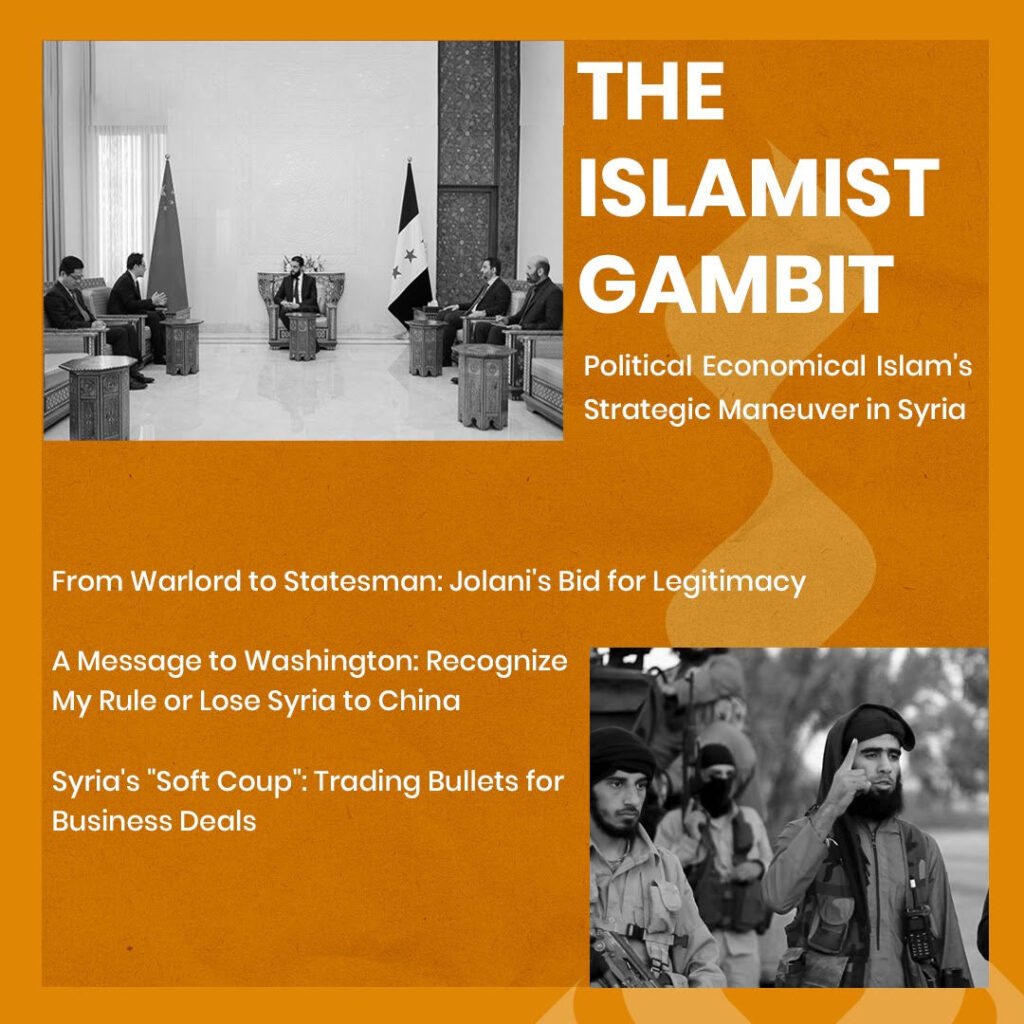
Signing of Syrian-Chinese Investment Agreements
According to media reports, Syria has signed memoranda of understanding with Chinese companies such as “Fidi Contracting” to invest in free and industrial zones in Adwa and Haseya, covering an area of more than one million square meters for a period of 20 years. There is no official confirmation of the exact investment figure exceeding $580 million, and these numbers may be estimates. China is following a cautious approach in its investments due to the political and security risks in Syria.
In a critical turn on the Syrian stage, the scene is no longer just a conflict between a regime and an opposition, but has transformed into an organized usurpation of power by the extremist Brotherhood current led by Abu Muhammad al-Jolani (Ahmad al-Shara), who managed to resolve the internal equation in his favor and infiltrate the center of governance in Damascus to become the strongman in Syria.
Within the framework of his new rule, the announced massive Chinese investment emerges not merely as an economic deal, but as a well-orchestrated political game managed by Al-Jolani’s leadership to achieve two main objectives: legitimizing the complete seizure of power and breaking the siege of isolation and American sanctions that threaten the existence of his project.
Chinese Investment: The Economic Arm of the New Brotherhood “Caliphate”
1. From “Jihad Emir” to “Head of State”: Al-Jolani seeks to transform his image from a leader of an armed group to a statesman recognized internationally. He has found in China, which deals with pure economic pragmatism regardless of ideological backgrounds, the ideal partner. Signing memoranda of understanding with giant Chinese companies is an attempt to formalize and internationalize his rule, announcing that “Al-Jolani’s Syria” is open for business – a message he wants to convey to Washington and the world.
2. The Grand Game: Using China to Pressure America
The relationship between Al-Jolani’s rule and the United States is ambiguous. On one hand, he derived his initial legitimacy from previous American support for some opposition factions, and on the other hand, Washington imposes strict sanctions on him as part of its counter-terrorism policies.
Here lies the brilliance of the maneuver:
· Message to the White House: Through China, Al-Jolani tells the United States: “If you don’t deal with me as a partner, your economic rival will. You are losing the Syrian market and its influence to Beijing.”
· Bargaining Chip to Lift Sanctions: This Chinese rapprochement aims to destabilize the American position. The presence of an economic player of this size as a partner to the new government in Damascus places Washington before two difficult choices: either continue the sanctions policy that will lead to further Syrian drift toward the Sino-Russian camp, or begin a new engagement with Al-Jolani, with the lifting of sanctions as an essential part of it, to maintain any American footprint in the region.
The Challenge: Between Investment Legitimacy and Governance Legitimacy
The dilemma facing Al-Jolani’s administration is that its success in attracting Chinese investments enhances its economic and international legitimacy de facto, but does not remove the description of “coup” or “usurpation of power” from its leadership in official international discourse. Moreover, rapprochement with China, America’s strategic rival, may anger sectors within the American establishment and complicate any prospects for normalizing relations.
Conclusion:
What is happening in Syria under the rule of Ahmad al-Shara (Al-Jolani) is more than just a shift in alliances. It is a model of a “soft coup” using economic tools in the battle for political legitimacy. By choosing China as a strategic partner, Al-Jolani seeks not only reconstruction, but to reshape his position on the global geopolitical map, forcing Washington to completely recalculate: either deal with the “new reality” imposed by him and the Brotherhood current in Damascus, or step aside and witness Syria’s transformation into a complete Chinese-Russian protectorate, in a strategic blow to American interests in the Middle East.