
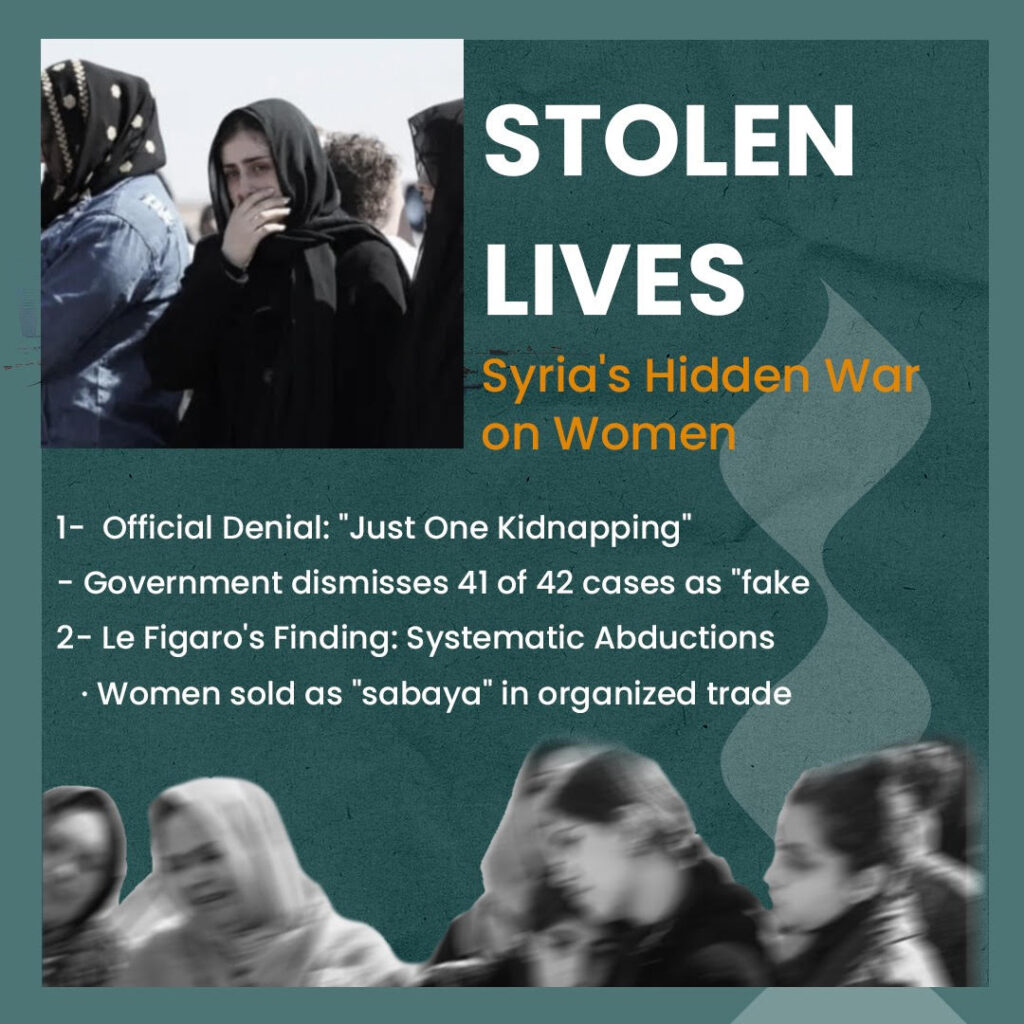
The Official Narrative: A Single Kidnapping Amidst a “Wave of Rumors”
In a statement that has sparked outrage and disbelief, the Syrian Ministry of Interior announced the results of its investigation into 42 alleged kidnapping cases circulating on social media. Its conclusion: only a single case was a genuine abduction, and the victim was safely returned.
The ministry dismissed the other 41 cases as “false claims,” voluntary elopement with romantic partners, temporary absence with relatives, or women fleeing domestic violence. This official narrative, disseminated by state-run media, aims to paint a picture of social media hysteria and fabrications, effectively denying the existence of any widespread, organized crime targeting women.
For a regime long-accused of manipulating information, this report serves to officially close the file, attributing the families’ anguish to misunderstandings and lies.
Le Figaro’s Investigation: Uncovering a Horrific Reality of “Sabaya” Markets
In stark contrast, a ground-breaking investigative report by France’s prestigious newspaper, Le Figaro, reveals a chilling reality of systematic kidnappings targeting Alawite women in Syria. The report, based on testimonies and documentation, alleges that women are being abducted in a coordinated manner, trafficked, and sold as “sabaya” (spoils of war) by criminal networks.
Key findings from the investigation include:
· Systematic Targeting: Nearly 90 Alawite women have been documented as missing, with activists believing the true number is far higher.
· Official Complicity: The criminal networks often operate with the cover or tacit approval of security apparatuses in opposition-held areas. Local authorities systematically ignore complaints or even pressure families to accept the abductions as a fait accompli.
· A Culture of Impunity: The report details a recurring pattern where security officials extort families, demanding money to remove their daughters’ names from lists of the wanted or kidnapped.
Case Study: The Agony of “Nour” – From Schoolgirl to Commodity
The human cost of this crisis is embodied in the story of “Nour” (a pseudonym), a 15-year-old girl. She disappeared on March 25 after stepping out to make a phone call. Her family’s nightmare began when they received photos of her with her hands tied and a ransom demand of $100,000.
The kidnappers claimed affiliation with a new security apparatus. When the family, unable to pay the enormous sum, tried to negotiate, they were met with brutal threats. An security official callously told the family that Nour had “voluntarily married” in Aleppo—a claim the family refutes, noting she is a minor and was clearly abducted. Her case exemplifies the cruel intersection of criminality, sectarian targeting, and official indifference.
A Pattern of Brutality and Silenced Victims
Le Figaro’s investigation goes beyond kidnapping for ransom, uncovering brutal practices that amount to torture and ethnic violence. The report documents:
· Married women being forced to divorce at gunpoint.
· Victims, including a woman identified as “Warda” and her infant child, being held in secret prisons and subjected to physical and psychological torture.
· A campaign of forced silence, where families—even those who managed to pay ransoms—are threatened with death or the kidnapping of other girls if they speak out.
This environment of terror ensures that the vast majority of crimes remain hidden, allowing the perpetrators to operate with impunity.
From Local Crime to International Courts: The Push for “Crimes Against Humanity”
Confronted with this systemic violence, Syrian activists and international groups are moving to break the wall of silence. Dozens of cases have been referred to the UN Committee on Missing Persons. Furthermore, the French Alawite Collective has filed a formal complaint with the Paris Court, which has jurisdiction over crimes against humanity, and has alerted the International Criminal Court.
The legal complaint warns that these organized crimes—including kidnapping and identity-based killing—could amount to “genocide and crimes against humanity.” A lawyer for the collective described the methods as “terrifyingly similar to what Yazidi women suffered,” drawing a direct parallel to a widely recognized genocide.
Conclusion: The Chasm Between Denial and documented Atrocity
The chasm between the Syrian regime’s dismissal and the findings of Le Figaro is not merely a difference in perspective; it is the gap between state-sponsored denial and documented, systematic human rights atrocities.
While the Ministry of Interior speaks of “false claims on social media,” a leading international newspaper, families, and human rights advocates present evidence of a coordinated campaign of terror. This discrepancy underscores the critical need for independent international investigations into the fate of missing women in Syria.
The international community must not accept the Syrian regime’s whitewashing of these crimes. The women of Syria, from all backgrounds, deserve justice and protection, not to be abandoned between the lines of official lies and the brutal reality of their captors.