
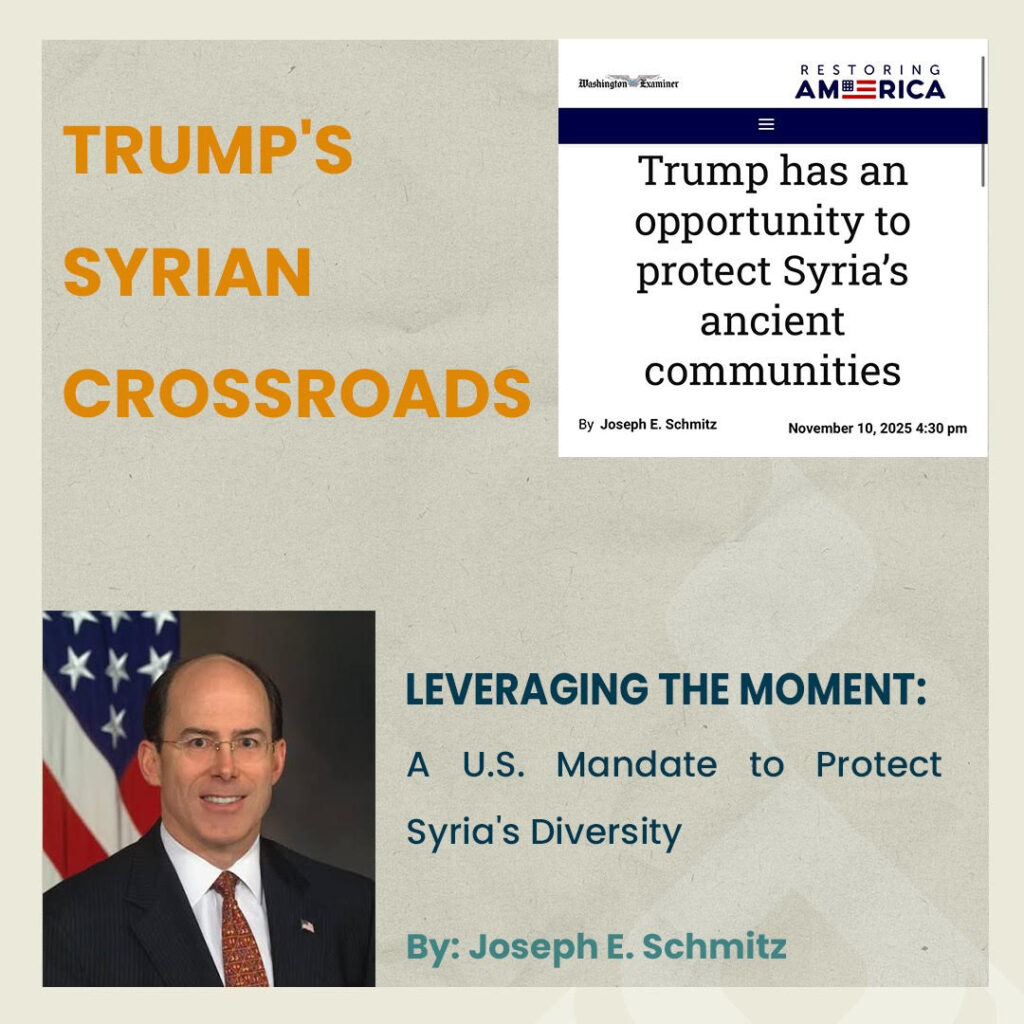
In a move that signals a potential turning point in the long and painful Syrian conflict, President Donald Trump recently met with Syrian leader Ahmad al-Sharaa, widely known by his nom de guerre, Abu Mohammad al-Jolani. This pivotal engagement is more than a diplomatic handshake; it represents a critical and fleeting opportunity for the United States to leverage its influence towards a singular, noble goal: the protection of Syria’s ancient and diverse communities.
For over a decade, these communities have been caught in a maelstrom of conflict, displacement, and despair. They have faced relentless threats from all sides—from the brutal regime of Bashar al-Assad to the genocidal ideology of ISIS and the encroaching influence of foreign powers. The very fabric of Syrian society, a tapestry woven over millennia, has been torn and frayed. The meeting with the leader of the Syrian opposition opens a door to begin mending it.
A Shared Aspiration for a United Syria
Beyond the complex web of international politics and competing interests, a fundamental aspiration unites the global community: the desire for a Syria that is united, stable, and sovereign. The Syrian people deserve a future free from the specter of fragmentation along sectarian lines. They must not be forced to live in a nation subservient to foreign powers or held hostage by extremist ideologies.
The path to this future does not lie in dividing the country into smaller, homogenous statelets. Such a course would only cement the tragedies of the past decade and erase the historical identity of the nation. True stability can only be built upon the foundation of Syria’s inherent strength—its profound diversity.
Syria’s Strength is in its Diversity
Syria is not merely a country on a map; it is one of the world’s oldest living mosaics of civilization. Its enduring strength has always been the rich tapestry of faiths and ethnicities that have coexisted and contributed to its cultural wealth for centuries. From the ancient Christian communities, whose roots trace back to the earliest days of the faith, to the Alawites, Druze, Kurds, and Sunni and Shia Muslims, each group is an integral thread in this vibrant tapestry.
These are not recent arrivals but the descendants of peoples who have built empires, founded great cities, and contributed to human knowledge and culture since the dawn of history. To allow any of these communities to be displaced, persecuted, or erased is to lose an irreplaceable piece of our shared human heritage. Their preservation is not a sectarian issue but a global responsibility.
The Path Forward: Leveraging American Influence
The United States, through this diplomatic opening, holds a unique position of influence. It can use this moment to champion a vision for Syria that prioritizes the safety and rights of all its citizens. This means advocating for:
· Security Guarantees: Ensuring that any future political or security arrangements explicitly protect minority communities from violence and persecution.
· Cultural Preservation: Supporting initiatives to rebuild not just infrastructure, but also the cultural and religious sites that define Syria’s historical identity.
· Inclusive Governance: Pushing for a political framework where all Syrians, regardless of faith or ethnicity, have an equal voice and stake in their nation’s future.
President Trump now has a historic choice. He can treat the meeting with al-Jolani as a mere tactical discussion, or he can seize it as a strategic opportunity to help steer Syria away from the abyss of permanent division and towards a future of unity and coexistence. The ancient communities of Syria have endured a long night of suffering. The international community must now support every effort to help them see the dawn.
BY: Joseph E. Schmitz