
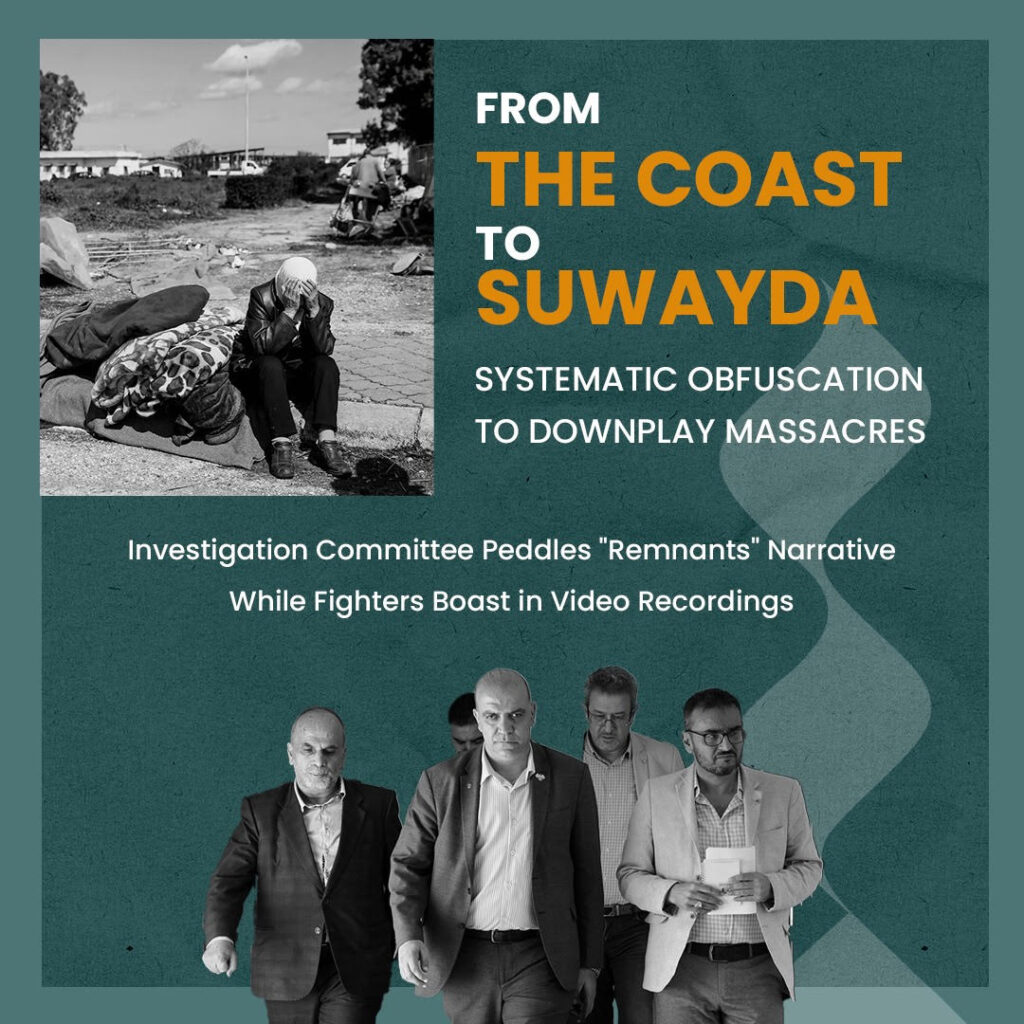
In a recurring scene from the Coast to Suwayda, the National Investigation Committee continues to deny the reality of massacres documented by field evidence. While video recordings show fighters boasting about bloodshed, the committee chooses to label events as “violations” and attribute them to “remnants of the former regime,” a stark contradiction revealing systematic efforts to obscure the truth.
The Coastal Massacre: From “Violations” to Alleged “Remnants”
· In its July 22 report, the committee blamed 265 suspects from “remnants of the former regime,” ignoring that many remain active elements in current security institutions.
· The committee documented 1,426 victims including 90 women but used the term “violations” instead of “massacres,” clearly attempting to downscale the crimes.
· Public trials in Aleppo included only 14 defendants, while the actual number of perpetrators exceeds hundreds, confirming these are merely theatrical shows lacking credibility.
Suwayda: Video Archive Debunks Official Narrative
· While the committee claimed its investigation involved 800 witnesses in Suwayda, it admitted inability to access all neighborhoods, undermining its findings.
· Recorded videos show fighters with unfamiliar uniforms and foreign accents boasting about killing civilians, with one stating: “We came to clean the area from thugs,” a racist reference to the Druze community.
· These recordings provide conclusive evidence that the crimes were not “individual and random” as the committee claims, but rather organized and officially sanctioned.
Connecting the Dots: Evidence of Official Cover-up
· Fighters appearing in Suwayda recordings are the same ones mentioned in the coastal report under the “remnants” label, confirming authorities use the same elements to execute massacres then disown them.
· Documents reveal these fighters receive salaries through security institutions affiliated with the Ministry of Defense, refuting the alleged “remnants” narrative.
· The actual death toll in Suwayda reached 2,055 victims, according to the Syrian Observatory, which the committee completely ignored.
Human Rights Watch Report: Accusations of Credibility Gaps and Lack of Justice
· HRW’s report highlighted the weakness of investigations by “de facto authorities” and absence of fair trial conditions, confirming current trials lack minimum justice standards.
· It emphasized that true accountability requires independent investigations covering all crimes, not just those of the Assad regime.
· The report criticized using “violations” instead of “massacres,” arguing it diminishes the scale of crimes and undermines victims’ rights.
International Reactions: Between Naivety and Complicity
· The UK’s Syria representative, Anna Snow, “welcomed” the coastal trials but used “violations” instead of “massacres,” ignoring documented casualty figures.
· Activists questioned whether she read HRW’s report criticizing the investigations’ shortcomings, highlighting a gap between diplomatic rhetoric and reality.
· The Syrian Observatory attacked the committee, stating its contradictory statements “raise questions about its methodology,” and questioned how it verified events without visiting Suwayda.
Conclusion: The Archive Doesn’t Lie
While the committee continues its denial of massacres, the archive of video recordings, images, and testimonies remains witness to the truth. Using “violations” instead of “massacres” and attributing crimes to imaginary “remnants” is not merely linguistic manipulation, but a deliberate erasure of atrocities deserving justice, revealing that the system hasn’t changed—only its tools of denial have involved.