
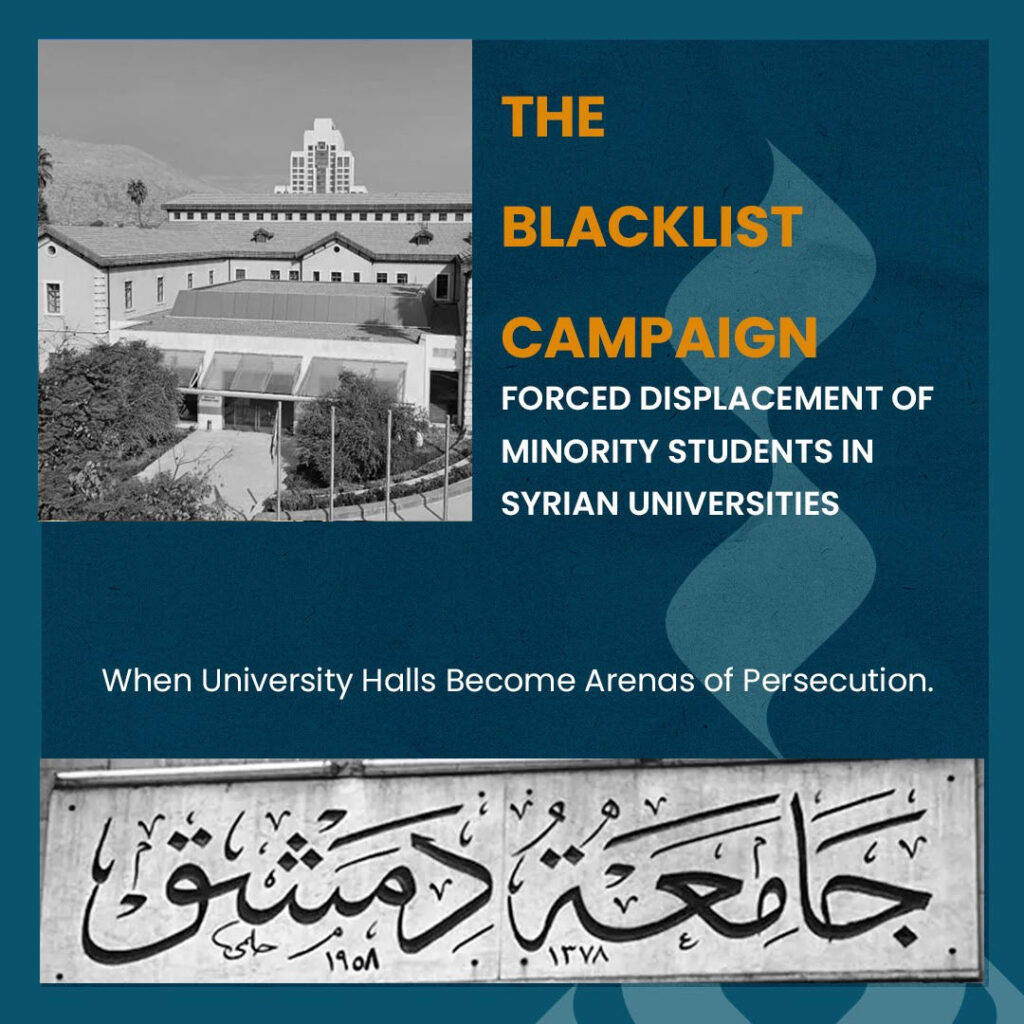
The Syrian conflict has entered a phase defined not only by territorial control but by a systematic campaign of societal re-engineering. One of its most insidious manifestations is the targeted persecution of students from minority backgrounds within academic institutions, orchestrated to create an environment so hostile that forced displacement becomes the only perceived option. Recent documented events at Damascus University and along the Syrian coast reveal a terrifying pattern of state-tolerated incitement, violence, and academic erasure that amounts to persecution—a crime against humanity.
The Damascus University Campaign – Academic Persecution of the Druze Community
A chillingly organized incitement campaign has unfolded within the halls of Damascus University, specifically targeting Druze students. Medical students were documented calling for the expulsion of their Druze peers, cynically suggesting they be sent “to study Hebrew” on the sole grounds that “they are not Muslims.” This rhetoric escalated to dehumanizing levels, with suggestions of “offering the Ismaili community as gifts.”
The campaign moved beyond words to actionable threats. A blacklist containing the names of 19 Druze students from Suwayda was circulated, urging their boycott and isolation. For their security, these victims’ names must remain withheld. The timing is particularly cruel, as this academic persecution coincided with the horrific Druze massacres in Suwayda in July 2025, perpetrated by de facto authority forces. Tragically, students named on these blacklists had already lost relatives to killing or abduction during those very atrocities.
The targeting extended to a Druze academic, with messages inciting sexual violence, murder, and professional erasure. This is not random bigotry; it is a coordinated effort to purge a minority community from a key national institution, severing their future and their stake in the country. The direct link between this organized public incitement and the physical crimes committed in Suwayda is undeniable. It constitutes a deliberate strategy of dehumanization, a precursor and driver of forced displacement.
The Coastal Front – Sectarian Violence Targeting Alawite Students
Parallel campaigns of terror are underway in government-held coastal areas, exposing the multi-directional nature of this sectarian engineering. In Baniyas, a violent assault erupted inside the Industrial School after Alawite students refrained from participating in official “liberation” celebrations. Radicalized students from the Sunni sect attacked their Alawite peers with sharp tools, causing serious injuries.
The aftermath was a mass exodus. Fearful for their lives, the majority of Alawite students and teachers were forced to abandon the school. This incident starkly illustrates how educational institutions are being transformed into arenas of sectarian conflict, where non-conformity to a imposed political-sectarian identity is met with extreme violence. The goal is clear: to make minority students feel unsafe in their own classrooms and communities, pushing them toward flight.
Conclusion & Urgent Appeal
The cases at Damascus University and in Baniyas are not isolated. They are facets of a broader, sustained phenomenon aimed at the forced displacement of Syrian minorities through fear, violence, and the destruction of their educational and professional futures. When universities—supposed bastions of reason and national future—and schools become epicenters for hate speech, blacklists, and physical assaults, it signals a profound societal breakdown and a deliberate policy of persecution.
This systematic targeting, which includes incitement to violence and the creation of a coercive environment leading to displacement, meets the criteria for crimes against humanity. The international community must move beyond mere condemnation.
We issue an urgent appeal:
· To the United Nations and Special Rapporteurs: Immediately investigate these documented campaigns of incitement and violence in Syrian educational institutions as possible crimes against humanity. Demand accountability from the de facto authorities.
· To Academic Institutions Worldwide: Recognize the specific threat to minority students in Syria and provide enhanced scholarship and sanctuary programs.
· To Human Rights Organizations: Prioritize the documentation of these academic persecution campaigns as a key component of the forced displacement strategy in Syria.
Silence in the face of this engineered hatred is complicity. Protecting Syria’s students from sectarian targeting is not merely an educational issue; it is a fundamental human rights imperative and a last stand to prevent the complete disintegration of Syrian society. The world must act before more lists are drawn, more classrooms are emptied, and more futures are violently erased.