
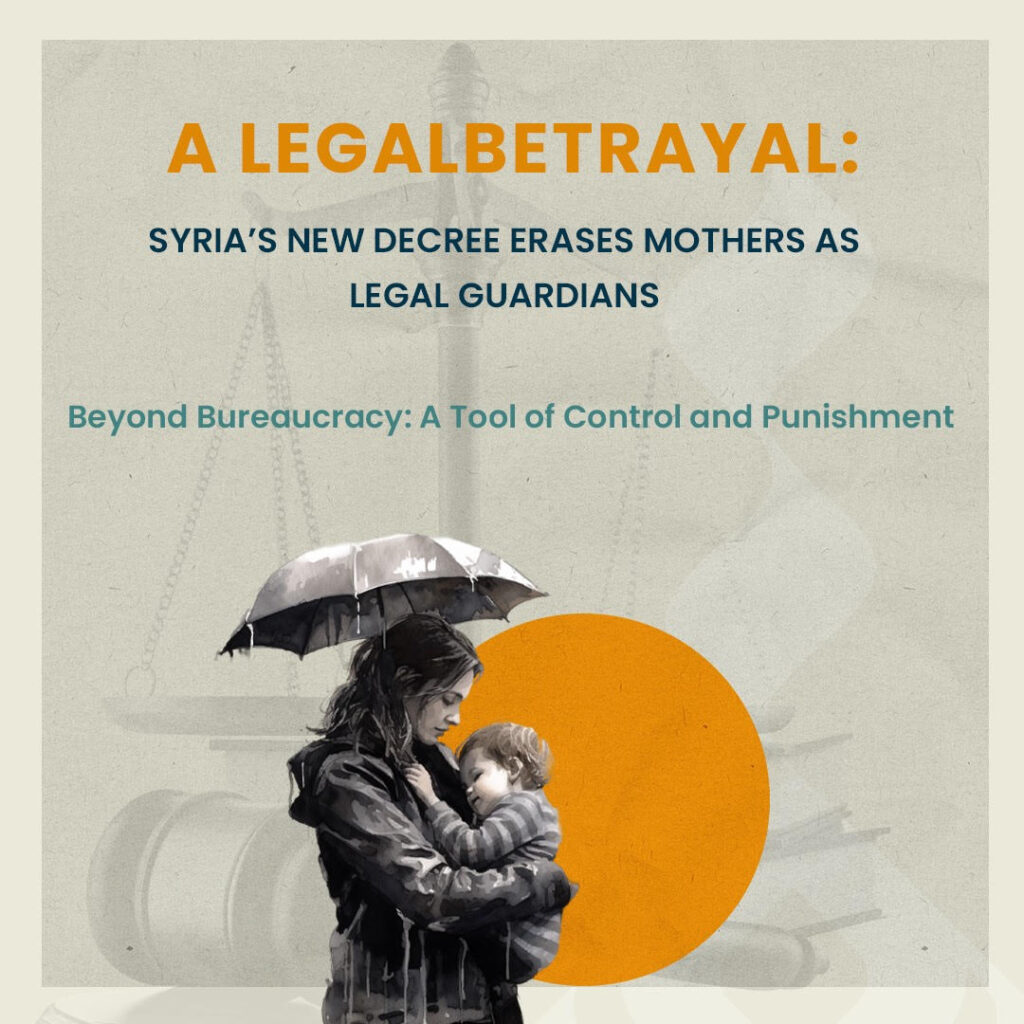
In a move that has sparked outrage among human rights defenders and Syrians worldwide, the Syrian Ministry of Justice has issued a judicial circular that systematically strips mothers of their fundamental rights over their own children. “Circular No. 17,” dated March 30, 2025, is not a minor administrative adjustment; it is a profound institutionalization of gender-based oppression, reducing Syrian mothers to legal non-entities in the eyes of the state.
The Mechanics of Erasure
The decree explicitly formalizes a rigid, male-only hierarchy of guardianship (wilayah) over minors. According to the text, legal guardianship is exclusively vested in male relatives from the father’s patrilineal line. The order of succession is: the father, then the paternal grandfather, then the uncle (father’s brother), then the paternal cousin, and so on. The mother’s name is conspicuously absent. She is not considered a legal guardian, regardless of whether she is the primary or sole caregiver, a widow, or separated from the father.
The practical implications are harrowing. For any critical procedure requiring legal consent for a child—such as obtaining a passport, securing a visa for travel or medical care, or enrolling in certain institutions—a mother must now navigate a demeaning and arduous legal maze. She is forced to file a formal petition in a religious (Sharia) court to request the appointment of a “special male guardian” from the predetermined list. This process is inherently humiliating, costly, time-consuming, and subject to the discretion of a judicial system long accused of being a tool of the state.
Beyond Bureaucracy: A Tool of Control and Punishment
Framing this as a mere bureaucratic step to reduce court caseloads, as the circular disingenuously suggests, ignores its true function. In a country shattered by over a decade of conflict, where hundreds of thousands of men have been killed, detained, forcibly disappeared, or displaced, this decree weaponizes that absence. It forces mothers—already bearing the immense burden of war—to seek permission from male relatives who may be missing, hostile, or themselves victims of the regime. It effectively holds children hostage to paternal lineage and state approval.
This policy serves multiple oppressive purposes:
1. Institutionalizing “Perpetual Minority”: It legally codifies the idea that women, regardless of age or circumstance, are perpetual minors requiring male oversight.
2. Dismantling Family Autonomy: It grants the state, through its courts, invasive control over the most intimate unit of society, breaking the natural bond between a mother and her child.
3. Collective Punishment: It acts as a form of collective punishment against Syrian women, who have been pillars of resilience throughout the conflict, and further traumatizes children by complicating access to safety, education, and reunification.
A Microcosm of a Broader Reality
“Circular 17” is a stark microcosm of the Syrian regime’s modus operandi. It demonstrates how laws are cynically manipulated not to serve justice, but to enforce a patriarchal authoritarian grip on society. It exposes the hypocrisy of a state that pays lip service to national sovereignty while violently usurping the sovereign rights of mothers over their families.
This decree also casts a long shadow over any future discussions of justice and reconstruction in Syria. It poses a searing question to the international community and those advocating for “transitional justice”: Can there be any meaningful justice in a Syria where the law itself is engineered to humiliate and disenfranchise half its population?
The silence of the world in the face of such a blatant violation is complicity. Defending the rights of Syrian mothers is not merely a women’s issue; it is a fundamental battle for human dignity and the very future of Syrian society. Rescinding “Circular 17” is a non-negotiable first step toward affirming that in Syria, a mother’s right to protect and care for her children is innate, inalienable, and must be recognized by law.