
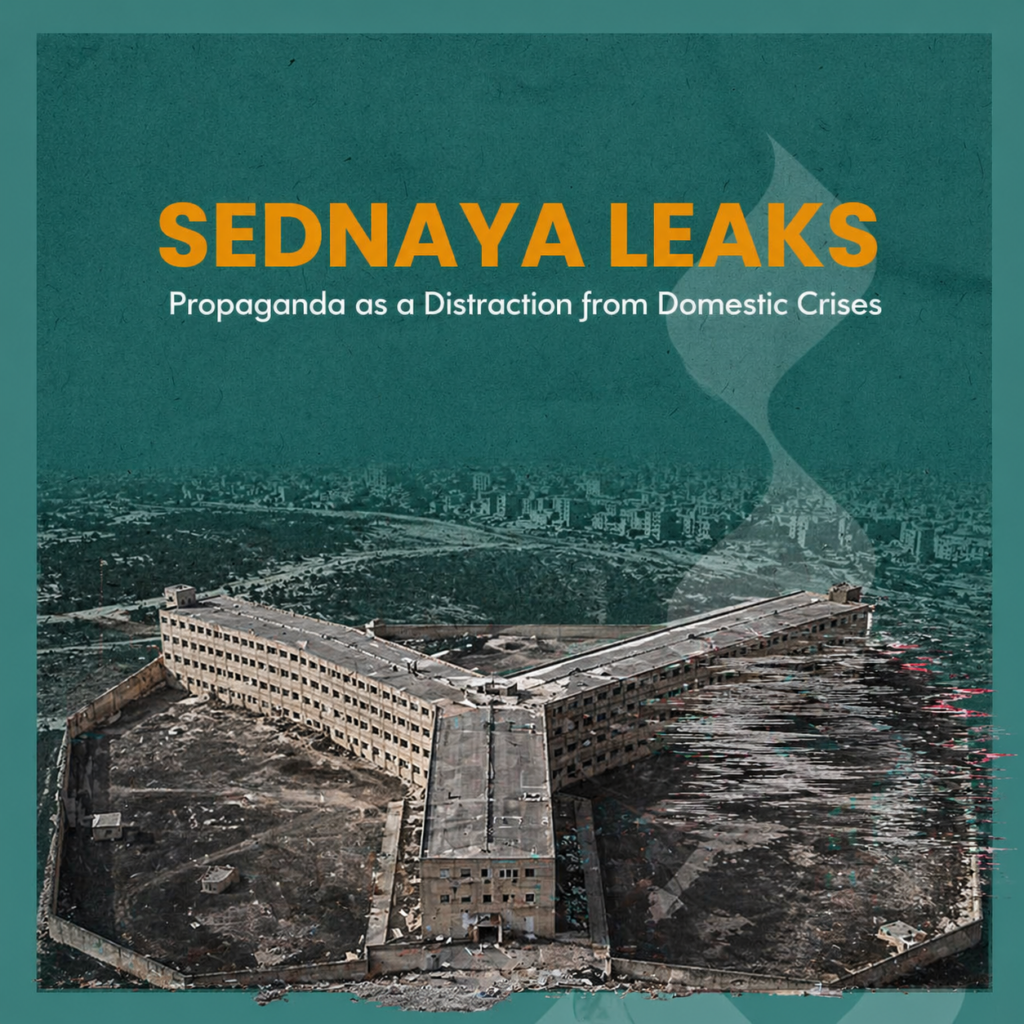
Sednaya Military Prison, the controversial facility established in the 1980s north of Damascus, has once again returned to the forefront of Syrian events. However, this time, its prominence does not stem from conventional human rights reports, but rather through a wave of “digital skepticism” and puzzling questions regarding the timing of this sudden media escalation—coinciding with suffocating living crises and major corruption scandals rocking state institutions.
“Sednaya” Between Security Mystique and Political Exploitation
For decades, the prison has been surrounded by an aura of mystery, making it fertile ground for polarization. While previous international reports discuss violations within its walls, the current reading of the scene reveals clear attempts to transform this lingering file into a “maneuvering tool.” Observers of Syrian affairs note that the current media hype is drifting away from a purely human rights framework, turning into a “digital battlefield” where facts are lost between politicization and disinformation.
The “Turkish Press” Trap and the Collapse of Credibility
The first major lapse in this escalation was the circulation of a video clip claiming to show a “manual torture press” inside the prison, representing a significant professional failure for several media outlets. Digital verification confirmed that the footage was actually taken from a Turkish entertainment channel (Koleksiyoncu Korku Evi) published in 2022, and has no connection to the Syrian reality.
This type of “fabrication” raises fundamental questions: Who benefits from flooding public opinion with misleading information at this specific time? Furthermore, is the goal to undermine the credibility of any future human rights movements by linking them to false data that can be easily debunked?
The “Distraction” Strategy: Escaping Corruption Files
Observers suggest that raising the momentum of the Sednaya file at this juncture is no coincidence. Amidst escalating economic crises and the emergence of massive administrative and financial corruption cases within state apparatuses, there appears to be an urgent need for a “smoke screen” to occupy the Syrian public.
Redirecting the compass of discussion toward old/new human rights files serves a “distraction” strategy, where public resentment over economic conditions is absorbed and channeled toward controversial issues that have persisted for years. Moreover, the leaking of certain guards’ identities at this particular moment reinforces the hypothesis of “strategic timing” intended to divert public attention away from current demands for financial and administrative accountability.
Between Disinformation and Loss of Truth
Ultimately, the Syrian observer finds themselves before a complex media landscape lost between attempts at politicization and digital disinformation. Turning the Sednaya prison file from a framework of transitional justice into a tool for settling scores or covering up domestic crises puts the credibility of everything published at stake, rendering the truth a second victim in the conflict of media agendas.