
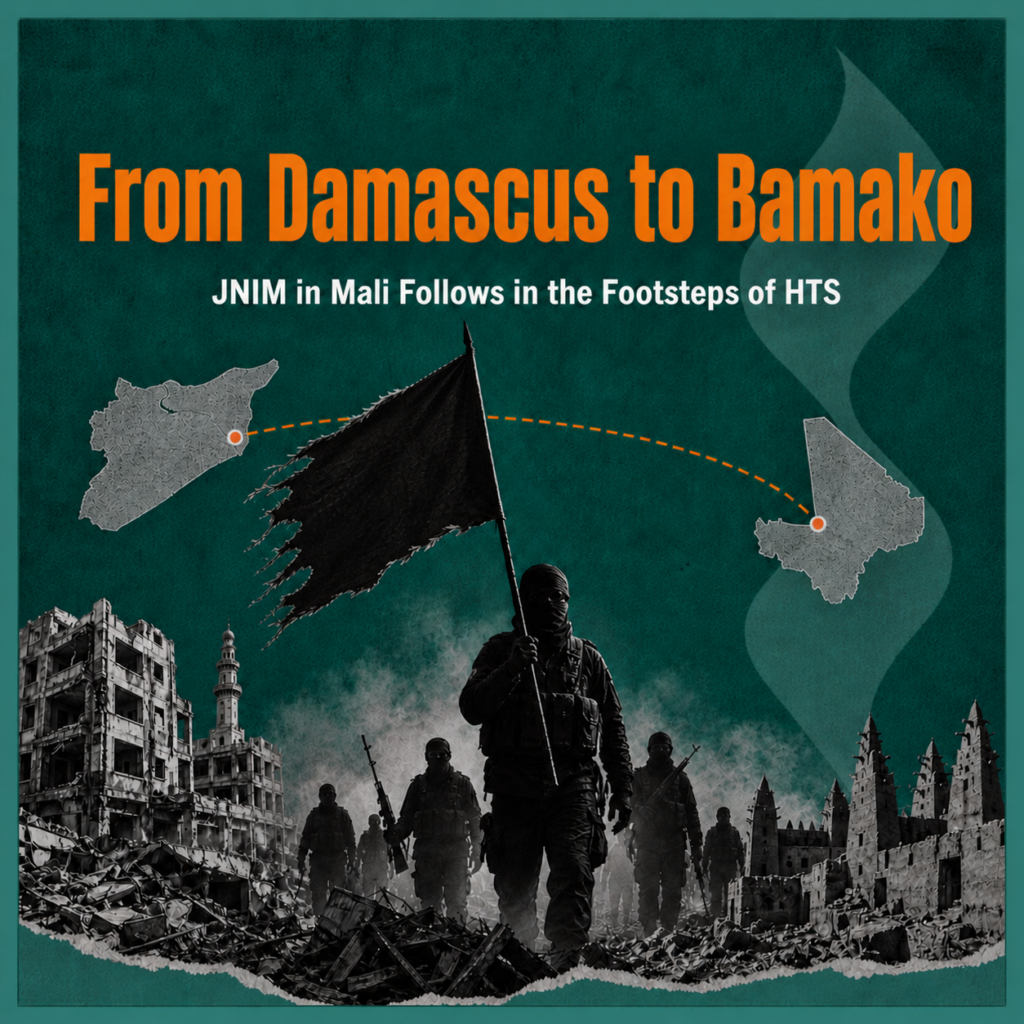
A year and a half after the dramatic collapse of the Assad regime in Syria in December 2024, the repercussions of that fall continue to shape conflicts far beyond the Middle East. Today, observers believe that the African Sahel—specifically Mali—is witnessing a new chapter of “model exportation,” as armed groups adopt strategies that precisely mimic the path that led to the transition of power to jihadist movements in Syria.
Replicating the Syrian “Empowerment Experience”
International attention is currently focused on how the Group for the Support of Islam and Muslims (JNIM) has drawn inspiration from the tactics of Hay’at Tahrir al-Sham (HTS). The core idea being exported is not merely military combat, but the strategy of “Alternative Governance.”
Just as in Syria, where factions spent years building de facto authority and service administrations in liberated areas, groups in Mali are seeking to impose a similar reality. This approach aims to make the collapse of the central government an inevitable result of internal erosion.
Ulf Laessing, head of the Sahel program at the Konrad Adenauer Foundation, asserts that the goal is to transform Mali into “spheres of influence” where these groups exercise their own sovereignty, awaiting the moment the military junta led by Assimi Goïta collapses—mirroring the disintegration of Syrian state institutions in late 2024.
The “Ghost Army” and the Siege of Capitals
The tactics that earned Al-Qaeda militants in the Sahel the nickname “The Ghost Army” rely on isolating major cities and cutting off fuel and food supplies. This approach is designed to push major urban centers to the brink of the abyss, facilitating a “handover of power” to armed movements when the grand collapse occurs.
“State-Dismantling” Alliances
Analysts point out that coordination between Al-Qaeda-linked groups and Tuareg separatists represents a “marriage of convenience” aimed solely at accelerating the collapse of the center. This type of alliance, which saw numerous iterations in Syria, contributes to creating a political and security vacuum that is ultimately filled only by the most organized forces on the ground: extremist Islamist movements.
Mali on the “Syrian Scenario” Path
An environment of poverty and sectarian tensions makes the Sahel fertile ground for this cross-continental “contagion of terrorism.” The warning issued by experts today is that what we are seeing in Mali is not just a local conflict, but an attempt to generalize the “State Collapse Model” witnessed by the world in December 2024. These groups are betting on the long game, waiting for the moment state authority vanishes entirely so they can present themselves as the ready alternative.