
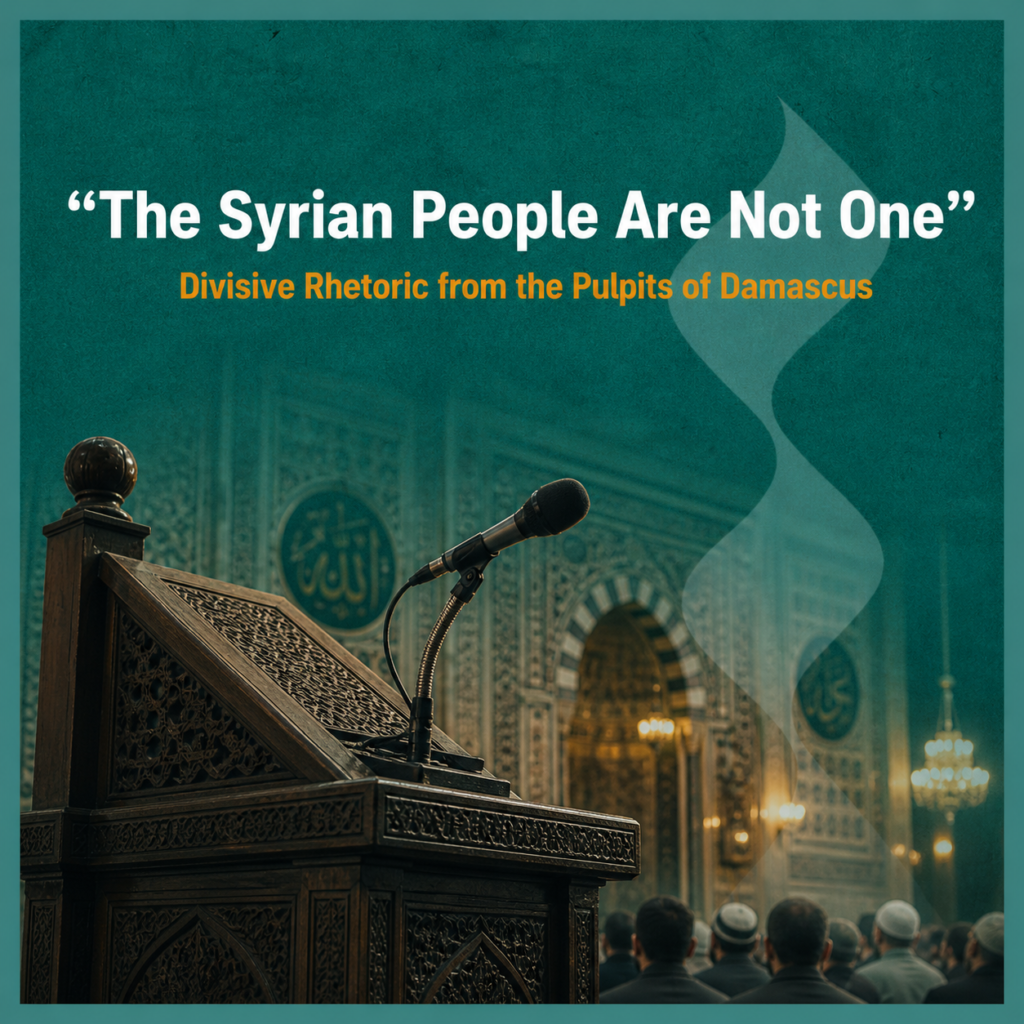
In the complex Syrian landscape, religious discourse has long played a pivotal role—acting either as a bridge toward harmony or as a sledgehammer for destruction and division. However, what “Al-Iman Mosque” in the heart of the capital, Damascus, witnessed recently was not merely a slip of the tongue. Rather, it was a blatant embodiment of the “on-demand sheikhs” phenomenon—those who shed their political and ideological skins according to the compass of narrow interests and the shifting agendas of their handlers.
From “Tears of the Reciters” to “Pulpit Poisons”
Alaa al-Din al-Sayeq, a face the public grew accustomed to seeing with a calm, “spiritual” tone on the program Tears of the Reciters on the Noor al-Sham channel, shocked observers with a fiery, inflammatory speech during the most recent Friday sermon. Al-Sayeq did not stop at religious theorizing; he went as far as striking at the very foundations of coexistence, directing his arrows toward the Alawite community and other minorities in Syria.
Using language that excludes the national “other,” al-Sayeq attacked slogans of national unity, describing the phrase “The Syrian people are one” as nonsense. He explicitly declared, “We are not one, and we do not resemble you,” in a clear attempt to deepen the social rift and fuel sectarian hatred while Syrian wounds are still bleeding.
The Memory of Daraa Exposes the Contradiction
The danger of this discourse lies not only in its content but in the “missionary opportunism” that accompanies it. Only two years ago, in the mosques of the Daraa governorate, al-Sayeq himself adopted an entirely different rhetoric, colored by the field and political circumstances of that time. This radical flip raises a fundamental question: Do these individuals follow a firm doctrine, or are these “ready-made scripts” dictated to them according to the requirements of the current stage?
Official Sponsorship: Incitement Under State Protection
The most alarming conclusion in this incident is not al-Sayeq as an individual, but the “cover” under which he operates. Allowing this type of takfiri and divisive discourse to be broadcast on official channels and echoed from the capital’s most prominent pulpits—without any accountability or legal oversight—gives a clear impression that:
-
This discourse is not spontaneous; it is a political tool intended to reshuffle the cards and ignite internal conflict.
-
The authority that claims to protect Syrian diversity is the same one granting a “microphone” to those who tear that diversity apart.
“Using religion as a card to settle political scores or to booby-trap society from within is the most dangerous game any authority can play against its people.”
Creating the Rift and Booby-trapping the Future
The peril of what al-Sayeq and his ilk promote lies in the creation of a “hatred gap” that may not be easily bridged. These systematic inflammatory discourses are time bombs planted in the consciousness of future generations, where the religious pulpit is exploited to legitimize division and render it an acceptable reality. Continuing to employ the language of exclusion and the betrayal of the national “other” leads only to the shredding of the social fabric and the transformation of difference into permanent enmity. This makes these “ready-made speeches” a true tool of destruction that threatens any future opportunity for national restoration.