
Damascus/Washington – May 2026
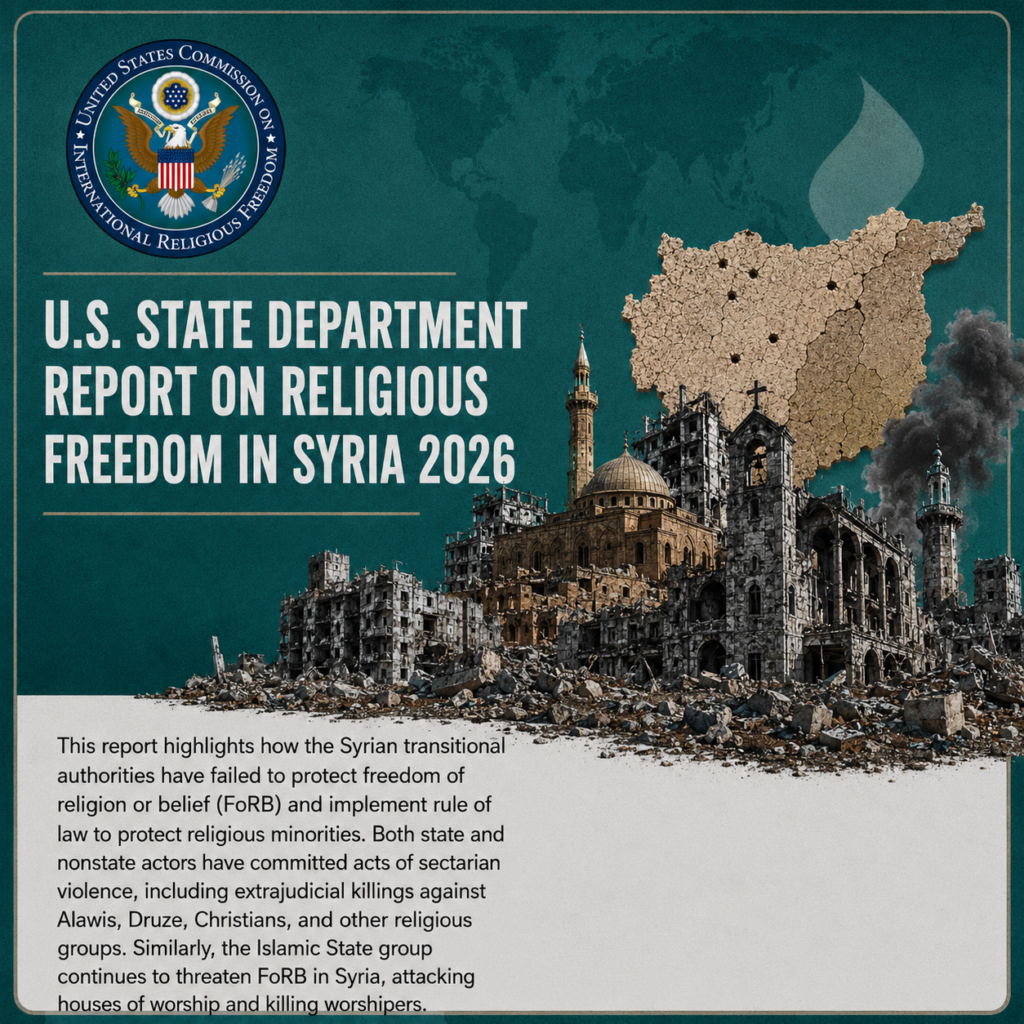
The 2026 report by the U.S. Commission on International Religious Freedom (USCIRF) confirmed that Syria’s transitional authority has not only failed to protect religious freedoms but has also been unable to curb systematic sectarian practices by affiliated entities or allies of its security institutions. Based on these findings, the Commission recommended designating Syria as a “Country of Particular Concern” (CPC), stating that the rule of law is entirely absent in the face of gross violations targeting minorities.
Dominance of Extremism and Marginalization of Minorities The report clearly noted that the political promises made by the head of the interim government were mere rhetoric that found no place in reality. Instead of building an inclusive system, former members of Hay’at Tahrir al-Sham (HTS) dominate military and security apparatuses, with a deliberate exclusion of religious and ethnic minorities from decision-making centers. On the ground, the report documented authorities imposing coercive restrictions reflecting hardline religious interpretations, such as alcohol bans in Damascus and arrest campaigns targeting those breaking the fast in Hama, indicating an attempt to impose a monolithic religious identity on society.
Responsibility for Sectarian Violence and Impunity The report accused the authorities and loyalist groups of responsibility for extrajudicial killings targeting Alawites, Druze, Christians, and Shiites. It stated that 2025 witnessed horrific massacres where the actual military and operational commanders were not held accountable, proving the existence of a “policy of impunity” protecting perpetrators belonging to the new regime. The report also documented ongoing sectarian assassinations in early 2026, deaths under torture in state-run detention centers, and the government’s failure regarding the abduction of minority women and girls and the vandalism of religious sites and shrines.
The Amnesty Decree and the Entrenchment of Crime The report strongly criticized the Ramadan 2026 amnesty decree, describing it as a step that undermined justice. The decree led to the release of individuals involved in sectarian massacres and kidnappings instead of bringing them to trial. The report considered this move a reflection of the transitional authority’s lack of seriousness in providing justice for victims or achieving genuine national reconciliation.
Security Failure and ISIS Threats The report explained that the security vacuum resulting from the transitional authority’s policies enabled ISIS to resurge and carry out bloody operations targeting houses of worship and religious figures. Despite government claims of conducting investigations, the report emphasized that suicide attacks and assassinations hitting mosques and churches in Damascus, Homs, and Aleppo reflect a fragile security grip and a failure to provide minimum safety for religious components.
“Transitional Syria” has become an environment that repels minorities, where the violence of armed groups intersects with the central authority’s failure to enforce the law, leaving the future of religious coexistence in the country in jeopardy.