
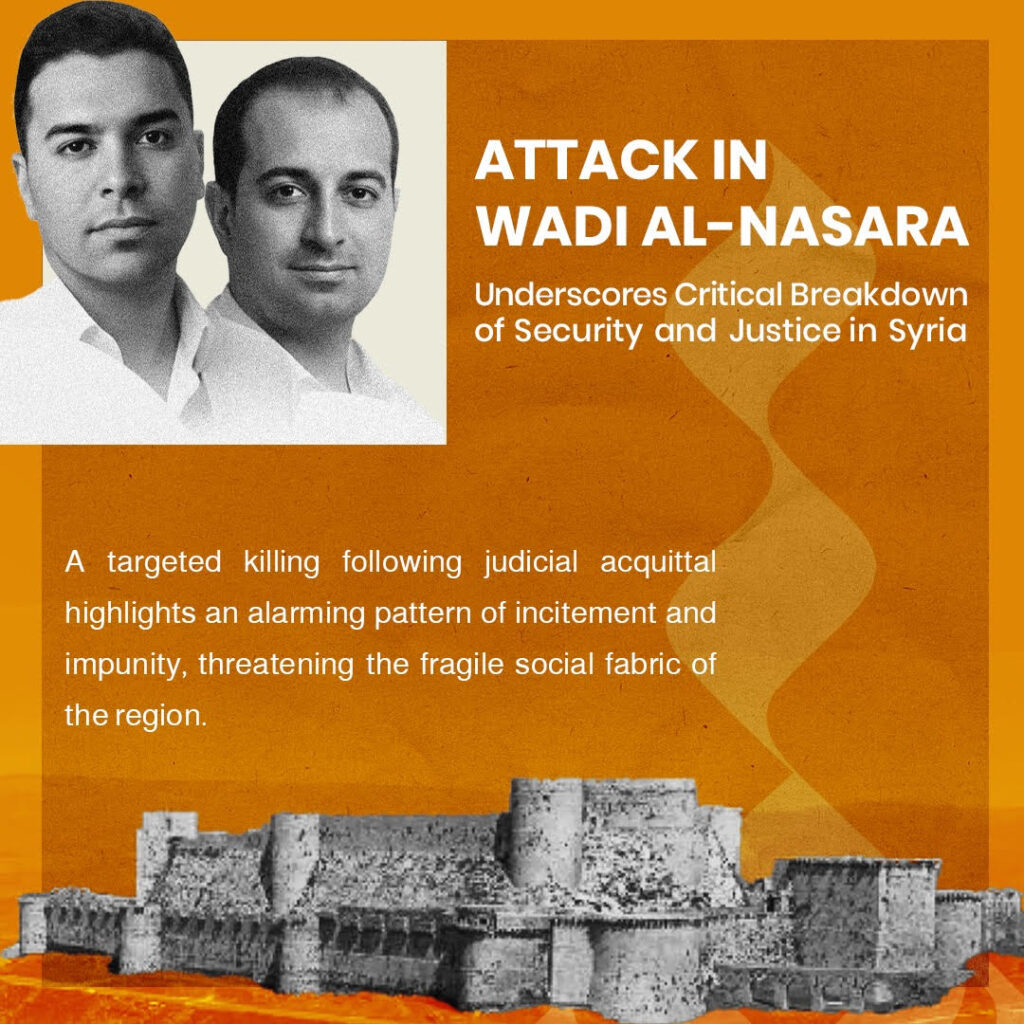
(Annaz – Syria ) – A brutal attack in the village of Anaz, located in the historically Christian-majority region of Wadi al-Nasara (Valley of the Christians), has exposed a dangerous collapse of the rule of law and security in Syria. The incident, which resulted in two deaths and multiple injuries, represents more than an isolated crime; it is a case study in how targeted incitement and state-level inaction can devastate community cohesion and reverse developmental progress.
Timeline of a Preventable Tragedy
The events unfold as a stark sequence of judicial integrity followed by extra-judicial violence:
· September 23, 2025: Wassim Mansour was summoned and detained by the General Security agency based on a complaint filed by individuals from the nearby town of Al-Hosn.
· September 29, 2025: A judicial court reviewed the case and issued a formal decision acquitting Mr. Mansour of all charges, finding no evidence of wrongdoing. He was released.
· September 30, 2025: A named individual from Al-Hosn, Khalid Al-Hosni, published a public social media post openly inciting against the acquitted Wassim Mansour. This post is part of a documented pattern of hate speech against the residents of Wadi al-Nasara.
· October 1, 2025 (Evening): Two masked gunmen, described as elements of the de facto authority, entered Anaz on motorcycles. They opened direct fire on a group of civilian youths, killing Wassim Mansour and his cousin, Shafiq Mansour, and seriously injuring Pierre Hreikess.
From Judicial Vindication to Fatal Violence
This timeline reveals a critical failure. The state’s own judicial system affirmed Wassim Mansour’s innocence, yet this official verdict was immediately undermined by public incitement and, ultimately, executed by fatal violence. Local witnesses and the victims’ families have directly linked the perpetrators to the town of Al-Hosn, drawing a clear line from the online hate speech to the physical crime.
In the aftermath, media outlets loyal to the de facto authority attempted to label the victims as “remnants” (“Fulul”), a term used to discredit and dehumanize them, shifting the blame away from the known perpetrators and onto the victims themselves.
A Community’s Plea for Tangible Justice
The emotional fallout was encapsulated by Bishop Basilious Mansour of the Akkar Archdiocese, who presided over the victims’ funeral. In a powerful address, he made several critical points relevant to any development and stabilization effort:
· A Crisis of Identity and Security: He symbolically rejected the name “Valley of the Christians” (Wadi al-Nasara), insisting on “Valley of the Christians” (Wadi al-Maseehiyeen) to reaffirm the community’s identity and belonging. This reflects a deep-seated fear of erasure.
· A Demand for Real Justice: He stated the community “will not be satisfied except with a justice that is seen with the eyes, not just said with words,” explicitly calling for public trials for the killers and rejecting superficial reconciliation agreements.
· Rejection of Collective Guilt: The Bishop forcefully defended the community, stating its residents have never been the aggressors and rejecting any attempts to label them as traitors or instigators.
Implications for Development and Stability
For organizations like the Western Syria Development Organisation, this incident serves as a severe warning. Sustainable development is impossible without foundational security and justice. When citizens are targeted after being exonerated by the official legal system, it destroys any trust in public institutions.
This environment of impunity and targeted violence:
· Erodes Social Cohesion: It deepens sectarian and communal divides, making long-term peacebuilding exponentially more difficult.
· Reverses Developmental Gains: It creates displacement, trauma, and economic paralysis, undoing years of humanitarian and development work.
· Undermines the Rule of Law: It establishes that powerful actors can operate outside the law, rendering judicial processes meaningless.
The victims in Anaz were not casualties of a random conflict; they were victims of a targeted attack enabled by a permissive environment for incitement and a failure of state protection. A serious investigation must, therefore, extend beyond the direct perpetrators to include those who filed the malicious initial complaint and those who systematically propagate hate speech.
Ensuring justice for Wassim and Shafiq Mansour is not just a moral imperative; it is a fundamental prerequisite for any future where security, development, and peaceful coexistence can take root in Syria.