
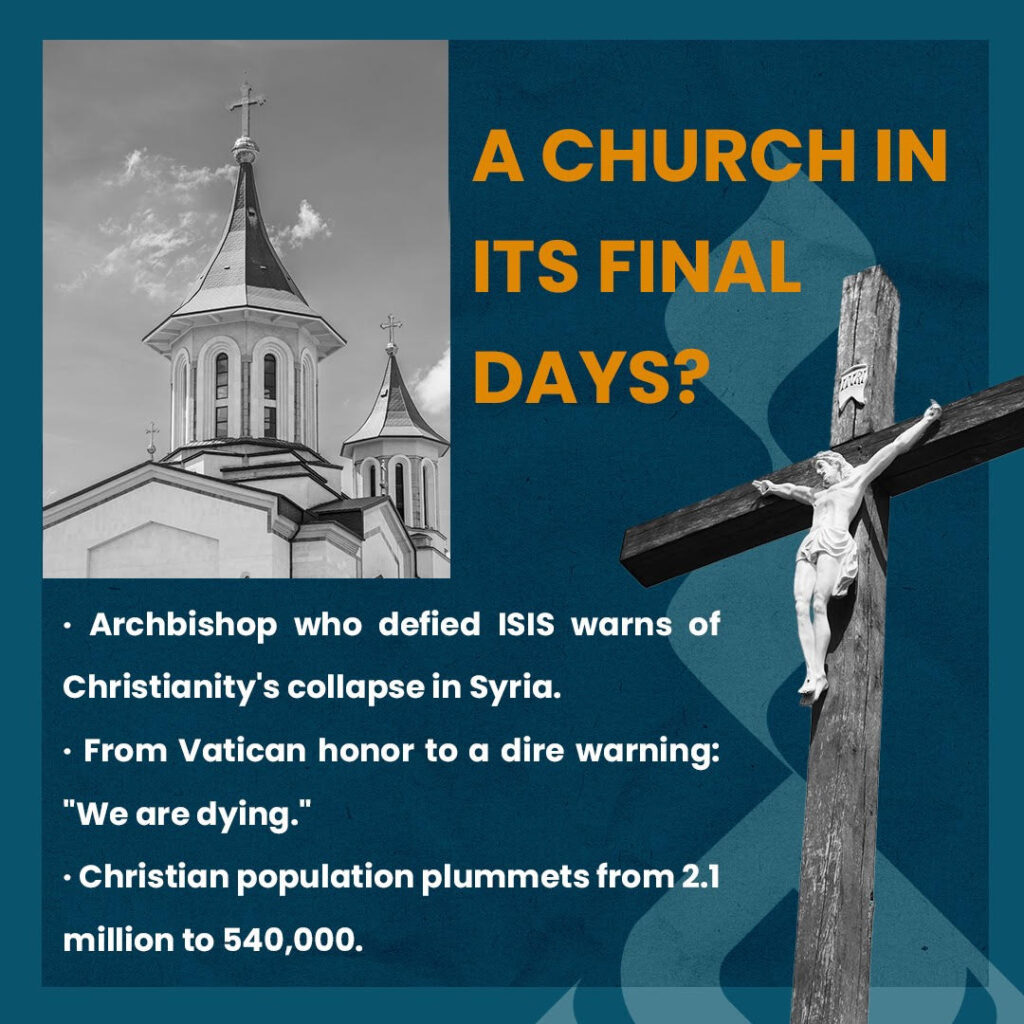
In a sobering assessment from the front lines of faith and conflict, a Syrian Catholic Archbishop who survived ISIS captivity has issued a stark warning: the ancient Christian community in Syria is on the brink of collapse. Despite recent Vatican recognition for his peace efforts, Archbishop Jacques Mourad paints a picture of a nation and a church in a desperate fight for survival.
Archbishop Mourad of the Syriac Catholic Archdiocese of Homs, Hama, and Al-Nabek was recently honoured at the Vatican with the St. John Paul II Award. Cardinal Kurt Koch, presenting the award, praised the Archbishop for his “lifetime of service, his witness of faith, Christian love, interreligious dialogue, and his dedication to peace and reconciliation.”
This recognition stands in stark contrast to the grim reality Archbishop Mourad described in a recent interview with Aid to the Church in Need. Just weeks after receiving the award, he stated that the Church in Syria is “dying,” unable to stem a relentless exodus of its faithful.
A Bleak New Era
The fall of the al-Assad regime last year raised immediate fears for the future of Syria’s religious minorities under a new, Islamist-dominated government. While the new administration has claimed to be inclusive and respectful of minority rights, the country remains a tinderbox of sectarian violence.
The official government has struggled to impose order, with armed groups continuing to operate with impunity. Recent months have seen a massacre of Alawites, fighting between Druze and Bedouins in Suwayda, and clashes between government forces and Kurds in Aleppo following the first parliamentary elections under the new regime.
This persistent instability has shattered any hope for security, making a normal life impossible for countless Syrians.
The Great Exodus
The most telling statistic of the crisis is the dramatic decline of the Christian population. Since the civil war began in 2011, an estimated 2.1 million Christians have fled the country. Today, only around 540,000 remain—a staggering drop of nearly 75%.
Archbishop Mourad bluntly stated that the Church’s efforts, both local and international, have failed to stop this tide. “The causes are not related to the Church,” he explained, “but rather to the country’s disastrous political and economic situation.”
He emphasized that migration cannot be halted without “first establishing a well-defined political government model in Syria and a solid security system.” The Archbishop lamented that the “Syrian people continue to suffer violence, reprisals, and tragic and regrettable events that undermine all the international claims… to put an end to this bloodbath.”
Drawing a chilling parallel, he warned that Syria was becoming increasingly like Afghanistan in its levels of violence, dashing hopes for a near-term “age of freedom.”
A Voice Forged in Captivity
Archbishop Mourad’s warnings carry the weight of profound personal sacrifice. In 2015, he was kidnapped by ISIS and held captive for five months. During his ordeal, he was tortured and subjected to a mock execution, yet he refused to renounce his faith. His testimony is not merely an analysis of geopolitical trends, but a witness born of immense suffering and resilience.
The Archbishop also voiced strong concern over a potential peace deal with Israel that would see Syria cede the Golan Heights. He argued such a move would “deprive the inhabitants of Damascus of water sources and enslave them,” questioning the fairness of any such agreement. “Where are the human rights values,” he asked, “that should help ensure that decisions are fair for both parties?”
As the international community looks on, the plea from leaders like Archbishop Mourad is clear: without a genuine and lasting political solution that guarantees security and justice for all, the ancient Christian presence in Syria, a community that has endured for two millennia, may soon exist only in history books.