
Damascus – April 17, 2026
In a display reflecting rising popular frustration, the Syrian capital, Damascus, witnessed a large-scale sit-in on Friday, April 17, 2026, under the banner of “Law and Dignity” at the Governorate Square (Youssef al-Azmeh Square). Citizens from diverse social strata gathered to demand improvements to the deteriorating living conditions and to call for the respect of public freedoms and the rule of law.
Slogans That Touch the Streets’ Pain
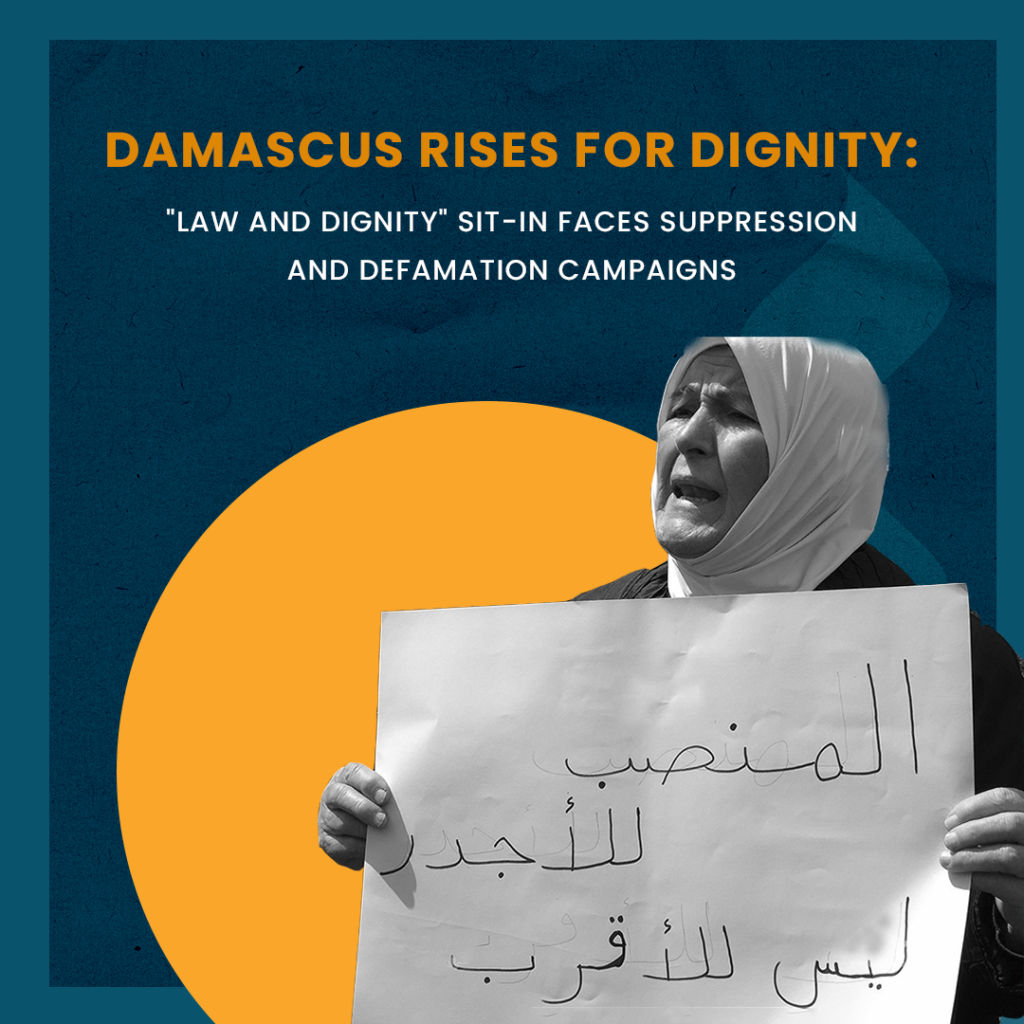
Protesters raised banners carrying bold political and social messages that summarized their demands in the face of current crises. The slogan “Syria is Not for Sale” was prominently displayed as a message of sovereignty, while a sign held by an elderly woman succinctly captured the street’s demands for meritocracy and accountability: “Positions belong to the most deserving, not the closest.” Furthermore, expressing the dire poverty and rising prices, women protesters held signs warning: “Beware, beware of my hunger and my anger.”
Dangerous Escalation: 9 Civilians Injured During the Sit-in
The peaceful sit-in turned into a scene of confrontation as Youssef al-Azmeh Square witnessed a dangerous escalation, resulting in the injury of 9 civilians—including several in critical condition—at the hands of supporters of the transitional government who infiltrated the peaceful gathering. The assailants attempted to disperse the protesters through hostile chanting, accusations, physical assault, and the prevention of filming. This occurred within sight and earshot of Public Security personnel stationed in the vicinity, who failed to take any measures to protect the peaceful protesters. The events triggered panic, amid urgent attempts to transport the wounded to nearby medical centers.
Systematic Suppression and Defamation Attempts
Beyond the direct assault, the movement faced systematic restrictions. The square saw a deliberate vehicular ramming incident carried out by a government supporter in an attempt to forcibly end the event. Participants, particularly women, were also subjected to verbal abuse, which the protesters met with silence and steadfastness.
The suppression was not limited to the square; it extended to the digital sphere. The demonstrations coincided with organized and paid defamation campaigns across social media platforms, which sought to label the organizers and participants as remnants of the former regime in an attempt to undermine the movement’s legitimacy and silence the citizens’ voices demanding their basic rights.
Questions Regarding the Future of Civil Activism
Despite this escalation, participants affirmed their commitment to the path of peaceful activism, emphasizing the continuation of their rights-based and livelihood demands. Observers believe that this sit-in, despite its forced conclusion and the assaults against it, succeeded in delivering a clear message to public opinion, confirming the Syrian public’s ability to organize and express their demands despite security pressures and attempts at character assassination.
At the same time, these recent field developments raise fundamental questions about how civil movements are being handled, and the extent to which authorities are serious about guaranteeing the right to peaceful protest, especially given the recurring tensions in public spaces. The pressing question remains: Will these movements succeed in imposing their reform agenda, or will the policy of “intimidation and defamation” remain the greatest obstacle to any civil activism in Syria?