
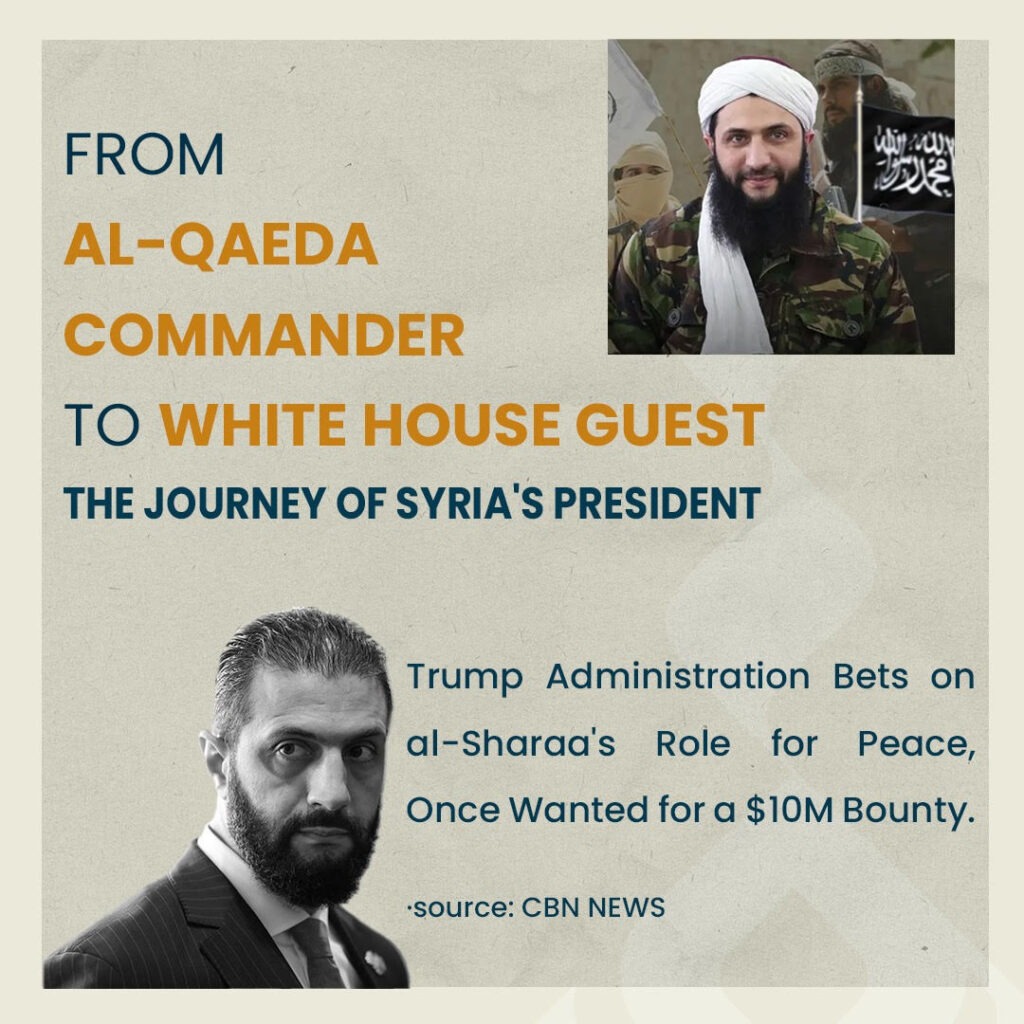
For the first time, a Syrian head of state will visit the White House. Monday’s visit by President Ahmad al-Sharra marks a major turnaround in U.S.-Syria relations.
Before his visit, the U.S. military released a video of al-Sharaa playing basketball with CENTCOM Commander Brad Cooper. The image of al-Sharaa contrasts with his past as an Al Qaeda commander with a $10 million U.S. bounty on his head for killing U.S. and allied troops.
Despite his past, the White House hopes al-Sharaa can play a key role in President Trump’s vision of Middle East peace.
Just before the visit, 100 faith leaders signed a letter hoping the president could use his meeting with al-Sharaa to protect Christians and Druze in southern Syria.
Religious freedom advocate Matthew Faracci is one of the faith leaders who signed.
He told CBN News, “Back in July, there was an October 7th-style attack in Suwayda, many thousands were killed – unspeakable horrors that were conducted there: grandparents and their grandbabies thrown off buildings; children raped, old people burned, people’s hearts ripped out – the most barbaric, horrific, things you can think about.”
Faracci explained, “The purpose of the letter is to first of all thank President Trump for his incredible leadership on religious freedom recently in Nigeria. The President essentially gave a Monroe Doctrine, if you will, about American foreign policy that said religious freedom is going to be one of the tenets of the administration and we’re not going to allow other countries to infringe upon other people’s religious freedom.”
He contends the situation in Syria is now desperate.
“They’re being starved, they’re being murdered, they’re being deprived of water, they’re being deprived of medical supplies.”
The 100 faith leaders have a simple but critical request.
“So now, a city of between 700,000 to 750,000 is surrounded by military forces, and they can’t go in or out, and so they have a chokehold on the aid. So, the letter is asking for a humanitarian corridor from Hadar, which is near the Israeli border, to Suwayda to allow the free flow of humanitarian aid back and forth,” Faracci explained.
He continued, “We know you have leverage over the President of Syria, so we encourage you to use that leverage, to tell him, hey, you’ve got to stop this activity, and you’ve got to respect religious liberty in Syria.”