
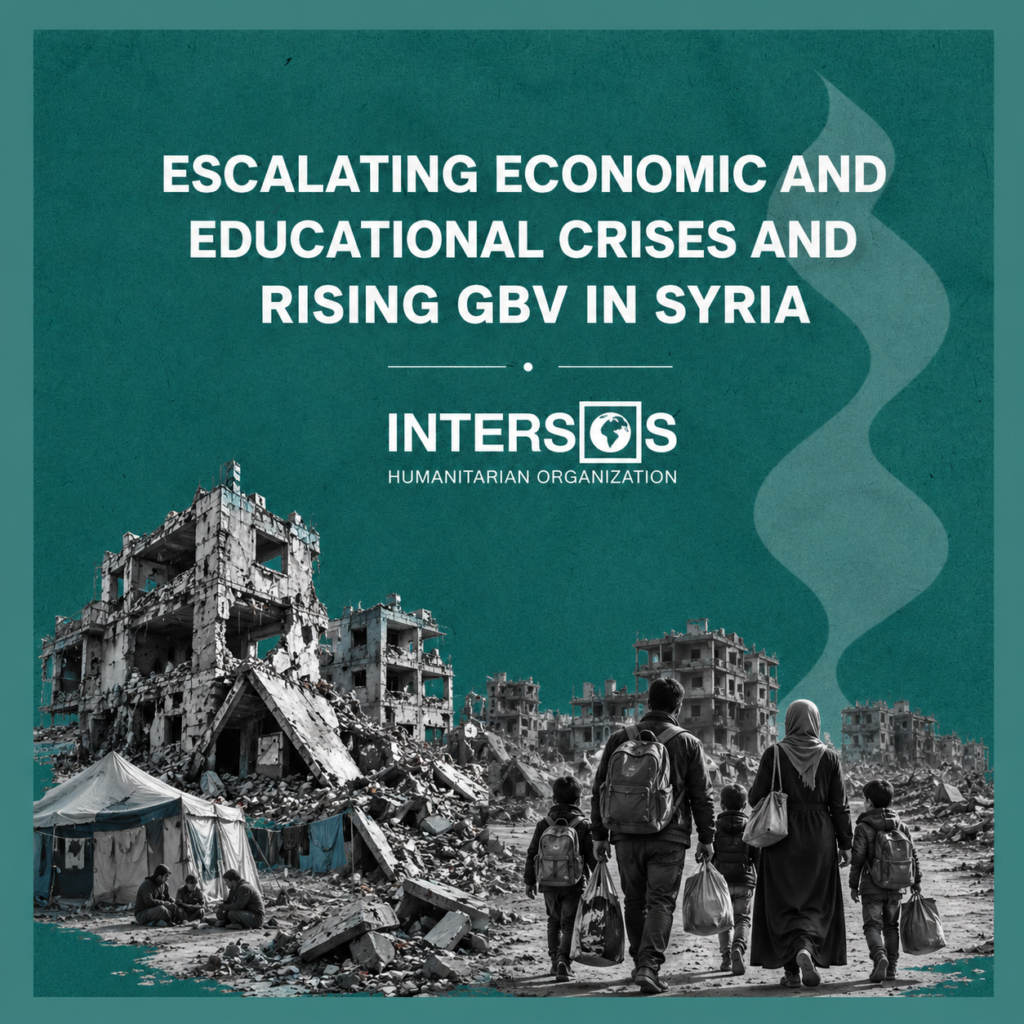
A recent report issued by the organization “INTERSOS,” covering the period between December 2025 and March 2026, reveals that the return of Syrian families to their areas of origin does not in any way translate into an improvement in living conditions. Instead, it places displaced persons before a series of complex challenges that make “return” the beginning of a new path of struggle for survival.
The report covers six strategic areas: Kafr Zeita, Khattab, and Taybat al-Imam (Hama countryside); Sinjar and al-Tamana’ah (Idlib countryside); and Beit Sawa (Damascus countryside).
Economic Collapse as a Structural Pressure Factor:
The suffocating economic crisis is the greatest obstacle to stability, as the scarcity of job opportunities has led to families’ inability to secure the most basic needs. This contraction in income has pushed families toward “harmful coping strategies,” including:
-
School dropouts.
-
Reliance on child labor.
-
Resorting to child marriage as a survival mechanism.
-
Escalating family tensions that increase rates of domestic violence and psychological distress.
Indicators of Gender-Based Violence:
Field data showed alarming levels of gender-based violence, with high rates of perception and prevalence in the areas covered by the report:
-
Kafr Zeita: 91%
-
Beit Sawa: 72%
-
Taybat al-Imam: 69%
-
Al-Tamana’ah: 60%
The organization asserts that these figures do not reflect the true scale of the problem, as most cases remain hidden due to social stigma, fear, and the lack of safe spaces for survivors.
The Education and Infrastructure Crisis:
The educational process suffers from tangible deterioration due to overcrowded, dilapidated schools and a lack of resources. In “Khattab,” classrooms were observed containing more than 70 students, while the crisis is exacerbated by social discrimination that deprives children with special needs of their right to education, as in the case of the child who was prevented from attending school in “Taybat al-Imam” due to bullying.
Legal and Security Obstacles:
Returnees face structural barriers that prevent their integration and stability:
-
Documents and Ownership: The dilemma of civil status documents and disputes over housing and land remains a major obstacle; challenges regarding civil documents reached 100% in Kafr Zeita, and housing and property issues reached 81% in Taybat al-Imam.
-
Danger of Explosives: Remnants of war (mines and ordnance) have become a permanent structural danger lurking for returnees in their homes, fields, and children’s play areas, paralyzing recovery efforts and hindering any attempt to repair homes or reclaim agricultural land.
In the face of this tragic reality, the government authority is content with issuing hollow promises about the “return of normal life,” while standing as a helpless spectator in the face of the collapse of basic services and the worsening living crises. The government’s failure to provide the minimum requirements for life, and its deliberate disregard for the magnitude of the challenges faced by returnees, confirms that these promises are merely deceptive tools. The Syrian citizen has been left to face their fate alone amidst the rubble, under an authority that possesses only false promises and reneges on its legal and moral responsibilities.