
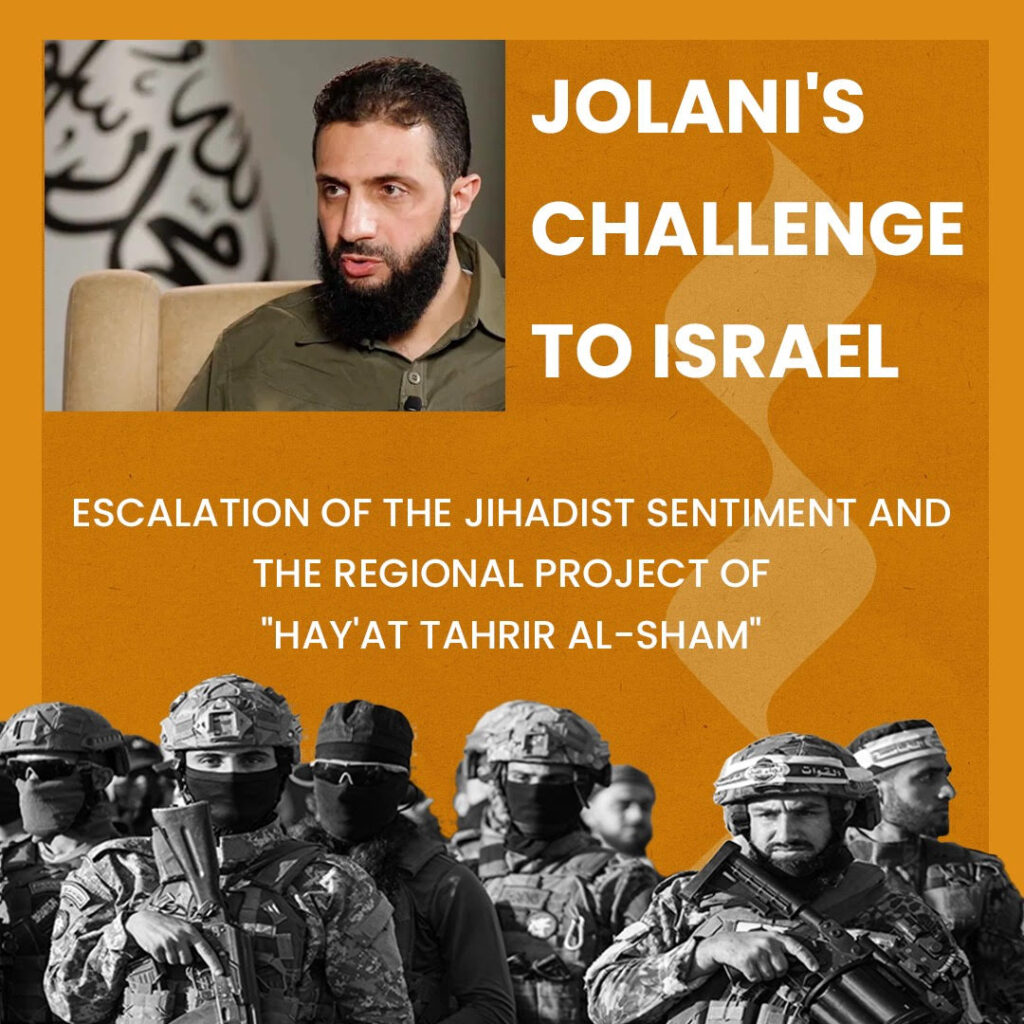
The media sphere recently saw the circulation of video clips containing clear and direct threats to the State of Israel, issued by factions close to, or within, the government of Abu Mohammed al-Jolani. This escalation is not merely a show of force; it is an affirmation of a profound shift in Jolani’s strategy: moving the compass of Jihad from fighting the Syrian regime toward Jerusalem and challenging Israel’s regional security. These steps reignite the jihadist sentiment and indicate that Hay’at Tahrir al-Sham (HTS) is no longer a local Syrian project, but is aspiring to a leading role in a wider regional conflict.
The Moment of Explosion: The Latest Threat Videos
The circulated clips—which appeared raising the banner of challenging Israel and liberating Gaza—coincided with the extremist groups’ celebrations of the alleged “Liberation Day” (referencing their seizure of territory in Syria). These explicit threats, which included direct calls to mobilize forces towards the southern front, served as a declaration of Jolani’s intention to expand the scope of the conflict. The aims of this shift are:
• Heightening Jihadist Sentiment: Rerouting the extremist ideology to unify the ranks of fighters under a new, inspiring objective.
• Acquiring Regional Legitimacy: An attempt to present HTS as a pioneering jihadist force that addresses central issues in the region, foremost among them the Palestinian cause.
• Declaring an Expansionist Project: Signaling that the jihadist war is not confined to the Syrian borders, but encompasses the entirety of the Levant (Bilad al-Sham).
- Watch some of these videos:
https://www.facebook.com/share/r/1A8tFFsmUd/?mibextid=wwXIfr
https://www.facebook.com/share/r/1AsRhBnoYh/?mibextid=wwXIfr
https://www.instagram.com/reel/DPMsXIYjtJS/?igsh=ODNpdGZnMHBxbGMz
https://www.instagram.com/reel/DQEd-aMjD2T/?igsh=MTg4ajYyeXhsOTg2NQ==
Al-Jolani: From Local Retrenchment to Regional Ambition:Since Abu Mohammed al-Jolani assumed the leadership of Hay’at Tahrir al-Sham (formerly Jabhat al-Nusra), took power under the name Ahmed al-Sharaa, and attempted to disavow the mantle of terrorism, a series of strategic transformations have occurred, paving the way for this latest challenge:
1. Turning Sectarian Rhetoric into Systematic Policy
In the early years of the revolution, the conflict was punctuated by sharp sectarian slogans. However, under Jolani’s rule, these slogans transformed into policies. He thanked the “zeal and uprising of his people”—a clear reference to the hardline Sunni majority—and rewarded some supporters with leadership positions after they committed massacres against Alawites, Christians, and Druze. This rhetoric establishes an exclusionary ideology of governance that entrenches hostility toward minorities and prepares the environment for a broader antagonism against the “Other.”
2. Escalation of Attacks Against Minorities
The threat was not limited to Syrian minorities (such as Alawites, Druze, and Christians), but extended to adopting anti-Jewish slogans like “Khaybar, Khaybar, O Jews.” Moreover, the recent attack on a church in Syria—the first of its kind in decades—and the near-daily bombing, desecration, and destruction of religious shrines belonging to minorities wherever they are found, confirm that the jihadist discourse is turning into systematic violence within a policy of internal “ideological purification,” which paves the way for engagement in an external conflict.
3. Ideological Expansion: “Jerusalem Awaits Us”
Jolani’s statements that “Jerusalem awaits us” were the clearest indication of HTS’s shift in direction. The goal is no longer merely the overthrow of the regime, but a redefinition of “liberation” to include a deeper regional challenge. This expansion indicates a clear intention to:
• Establish a Transnational Jihadist Entity: Transforming Syria into a base for launching the project of “The Liberation of the Levant and Iraq.”
• Compete for Global Jihadist Leadership: An attempt to attract new jihadists and prove itself against rival organizations such as ISIS.
Regional and International Risks of Jolani’s Challenge:
Jolani’s challenge to Israel is not merely an empty threat; it carries severe geopolitical and strategic risks:
• Destabilization of Israel’s Northern Front: The transformation of HTS into a declared fighting force on the border could create a new, volatile conflict front that threatens Israel’s interior and border security.
• Worsening Regional Extremism: Policies of exclusion and sectarian/jihadist threats contribute to fueling old conflicts and creating warring sectarian entities, threatening stability in Lebanon, Jordan, and Iraq.
• Complicating the Syrian Political Solution: Extremist rhetoric further complicates any attempt to reach a comprehensive political settlement that guarantees the rights of all components and minorities in Syria.
Recommendations for the U.S. Congress:
To counter this dual threat—internal extremism (sectarian) and external challenge (to Israel)—the following is recommended:
• Monitoring Funding and Countering Extremism: Strengthening mechanisms to track the funding reaching jihadist groups in Syria, while simultaneously supporting counter-extremism programs and promoting moderate discourse as an alternative to jihadist ideology.
• Protecting Minorities and Securing the Region: Pressuring factions to ensure the protection of civilians and minorities, and supporting regional efforts to secure borders and prevent Syria from becoming a base for transnational jihad.
• Diplomatic Pressure and Political Support: Insisting on a comprehensive political solution that guarantees the rights of all components and prevents the entrenchment of an extremist ideological rule as an alternative to central governance.
Conclusion
Jolani’s challenge to Israel, backed by an escalation in jihadist rhetoric, is a formal declaration of Hay’at Tahrir al-Sham’s transformation into a regional force seeking to lead a transnational conflict. The threat is no longer solely internal to Syria but affects regional stability and international security. The international community, and the United States in particular, must understand this shift and act quickly to halt the expansion of this new jihadist project before it escalates and spreads beyond Syrian borders.