
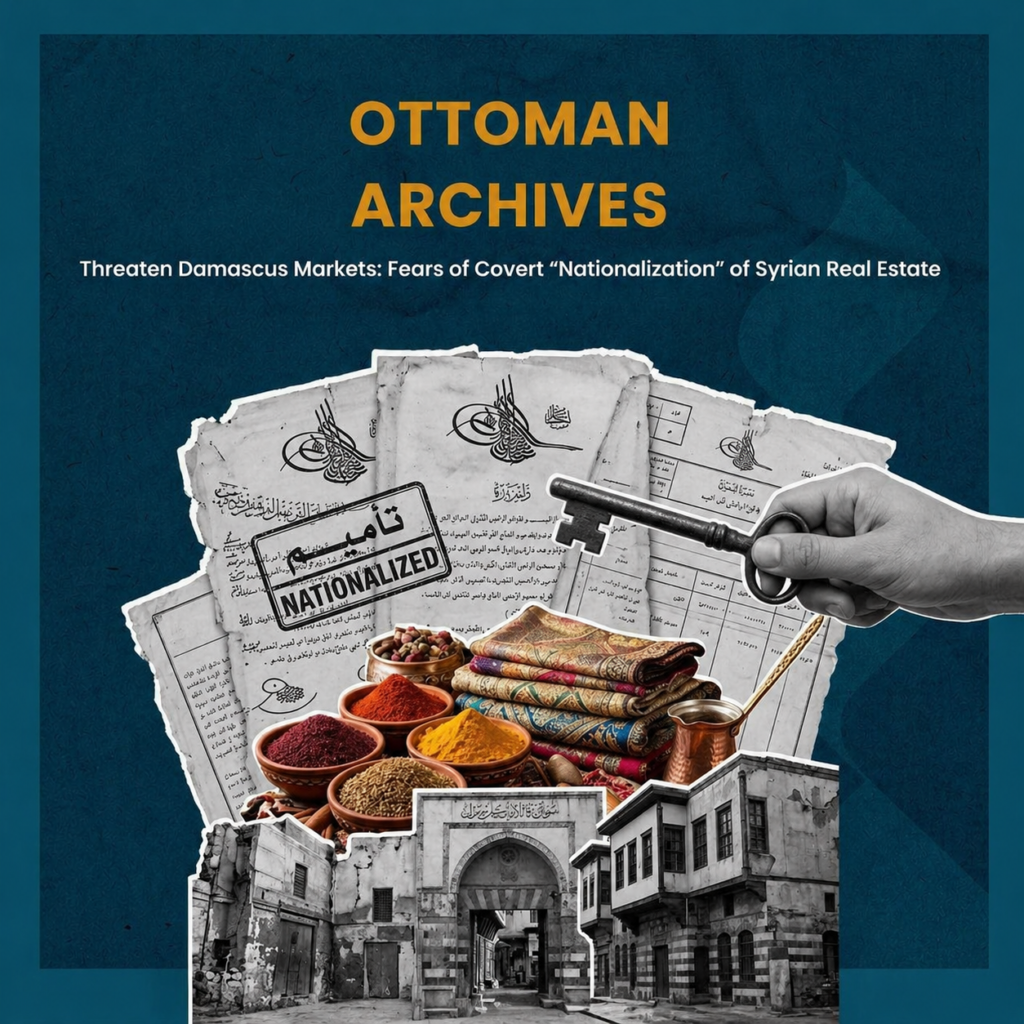
In a development signaling a new legal and economic crisis, the government is moving to expand its control over real estate in Syria through the Ministry of Awqaf (Religious Endowments).
Government sources have revealed a government push to consult the “Ottoman Archives” in Turkey under the pretext of inventorying old endowment properties. This move, widely described as a thinly veiled attempt to expropriate private property, has sparked profound public concern regarding the fate of citizens’ constitutional rights.
Properties in the Crosshairs
These maneuvers place tens of thousands of properties in the crosshairs. Estimates suggest an effort to seize roughly 7,000 properties in the capital, Damascus, alone, alongside another 18,000 in the city of Aleppo.
The threat extends to the commercial and historical lifeblood of Damascus. Data indicates that classifications based on the Ottoman Archives designate over half the area of the historic Al-Hamidiyah and Midhat Pasha souks as endowment properties. If implemented, this measure threatens to deal a devastating blow to the livelihoods of thousands of families who have relied on these markets for decades, potentially causing a radical shift in the capital’s economic and social identity.
Fears of Covert Confiscation
Despite official justifications and authorities denying any intent to “nationalize,” economic experts warn that these procedures open a broad legal loophole for covert, retroactive confiscations, thereby threatening the stability of private property ownership.
In a related context, observers view the recent dispute instigated by the Awqaf Directorate to seize control of the historic “Al-Sibai Guesthouse” in Homs as a clear indicator and tangible proof of this growing expansionist approach and its implementation on the ground.