
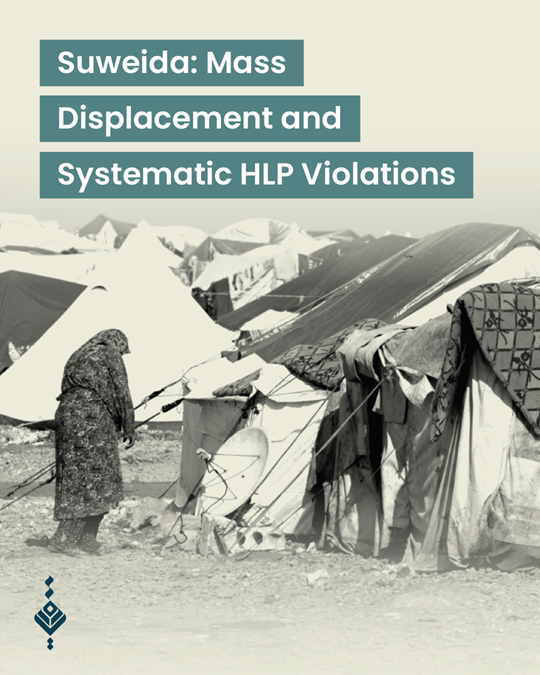
The ongoing conflict in Suweida Governorate has resulted in significant displacement and a disturbing pattern of Housing, Land and Property (HLP) rights violations in the western and northern countryside. The situation has created a humanitarian crisis that extends far beyond immediate physical harm, threatening the very foundations of community life and individual livelihoods in the region.
According to reports by the U.N. Office for the Coordination of Humanitarian Affairs (OCHA), 184,000 people had been displaced by August 19. The majority of them remained inside Suweida, living in temporary shelters such as schools and community centres, amid worsening shortages of basic services. OCHA, together with other organisations, also launched a mission to the neighbouring Daraa governorate to assess the conditions of displaced persons there and to discuss options for resettlement in the near future.
With direct media and human rights access still blocked to the western and northern countryside of Suweida – areas still under the control of the Transitional Administration’s forces – this article relies on field testimonies on those areas gathered by The Syria Report’s local correspondent from residents and survivors of displacement. These testimonies document violations that went beyond killing and destruction, reaching into HLP rights and the very basis of livelihoods.
Systematic Destruction Campaign
In western Suweida, known as Al-Muqran Al-Gharbi, between July 13 and 16, the transitional administration forces shelled the residential areas in villages and towns, even though they had not witnessed fighting. The shelling caused mass displacement towards Suweida city and the southern countryside of the governorate. Afterwards came systemic looting of homes, followed by burning and demolition with bulldozers.
“Bulldozers began flattening houses to the ground just a few days after people left. They did not leave a single house standing in the northern neighbourhoods of the village,” a resident from the village of Al-Dour explained. “It seems to me the goal was to prevent people from returning. I saw with my own eyes whole houses levelled, including those built of reinforced concrete.”
These field testimonies, alongside the U.N. experts’ report on August 21, make clear that the violations in Suweida directly targeted residents’ HLP rights and their livelihoods. Bulldozing homes, burning villages, looting farms, water wells, and mills were not mere side effects of war, but a deliberate policy that deprived people of their homes, lands, and means of survival, and forced them into displacement.
Impact on Agricultural Livelihoods
The destruction extended beyond residential areas to agricultural infrastructure. Farms, irrigation systems, water wells, and grain mills were systematically destroyed or looted. This deliberate targeting of agricultural assets has long-term implications for the region’s food security and economic recovery.
Local farmers reported the theft of livestock, destruction of crops ready for harvest, and the sabotage of irrigation systems that took years to build. The timing of these attacks, coinciding with the harvest season, suggests a calculated effort to maximize economic damage and ensure long-term displacement.
Deliberate Prevention of Return
Evidence suggests that the destruction was not random but followed a pattern designed to prevent the return of displaced populations. The systematic nature of the demolitions, using heavy machinery to level even structurally sound buildings, indicates a policy of ensuring that displaced residents would have nothing to return to.
UN experts have characterized these actions as potentially constituting war crimes, given their systematic nature and apparent intent to permanently displace civilian populations based on their ethnic and religious identity.
International Response Needed
The scale and systematic nature of HLP violations in Suweida demand urgent international attention and accountability measures. The targeting of civilian infrastructure, the prevention of return through deliberate destruction, and the apparent ethnic and religious motivations behind these actions represent serious violations of international humanitarian law.
The international community must move beyond statements of concern to concrete action, including investigations into war crimes, accountability mechanisms for perpetrators, and comprehensive support for displaced populations and their eventual return to their homes and livelihoods.