
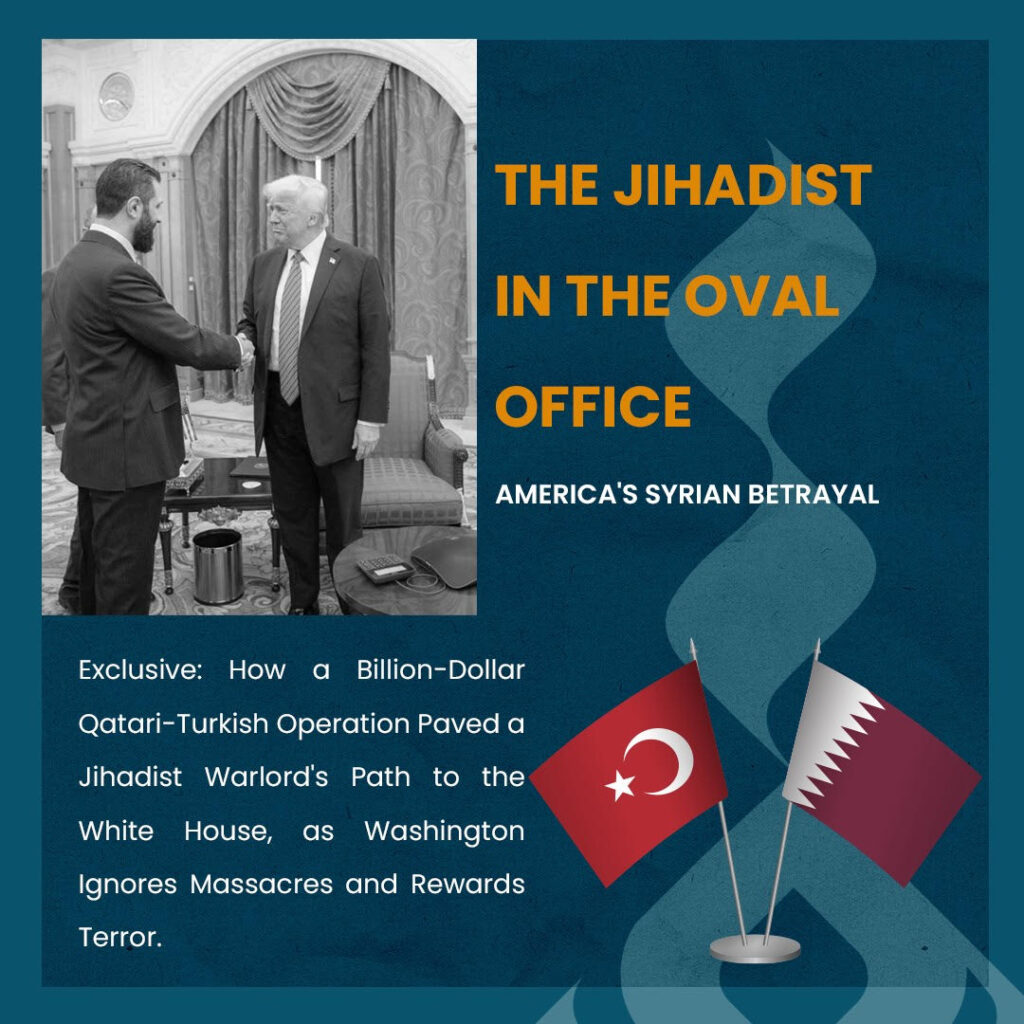
On Veterans Day—when Americans honor those who died fighting jihadist terror—the nation watched in disbelief as a jihadist warlord walked into the Oval Office. Abu Mohammed al-Jolani, former commander of Jabhat al-Nusra—Al-Qaeda’s Syrian affiliate—stood in the White House receiving a presidential handshake. Until December, the U.S. offered $10 million for his capture. Now he was treated as a statesman.
This moment was not an accident. It was the product of a billion-dollar Islamist influence operation, engineered by Qatar and Turkey, and allowed to penetrate American institutions, media, and political circles with almost no resistance.
A Perfectly Timed “Jihadi Coup”
The jihadist takeover of Syria was executed with precision. In December 2024, the outgoing Biden administration—after years of partnering with the Muslim Brotherhood in Libya, Yemen, Egypt, legitimizing the Islamic regime in Iran, accommodating the Taliban, and turning hostage deals into terrorist incentives—was distracted and unwilling to act. In its final weeks, it even sent officials to meet with HTS leaders while they remained on the U.S. terrorist list.
As President-elect Trump had no authority to intervene, Al-Jolani’s HTS seized America’s power vacuum with the full backing of Qatar—Hamas’s patron, the Muslim Brotherhood’s banker, and the ayatollahs’ favorite partner—and Turkey’s Islamist AKP government. Western media obediently repeated the narrative of a “Syrian revolution.” But Syria’s real revolution ended years earlier. From 2011–2014, Syrians protesting Assad were crushed not only by the murderous regime but by al-Jolani’s jihadists, who hunted down secular and democratic opposition figures.
December 2024 was not a revolution.
It was a coordinated Jihadi coup, following the same strategy that toppled Iran in 1979.
The Rush for Recognition and Blood Money
HTS’s control of Damascus triggered a stampede of opportunists. Diplomats, consultants, and corporations rushed to position themselves for reconstruction deals worth billions. These connections were actively facilitated by the Syrian-American Business Association, an organization with close ties to the Muslim Brotherhood. In plain sight, relationship brokers, such as Tarek Naemo and his wife, served as intermediaries between Washington power brokers and the jihadist leadership.
U.S. lawmakers soon appeared in Naemo-arranged meetings and photo-ops with Syria’s “new leadership”. Congressmen C.M and M.S traveled to Damascus on a trip the lobby facilitated, followed by another Naemo-coordinated delegation with congressman Joe Wilson and Senator Jeanne Shaheen. In Washington, Naemo the Lobby then helped stage the now-viral photo of Ahmed al-Sharaa beside chair of foreign relations committee Rep. Brian Mast—timed precisely as pressure mounted to break Madst’s opposition to repealing the Caesar Act. The image was immediately pushed online to suggest that even Congress’s strongest anti-jihadist voice was wavering.
This is what a modern influence operation looks like: curated access, timed imagery, and foreign-backed narratives engineered to flip U.S. policy.
The Fabricated Debate Over an Obvious Truth
By February, Washington’s pundits were asking a surreal question: Is al-Jolani still a jihadist?
Counterterrorism experts gave the only answer that matters: unless a jihadist explicitly renounces jihadism—in ideology, structure, and practice—he remains a jihadist.
Events proved them right.
In March, HTS militias disguised as “security forces” massacred more than 1,500 Alawites and Christians. International NGOs confirmed the killings. Christian and Alawite groups in America begged Congress to intervene. Washington ignored them.
Simultaneously, Qatari and Turkish networks accelerated their push to normalize the jihadist regime. In Damascus, HTS staged a fake “election” where roughly 100 militants hand-picked their “president.” No voting. No public participation. A “constitution” that excluded Kurds, Christians, Alawites, and Druze was proposed.
This was not governance.
It was jihadist rule dressed up for Western consumption.
Genocide Met With Silence—and Rewards
In July, HTS launched a massive assault on the Druze homeland in Sweida. Tens of thousands of fighters surrounded the province, bombarding civilians in an ethnic-cleansing campaign. Washington claimed to see nothing. U.S. counterterrorism messaging fixated on a single jihadist in Somalia while ignoring Al-Jolani’s massive bloodbath—an intentional display of selective blindness.
Only Israel intervened. The Israeli Air Force halted HTS advances and created a protective zone that prevented the Druze from being wiped out. Their survival came from Israel, not the United States—a fact that should force a reckoning in Washington.
Yet instead of consequences, al-Jolani was rewarded. He was invited to the UN General Assembly, then—shockingly—welcomed into the Oval Office. A man who led Al-Qaeda’s Syrian branch, who massacred minorities, killed Americans, and never renounced bin Laden’s ideological mission, stood in America’s highest office receiving a presidential salute.
The Corruption Behind the Collapse
Some claim this shift is mere business pragmatism. But profit does not justify enabling a regime responsible for genocide. Qatar’s influence network—through universities, think tanks, media outlets, and political intermediaries—mounted a full rebranding of HTS.
Western media, heavily funded by Qatari sponsorship, played along. Al Jazeera led the propaganda effort; Western outlets followed, calling HTS “rebels” or “opposition forces.” The goal was simple: make Americans forget who al-Jolani is and call Islamists billion dollar influence campaigns “great business opportunities”.
Now HTS controls territory where extremist ideology can metastasize, fighters can reorganize, and jihadist networks can operate within U.S. military infrastructure. Meanwhile, HTS continues threatening America’s only reliable Syrian allies—the SDF.
The Last Line Still Standing
A small number of lawmakers refused to buckle. Rep. Brian Mast, despite the staged photo-op campaign targeting him, ultimately held the line and opposed efforts to repeal the Caesar Act—an effort backed by the same foreign-aligned networks working to rehabilitate al-Jolani. The resistance to jihadism group may hold the line or not, but it showed the existence of a group of lawmakers opposing the empowerment of the terrorist.
These lawmakers now represent the final barrier between principled U.S. policy and foreign-funded capitulation.
Congress must demand as a bare minimum:
• Immediate withdrawal of HTS militias from areas where they committed massacres
• An end to HTS threats against the SDF
• A full investigation into Qatari- and Turkish-backed influence operations in Washington
• Transparency about every contract and every lawmaker meeting coordinated by Islamist intermediaries
A Nation at a Crossroads
The apocalypse is not hypothetical. It is already unfolding. American leadership has not merely failed to confront jihadist networks—it has legitimized them. Qatari money purchased narratives; lobbyists purchased access; foreign networks manufactured consent.
Last week, a jihadist walked into the Oval Office with America’s blessing.
America must now decide whether it still recognizes the difference between civilization and savagery, allies and enemies, truth and manipulation.
Will the nation of the free correct this betrayal?
Or will it accept the unthinkable—that in America terrorism, too, can be rebranded and rewarded if the price is high enough.