
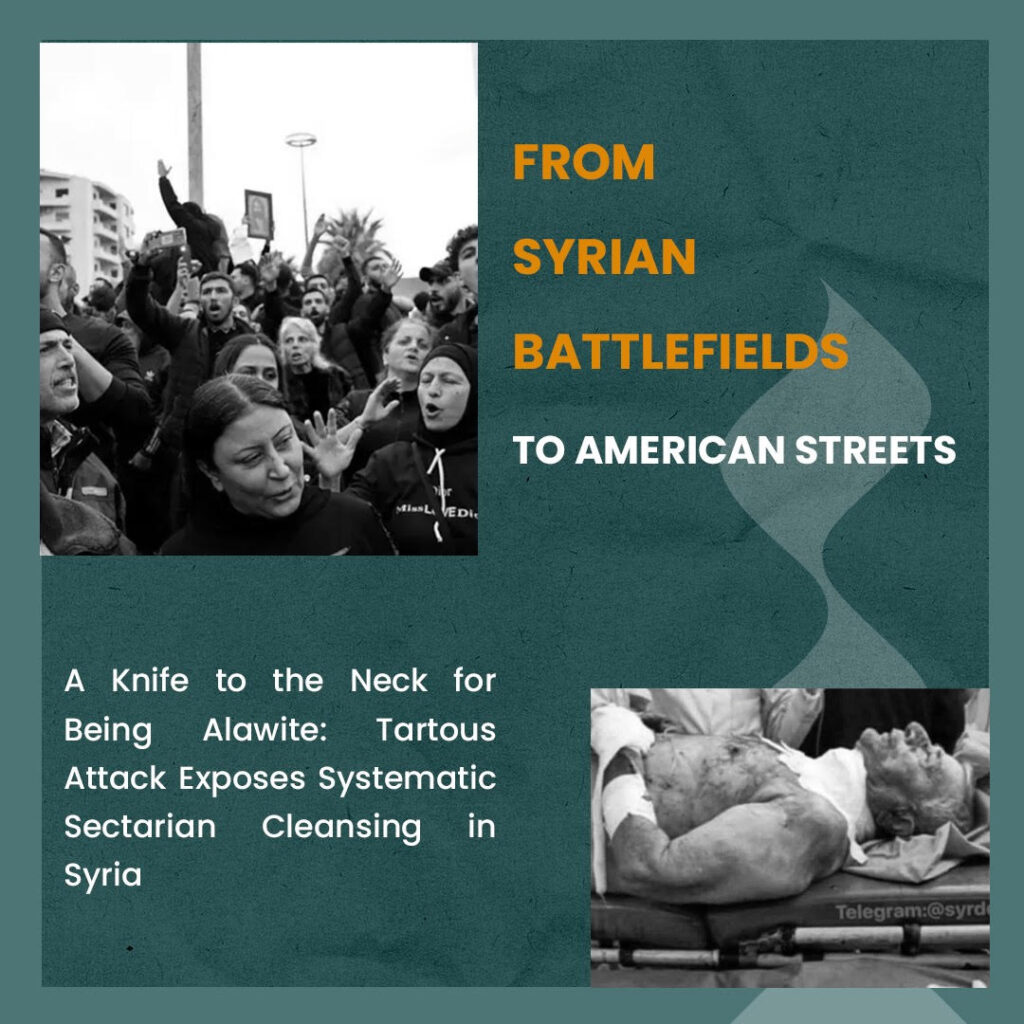
In the coastal city of Tartous, a 70-year-old man’s struggle to make ends meet as a taxi driver nearly cost him his life yesterday, not for political reasons, but simply for being born Alawite.
The victim, Abu Majd (Hussein Salama), a diabetic and hypertensive septuagenarian, was subjected to a brutal sectarian attack on Al-Thawra Street. What began as a routine interrogation about his religious affiliation ended with a sharp knife aimed at his neck.
The Anatomy of a Hate Crime
According to eyewitness accounts and confirmed reports, the assailant, later identified as Ali Ahmed Basheer, specifically questioned Abu Majd about his religious background. Upon confirming the elderly man was Alawite, Basheer immediately attempted to slit his throat. Only the angle of the seating position prevented the murder from being completed.
“The criminal didn’t ask for money, didn’t have any personal dispute with Abu Majd,” a local shopkeeper who witnessed the incident stated. “He only cared about one thing – whether this hardworking old man was Alawite. That was enough for him to justify murder.”
From Civilian Arrest to Institutional Cover-up
In a display of community solidarity, local residents intervened, subduing the attacker and handing him over to the de facto security forces. However, what followed reveals a disturbing pattern of institutional protection for sectarian violence.
Rather than processing the criminal through legal channels, security forces transported Basheer to a hospital where attempts were made to obtain a fraudulent medical certificate declaring him mentally ill. The psychologist involved, Dr. Hussam Malham, has previous convictions for writing fake medical reports.
“This is their standard procedure for sectarian crimes,” a human rights activist from Tartous explained. “When the criminal is caught red-handed targeting religious minorities, they immediately fabricate a mental health defense.”
Systematic Sectarian Cleansing
This attack is not an isolated incident but part of a broader policy of sectarian cleansing implemented by the de facto authorities. By transforming religious identity into a legitimate target, these forces have institutionalized violence against minorities.
The timing of this attack is particularly significant as it coincides with military parades by armed factions in nearby Jableh, demonstrating the environment of impunity that enables such crimes.
International Implications: The Same Ideology Threatens Global Security
The takfiri ideology that fueled this attack in Tartous is the same extremist thinking that recently manifested near the White House, where an Afghan refugee attacked National Guard members. This parallel demonstrates that the terrorism threatening Syria today represents the same global security threat that endangers Western nations.
Appeal to the International Community
We call upon the United States and the international community to:
1. Recognize that the terrorist groups governing parts of Syria and their extremist ideology represent a direct threat to global security
2. Demand immediate protection for religious minorities in Syria
3. Support independent investigations into sectarian crimes
4. Reject the systematic cover-up of religiously motivated violence
As Abu Majd fights for his life in intensive care, and his family faces pressure to alter their testimony, the world must not look away. The targeting of individuals based on religious identity constitutes a crime against humanity that cannot be justified or covered up by fake medical reports.
The fire of sectarianism, once ignited, knows no borders. What burns in Syria today threatens to spark flames across the world tomorrow.