
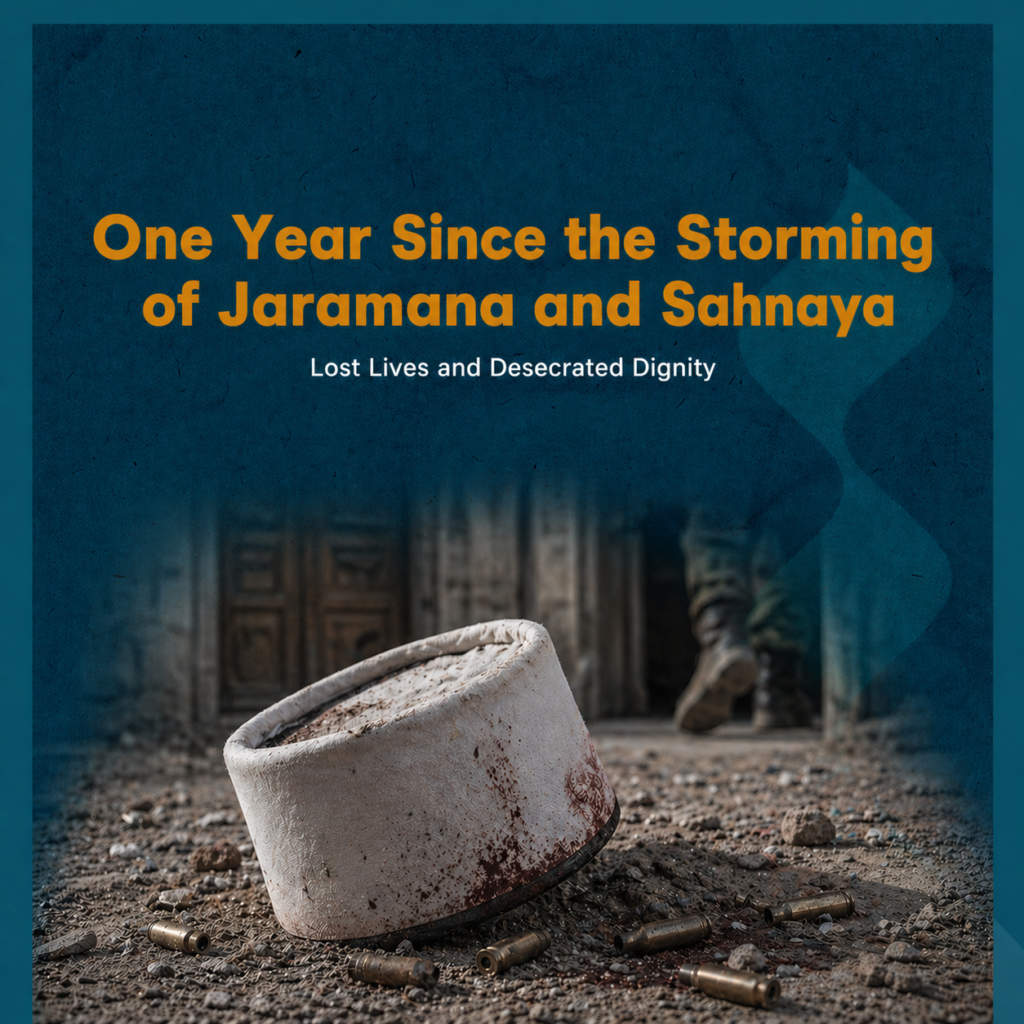
One year on from one of the most difficult trials for civil peace in Syria, an orchestrated strife escalated into a bloody incursion targeting the towns of the Damascus countryside and Southern Syria. Despite the passage of an entire year, a “media massacre” continues to obscure the facts. Media outlets close to the Transitional Government persist in portraying the events as a campaign against “outlaws,” deliberately ignoring the documented chronological sequence of sectarian attacks that targeted civilians in their homes.
The Spark of Strife: Exploiting the “Unknown” for Mass Incitement
The events began a year ago with an anonymous leaked audio recording containing religious insults. Although the government denied its affiliation with any leader in Suwayda at the time, the response was immediate and organized. University dormitories in Damascus and Homs witnessed attacks with knives and batons against students from the Druze community, forcing hundreds to flee and abandon their studies—an escalation documented by the Syrian Observatory for Human Rights.
Jaramana and Sahnaya: When Diversity is Targeted by Incitement
Provocative groups did not wait for investigations. On the night of April 29, 2025, they launched an attack on Jaramana—a town long considered a model of Syrian coexistence. The attack, launched from the direction of Al-Maliha, was not a security operation but a sectarian-tinged act of revenge, resulting in casualties among civilians and local security personnel who attempted to repel the assault.
In Sahnaya and Ashrafiyat Sahnaya, the scene was even bloodier. While community notables were issuing statements denouncing the religious insults, factional groups were participating in the attack. The “timing” was suspicious; the government’s narrative suddenly shifted from repelling a sectarian attack to a “campaign to seize unregulated weapons”—a transparent attempt to justify the onslaught against residents who found themselves forced to defend their homes.
Silent Massacres and Documented Violations
The most harrowing evidence from this period is what occurred following the alleged “calm agreements.” On Wednesday, April 30, 2025, while a delegation from Suwayda was meeting with officials in Daraya, field executions were carried out in Sahnaya. Seven civilians were killed, including five members of the “Mkaki” family, as well as the former mayor, Hussam Warwar, and his son. Notably, Warwar had appeared in a video just hours before his death calling for calm and de-escalation.
These killings were accompanied by documented humiliating violations against detainees, including physical and psychological torture, the filming of degrading videos, and widespread looting of property in Ashrafiyat Sahnaya, which triggered a mass displacement of families toward the villages of Mount Hermon (Jabal al-Sheikh).
Suwayda: Under Siege and Internal Displacement
The violence was not limited to the Damascus countryside; it extended to attacks on the villages of Al-Soura al-Kabira, ‘Ara, Ressas, and Kanaker in the Suwayda countryside, causing a massive wave of displacement toward the provincial center. Despite efforts by religious leaders (Mashayekh al-Aql) and local forces to contain the situation, shelling continued from the “Radar Battalion” and groups described by the government itself as “outlaw gangs” in the Al-Lajat region, placing the state’s credibility in protecting its citizens at stake ever since.