
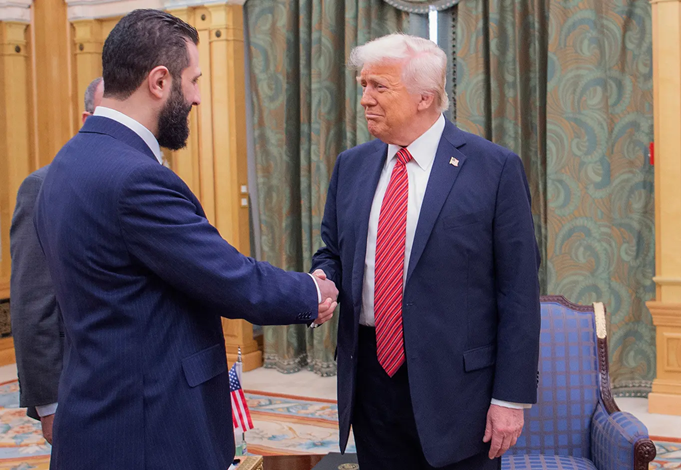
Opinion: Syria’s President Ahmad al-Sharaa should publicly denounce al-Qaeda before walking New York’s streets
When the world gathers in New York for the annual United Nations General Assembly, the city becomes a stage for dialogue, diplomacy and global ambition. But this year, that stage is overshadowed by a deeply uncomfortable reality: Syria’s President Ahmad al-Sharaa — a man whose political and militant roots are tied to al Qaeda and its affiliates — will be walking the same streets that still bear the weight of Sept. 11, 2001.
As world leaders converge for high-stakes diplomacy, Americans deserve transparency about who is being welcomed into their midst. President Trump, who has made significant strides in Middle Eastern diplomacy, now faces a critical test: Will he demand that al-Sharaa publicly denounce his al-Qaeda past before extending the privileges of American soil?
The question is not merely symbolic. It strikes at the heart of America’s commitment to both justice and the memory of those lost on September 11. For New Yorkers especially, the presence of someone with documented ties to al-Qaeda represents more than diplomatic complexity—it’s a painful reminder of wounds that may never fully heal.
Al-Sharaa’s transformation from militant leader to president has been rapid, but transformation requires acknowledgment of the past. Without a clear, public denunciation of his former affiliations and the ideology that drove them, his presence at the UN becomes a bitter irony—a man with al-Qaeda ties speaking about peace and cooperation on American soil.
This is not about preventing dialogue or shutting down diplomatic channels. It’s about setting standards. If Syria wants to be welcomed back into the international community, its leaders must be willing to confront their past honestly and publicly reject the extremist ideologies that have caused so much suffering.
President Trump has an opportunity—and arguably a responsibility—to make this demand. The families of 9/11 victims, the survivors, and every American who remembers that dark day deserve to know that their government will not normalize the presence of those with al-Qaeda connections without demanding accountability.
The stakes extend beyond symbolism. How America handles this situation sets a precedent for how it will engage with other former extremists who may seek legitimacy on the world stage. It sends a message about whether past affiliations with terrorism can simply be ignored in the name of political expediency.
Syria deserves peace, and its people deserve leadership that can help heal the country’s wounds. But healing cannot begin without honesty. If al-Sharaa truly represents a new chapter for Syria, he should have no difficulty publicly denouncing the al-Qaeda ideology that once defined his political journey.
As the UN General Assembly approaches, President Trump should make clear that America’s willingness to engage with Syria’s new leadership is contingent on this basic act of accountability. The streets of New York—forever marked by al-Qaeda’s violence—deserve nothing less than complete transparency about who walks among its people.
This is not about revenge or endless punishment. It’s about requiring a simple but crucial acknowledgment: that the ideology of al-Qaeda was wrong, destructive, and incompatible with the peaceful future Syria claims to want. Without this acknowledgment, any diplomacy rings hollow, and America’s credibility in fighting terrorism becomes questionable.
The choice before President Trump is clear: Demand accountability or risk normalizing a dangerous precedent. For the sake of America’s principles and the memory of those lost on September 11, the right choice should be obvious.