
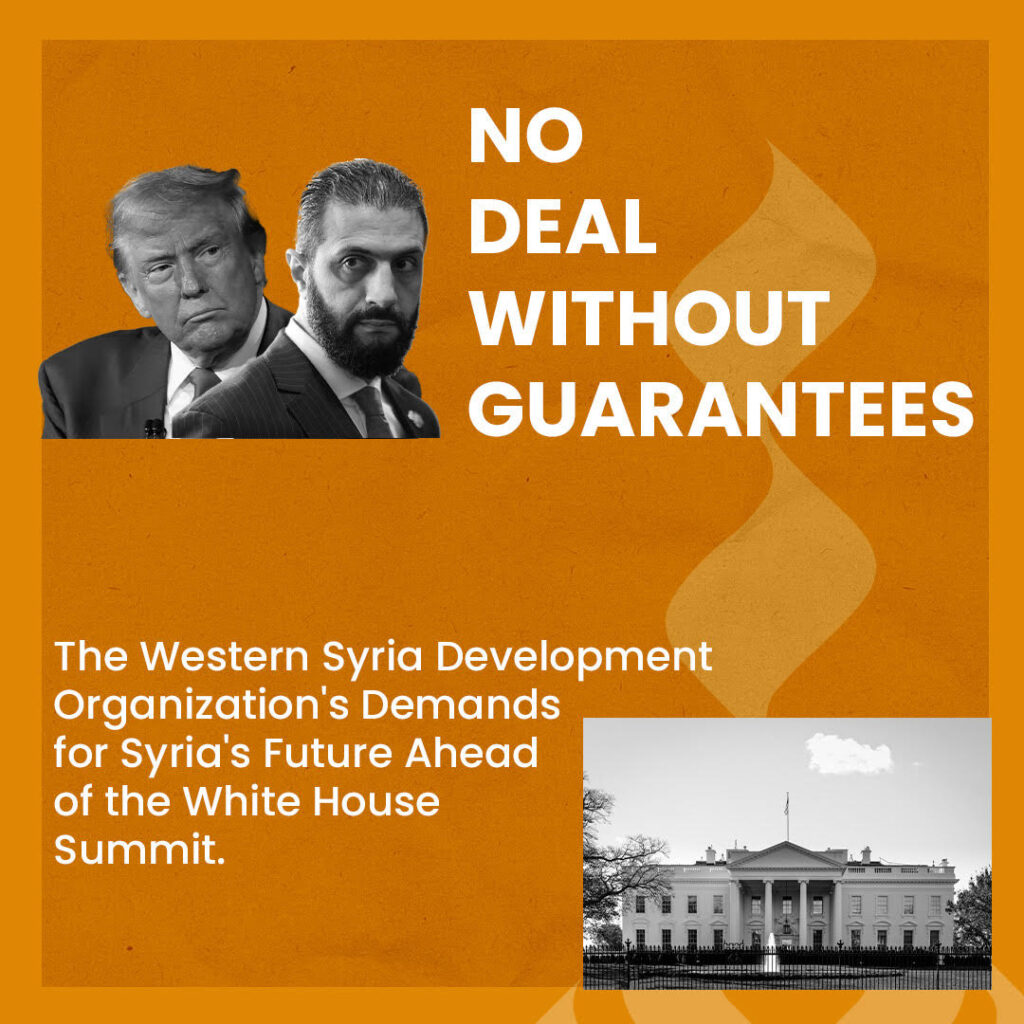
WASHINGTON- As President Donald J. Trump prepared to meet Syrian leader Abu Mohammed al-Jolani at the White House last Monday, the Western Syria Development Organization (WSDO) had called on both parties to ensure that the meeting would produce tangible commitments protecting Syria’s pluralistic fabric and securing the rights of its vulnerable minorities.
In a statement released ahead of the Monday meeting, the WSDO had underscored the critical juncture at which Syria stood. The Organization highlighted that for centuries, Syria’s Christian, Alawite, Druze, Kurdish, and other minority groups had been integral to the nation’s identity.
“The United States possesses significant leverage in this process,” a representative for the WSDO noted, emphasizing that “it was imperative that this meeting moved beyond symbolism to secure enforceable guarantees that would determine Syria’s future character.”
To this end, the Organization outlined a series of specific demands that it believed needed to be explicitly articulated and codified as a direct outcome of the White House discussions.
A Blueprint for a Pluralistic Syria
The WSDO’s call to action centered on four key pillars:
1. Recognition and Security of Minority Communities: The WSDO demanded that the Jolani regime publicly and formally recognize the historical presence and rights of Syria’s minority populations. Furthermore, the Organization insisted that security forces operating in minority regions include officers recruited directly from those local communities.
2. Removal of Foreign Jihadist Elements: The Organization insisted that Jolani issue an unambiguous declaration for the withdrawal of all foreign jihadist fighters and militias from strategic areas, including Syria’s coastal ports and adjacent territories.
3. Regional Representation in Damascus: The WSDO called for a political structure granting minority populations political representation in the capital Damascus based on their regional constituencies.
4. Verification of Protection Mechanisms: Emphasizing that vague promises were “insufficient and unacceptable,” the WSDO urged the U.S. government to insist on clear, monitorable protection mechanisms, subject to verification by independent observers.
A Call for Consistent Advocacy
Drawing a parallel to recent U.S. foreign policy, the Organization also called on the Trump Administration to demonstrate the same level of advocacy for persecuted Christians in Syria as it had recently shown toward Christians in Nigeria.
The WSDO concluded by welcoming the renewed U.S. engagement on Syria while stressing that American diplomatic, political, and economic leverage must be used purposefully to secure a sovereign, safe, and pluralistic Syria for all its people.