
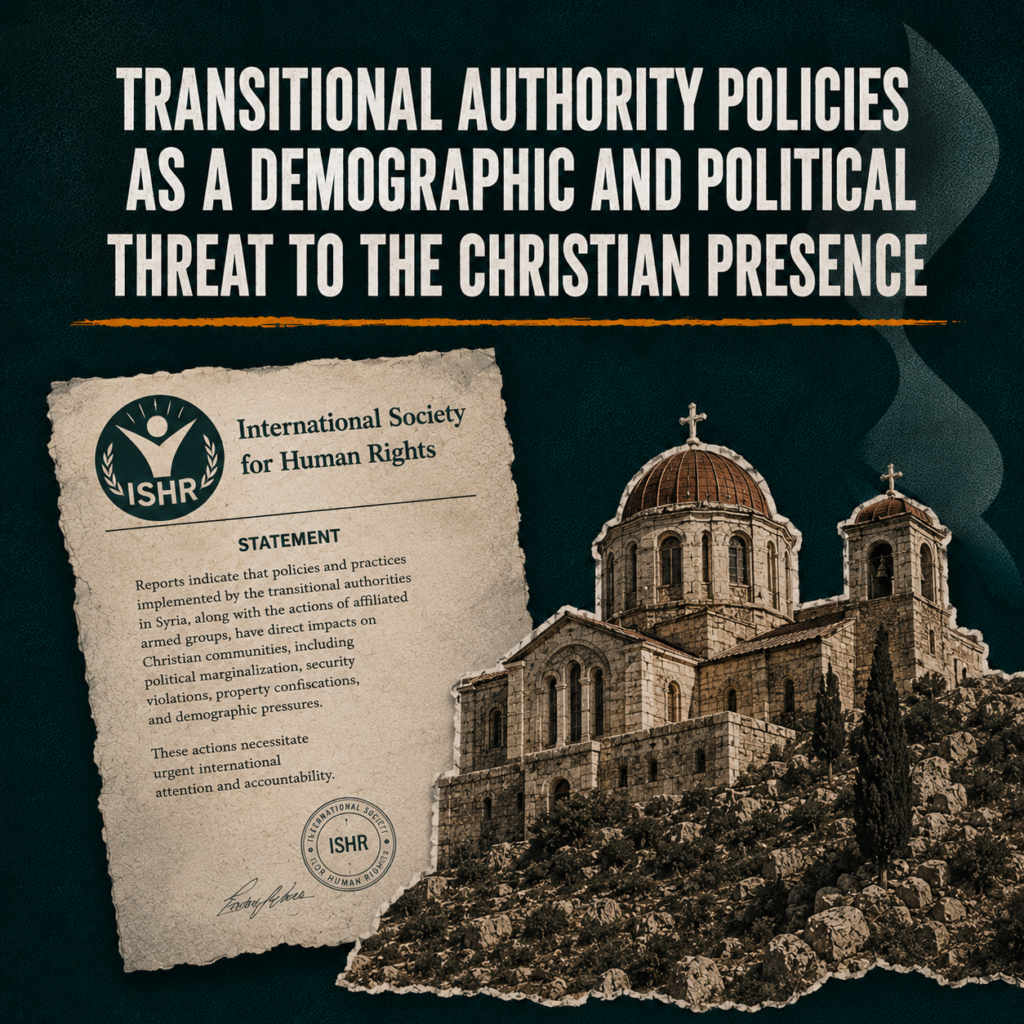
More than a year and a half after the overthrow of the Assad regime, political and security data in Syria show a continuation of the structural challenges facing the Christian component. Field reports indicate that the policies pursued by the Syrian transitional government and its affiliated armed groups contribute to reducing the Christian presence and altering the demographic map in their historical areas of presence, through a series of administrative, security, and legal measures.
Political Centralization and Lack of Representation
The transitional government is moving towards centralizing power through mechanisms officially termed “institutionalization.” This was evident in the issuance of decrees dissolving former political parties and direct interference in the formation of the new parliament, where it was determined that one-third of the parliament members would be appointed by a decision from the transitional president.
Regarding the political representation of minorities, local reports documented the exclusion of Assyrian and Armenian representatives from the electoral lists. Political analyses suggest that these measures reflect a continuation of the ideological legacy of “Hay’at Tahrir al-Sham” (HTS) and demonstrate a trend towards forming a pro-authority parliamentary majority, thereby limiting political pluralism and undermining the principle of equal representation.
The Security File and Property Disputes
At the security and societal levels, several Syrian regions are recording systematic incidents that directly affect the stability of the Christian population:
- Aleppo: Reports indicate occurrences of home seizures and increasing real estate property disputes coinciding with the presence of armed militias, which has led to a decline in local security indicators.
- Damascus: Restrictions on public gatherings have been recorded, resulting in the cancellation or reduction of major religious events, such as Palm Sunday and Easter celebrations, due to imposed security arrangements.
- Saidnaya: The region is experiencing tensions following the authorities’ execution of arrest campaigns against the backdrop of discussions about mass graves belonging to Islamist fighters. This coincides with the launch of new real estate projects in the area, which observers classify as attempts to alter the demographic and historical identity of the city.
- Wadi al-Nasara (Al-Anaz Village): Deaths of Christian youths were recorded, where tribal settlements and informal mediations were resorted to instead of transferring the files to the specialized criminal judiciary, reflecting a decline in the role of judicial institutions.
Absence of Legal Accountability and Economic Pressures
The transitional government has yet to take steps to establish fact-finding commissions or specialized courts to hold accountable those responsible for the attacks that targeted Christian cities and churches (such as Maaloula, Al-Khabour, and Homs) during the war years. This stall in the transitional justice process is accompanied by reports of administrative discrimination and economic pressures facing Christian individuals in employment sectors, contributing to rising outward migration rates.
The International Community’s Responsibility
Current data indicate that state management mechanisms by the transitional authority do not provide equal legal protection for all citizens. Accordingly, there is an immediate need for the international community, specifically the European Union and Germany, to politically assess these developments, and to link future support and cooperation programs with the Syrian government to the extent of its actual commitment to applying the rule of law, dismantling armed formations, and guaranteeing minority rights regardless of ethnic or religious affiliations.