
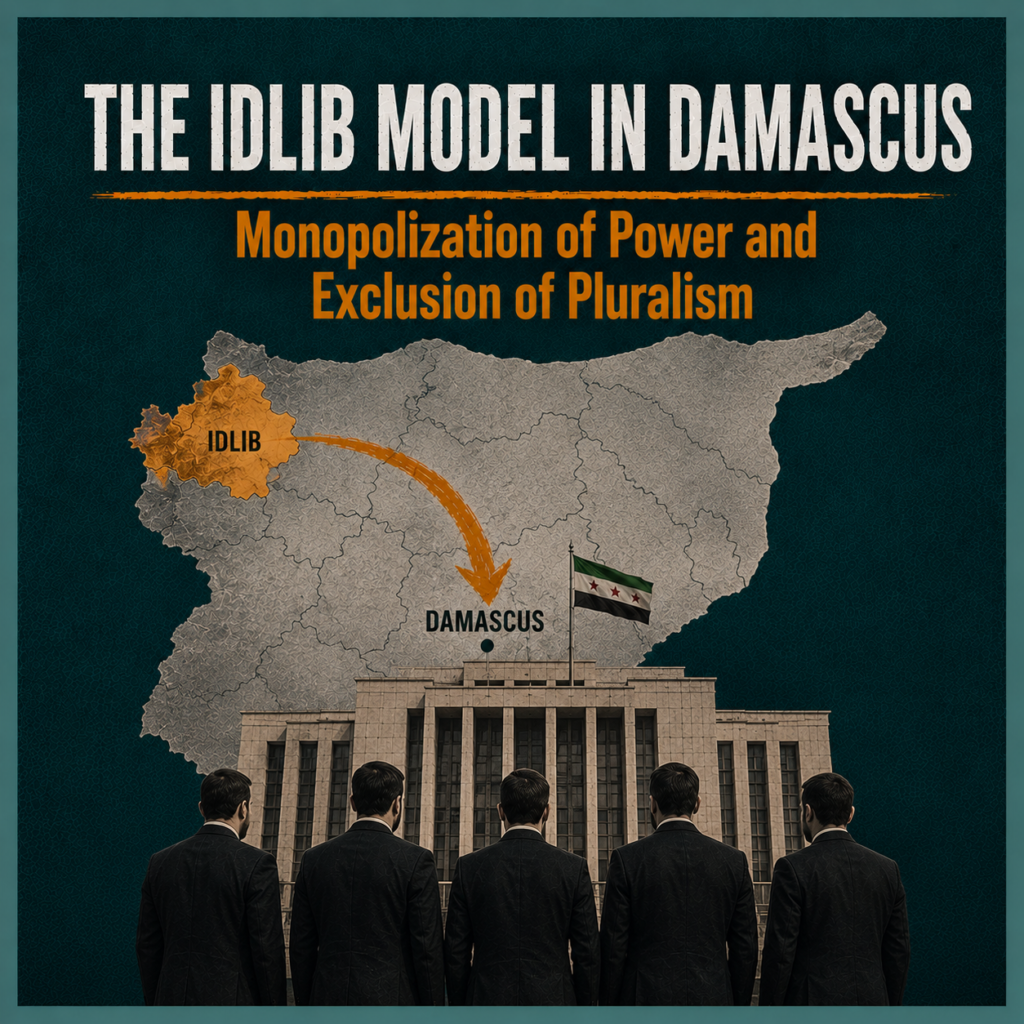
The recent appointments and reshuffles conducted by the transitional authority in Damascus, headed by Ahmed al-Sharaa, reveal a strategy to monopolize the key pillars of the Syrian state. The new lineup does not reflect a participatory political transition; rather, it represents the continuation of a decade-long project aimed at cloning the cadres of the “Salvation Government” (the civilian wing of Hayat Tahrir al-Sham) and installing them across the country’s institutions.
What appeared during the war years as a local administration in Idlib province now emerges as a systematic plan to prepare a bureaucratic staff absolutely loyal to a single political and military network, which is now being awarded the seats of power in Syria.
Security Leaders and Crossing Managers in Top Positions
A reading of the resumes of the newly appointed figures shows that the criterion of loyalty to the Idlib experience has superseded the criterion of competence. These leaders have taken control of sensitive positions and strategic provinces. Prominent among them are:
-
Abdulrahman Badr al-Din al-Ama (Secretary-General of the Presidency): He previously held multiple ministerial and administrative portfolios in the Salvation Government, including Development, Humanitarian Affairs, and Central Planning, before being swiftly transferred from Homs province to the Presidency.
-
Ziad al-Ayesh (Governor of Deir al-Zour): His background centers around the general supervision of checkpoints in Idlib and working in civil affairs under the Salvation Government’s Ministry of Interior. His appointment in Deir al-Zour places a figure with a purely security-oriented background in charge of one of the country’s most complex regions.
-
Murhaf al-Naasan (Governor of Homs): A former police officer in Idlib who worked for years within the General Security apparatus affiliated with Hayat Tahrir al-Sham.
-
Ahmad Ali Mustafa (Governor of Latakia): A former commander in the Ahrar al-Sham movement and the actual director of the Bab al-Hawa border crossing for eight years. He was gradually moved through the customs and ports sector until reaching the administration of Latakia.
A Technocratic Cover to Conceal the Monopoly on Power
The government appointed a limited number of technocrats in an effort to convince the international community of its administrative competence. Notable among them are Mohammed Safwat Raslan (Governor of the Central Bank), who has a banking background and worked with the former regime, and Khaled Fawaz Zaarour (Minister of Information), who comes from academia.
These appointments are merely a procedural facade within the government lineup, an attempt to project a modern image that hides the reality that the hard core of the state remains firmly in the grip of the cadres from Idlib’s phase.
The Danger of Generalizing the Idlib Experience
The new Syrian government ignores the fact that managing a specific region during wartime differs fundamentally from governing a vast, devastated country suffering from poverty and deep sectarian, regional, and economic divides. Applying the “Idlib model” on a national level without substantial modifications is a step that lacks the foundations of national consensus and carries a high risk of administrative failure.
Security Failures and Foreign Apprehension
This administrative takeover cannot be separated from ongoing security failures. The current appointments have not contributed to broadening political participation, nor have they included minorities. Furthermore, the security apparatuses—controlled by the exact same network—remain incapable of providing any genuine accountability or transparency mechanisms in accordance with the 2025 Constitutional Declaration.
The new authority faces mounting international doubts, particularly from Washington, regarding its inability toward extremist elements infiltrating its ranks. This was evident in the attack that killed American soldiers in Palmyra in December 2025. The failure to purge institutions of extremists, coupled with the continued monopoly on power, makes any discussion of sanctions relief or diplomatic recognition highly unlikely.
The message sent by the current government lineup is clear: the authority in Damascus today is merely an expanded version of the Idlib government, managing state institutions with a factional mentality, and prioritizing the empowerment of its own cadres at the expense of building institutions capable of accommodating all Syrians.