
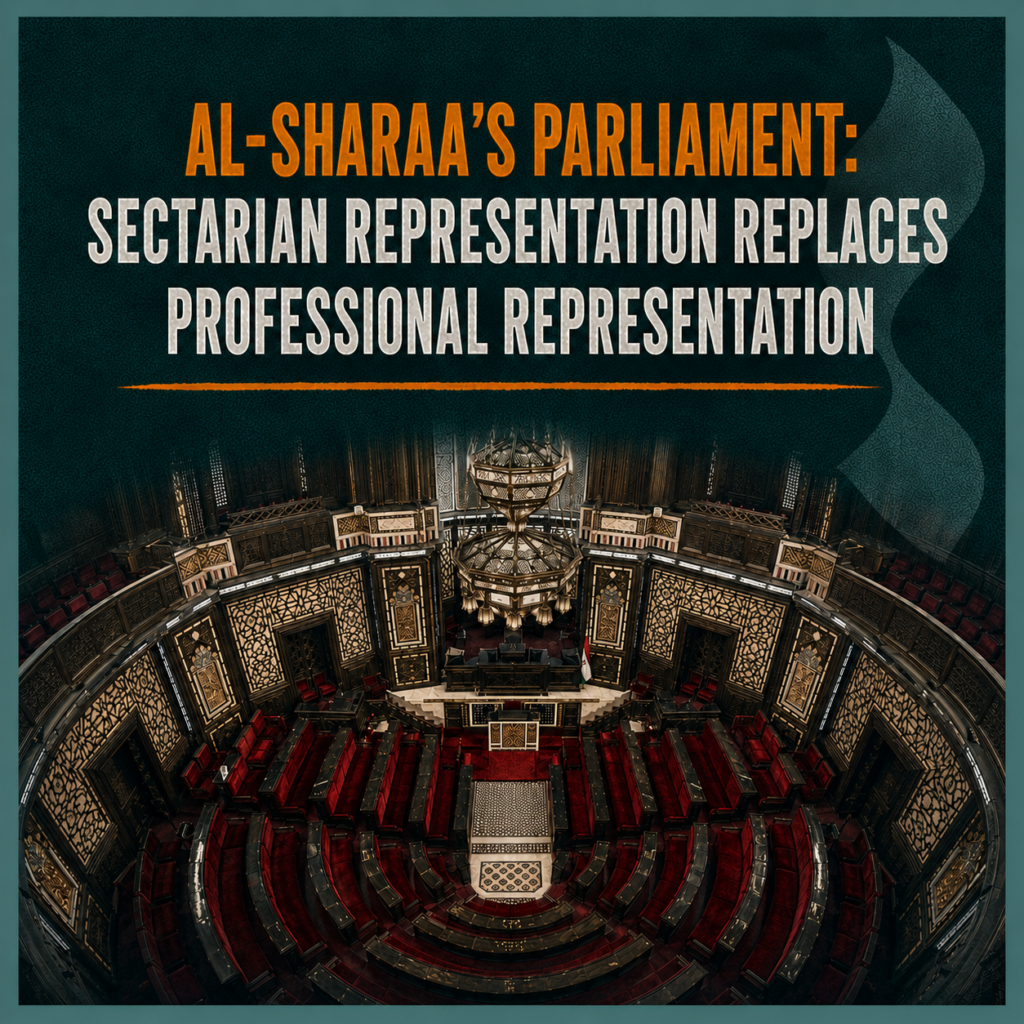
The completion of the formation of the Syrian Transitional Parliament (People’s Assembly), consisting of 210 members, following the authorities’ announcement of 70 deputies directly appointed by the head of the transitional authority, Ahmed Al-Sharaa, demonstrates the current authority’s drive towards institutionalizing a centralized presidential governance system. This system is devoid of direct popular electoral legitimacy and consolidates actual powers strictly in the hands of the presidency.
This parliament operates under a temporary constitution adopted in March 2025, which grants it legislative powers stripped of any oversight tools. Current laws do not require the government to obtain a parliamentary vote of confidence to assume its duties, effectively rendering the parliament a mere advisory body subordinate to the directives of the executive authority.
Selection Mechanisms and Direct Appointment
Parliamentary seats were determined through mechanisms that bypassed universal and direct suffrage, with the composition distributed as follows:
-
Indirect Selection (140 seats): Two-thirds of the members were selected last year through “regional electoral councils” formed under the supervision of a central committee appointed by Al-Sharaa himself, under the pretext that relying on standard voter rolls was impossible due to the conditions of war and displacement.
-
Direct Presidential Appointment (70 seats): The remaining third was filled via a direct presidential decree to guarantee a fixed voting bloc whose political existence is entirely owed to the presidency’s direct appointment.
Marginalization of Women and the Shift to Sectarian Representation
Despite the authority’s attempts to market the recent presidential appointments as a step to balance the scales—after Al-Sharaa appointed 15 women—the overall figures reveal a severe deficit in female representation. The total number of women in the new parliament does not exceed 21 seats (representing a mere 10%).
Furthermore, rather than reflecting the competencies and traditional representation of fundamental and independent societal sectors—such as farmers, workers, industrialists, and independent professions—the People’s Assembly this year has been transformed into an arena for directed sectarian and local representation. Seats were subjected to a quota system designed to produce sectarian fronts pledging direct loyalty to the center of power, rather than genuinely and independently representing Syrian professional and social groups.
Undermining Pluralism and Marginalizing Syrian Components
The approved lists reveal a sharp and disproportionate decline in the representation of Syrian components (non-Sunni). These components collectively obtained only 15 out of the 207 announced seats, equating to a mere 6% to 7% of the assembly’s total size. This structural imbalance becomes glaringly evident when comparing these representation rates with the actual demographic weight on the ground.
Regarding the distribution of these limited percentages, the Christian component received only 6 seats, equivalent to 3% of the assembly’s total composition, while the representation of the Alawite component was restricted to just 5 seats, not exceeding 2%.
In the same context, the Ismaili component secured 3 seats (1.5% of the announced seats), while the representation of the Druze component was reduced to a single seat (0.5%), filled through the presidential appointment of Laith Al-Balous.
The appointment of Al-Balous has faced categorical and widespread rejection from the street and the popular movement in Suwayda. Field data confirms that the majority of the Druze stand firmly against Al-Balous, who is loyal to Al-Julani’s (Ahmed Al-Sharaa) authority. They view his appointment as an attempt by the Damascus authority to impose an illegitimate front to bypass the governorate’s general stance, which strongly rejects the current government’s orientations and structure. This approach underscores that all parties represented in the assembly were meticulously selected to ensure absolute loyalty to the authority, with the complete exclusion of any genuine opposition or independent forces.
The Exclusion of Suwayda and Human Rights Concerns
The announcement by the Supreme Judicial Committee for Elections to postpone the selection of deputies for Suwayda governorate “until appropriate conditions are met” underscores the depth of the political crisis with the governorate, which rejects Damascus’s policies and has been living outside the authority’s actual control since last July’s clashes that left around 1,700 dead, according to UN data. This exclusion reflects a reliance on administrative marginalization and the isolation of opposing governorates rather than offering an inclusive political formula.
In this regard, a coalition of Syrian human rights organizations issued a joint position paper emphasizing that the current legal and electoral framework concentrates influence and control over the legislative body directly in the hands of the presidency. It lacks guarantees for electoral oversight and judicial independence, thereby confiscating political pluralism and undermining the independence of parliamentary work. Furthermore, the UN Deputy Special Envoy for Syria, Claudio Cordone, warned before the UN Security Council that the ambiguity and stalling surrounding the formation of these institutions parallel a state of regional anxiety and turmoil.
A structural examination of the new Syrian People’s Assembly reveals a legal formulation designed to produce a parliament that is politically and administratively dependent. Rather than transitioning towards a state of institutions and pluralism, this formation entrenches one-man rule by stripping the assembly of oversight powers and replacing professional representation and popular voting with lists of direct appointment and loyalty. By ignoring the true demographic weights of Syrian components, this reality exposes the vast gap between official promises of democratic transition and the political reality forcibly imposed on the ground.