
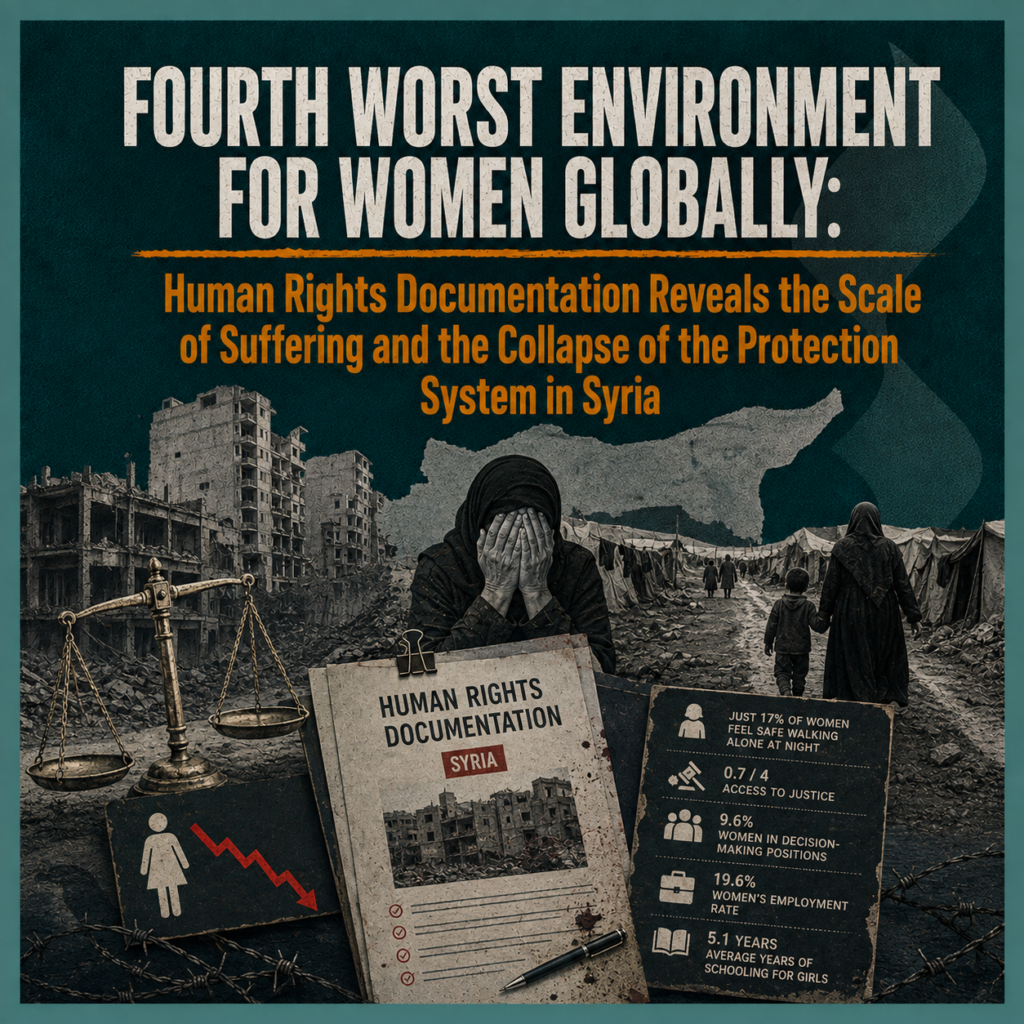
In the latest documentation reflecting the scale of the human rights and institutional deterioration in Syria under the current authorities, the “Women, Peace and Security Index 2025/26” report—published in partnership between the Georgetown Institute for Women, Peace and Security (GIWPS) and the Peace Research Institute Oslo (PRIO)—revealed that Syria remains at the bottom of the global rankings, occupying the 178th position out of 181 countries. This ranking, which places the country as the fourth worst globally for women to live in, highlights the structural failures of the authorities in providing the minimum standards of legal protection and community safety.
Militarization of the Public Sphere and Lack of Community Safety The indicators documented in the report point to a daily reality dominated by the militarization of the public sphere, with 97.1% of Syrian women living 50 kilometers or less from armed conflict zones. This direct exposure to conflict is accompanied by an unprecedented collapse in the level of “community safety,” as only 17% of women reported feeling safe walking alone at night, which is the absolute worst rate globally. These figures prove that the policies adopted have only resulted in turning the civilian environment into a sustained space of threat and fear.
Collapse of the Judicial System and Entrenchment of Legal Discrimination From a legal and human rights perspective, the report reveals a near-total paralysis in justice mechanisms; Syria recorded an almost non-existent score of (0.7 out of 4) in the “access to justice” indicator, confirming the absence of any independent and effective institutional channels to protect women’s rights from violations. The country also scored (40.0 out of 100) in the “absence of legal discrimination” indicator, reflecting the continuation of unjust legislation that legitimizes exclusion and hinders the fulfillment of international human rights standards.
Furthermore, the report documented an alarming rate of “political violence targeting women,” reaching 0.884 politicized incidents per 100,000 women. This violence parallels a systematic political exclusion, evident in a parliamentary representation rate that does not exceed 9.6% in the decision-making councils affiliated with the central authority.
Economic Paralysis and Deprivation of Basic Rights These structural violations directly reflect on economic and social rights; the employment rate for women is a mere 19.6%. In a vital sector like education, the average years of schooling available to girls has dropped to only 5.1 years. These data do not exclusively reflect the repercussions of war, but rather exclusionary policies and a systematic neglect of service and development sectors in favor of other agendas.
Ultimately, this report presents a precise documentation framework that holds the international community and relevant actors to their responsibilities. The figures presented in the index are not merely passing statistics, but a documented testimony to the shortcomings of state institutions and their complicity in perpetuating an environment devoid of the most basic human rights standards, calling for intensified international advocacy efforts to ensure effective and sustainable accountability mechanisms.