
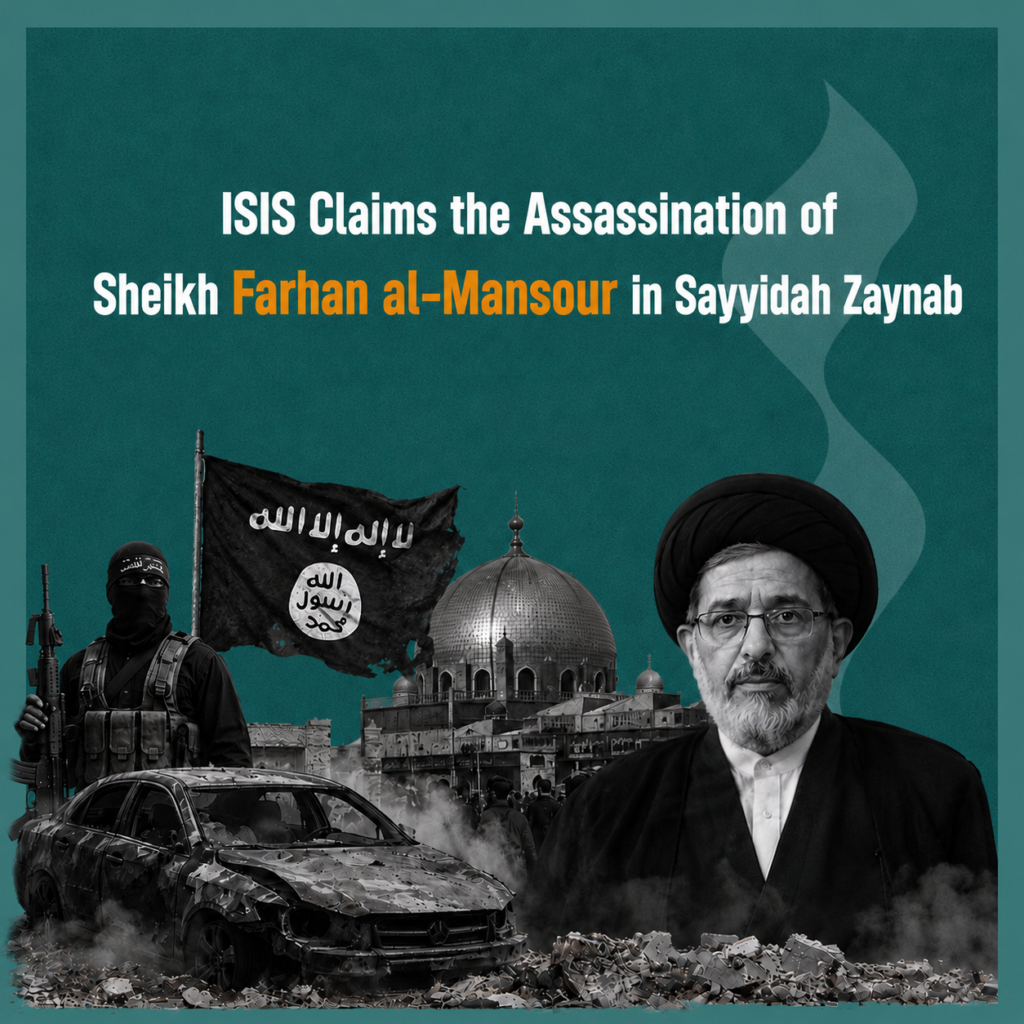
The Islamic State (ISIS), through its official weekly newspaper “Al-Naba,” has claimed responsibility for the assassination of the cleric Sayyid Farhan Hassan al-Mansour in the Sayyidah Zaynab area of rural Damascus. This operation highlights severe security vulnerabilities in an area supposed to be under the direct oversight of the authorities.
Details of the Targeting and Symbolic Stature
According to the report published by the organization under the title “The Assassination of an Apostate Leader in a Qualitative Explosion,” the operation was carried out using a sticky IED planted inside Al-Mansour’s vehicle. The device was detonated on Friday (13 Dhu al-Qi’dah) in the Sayyidah Zaynab district, resulting in his immediate death.
In its rhetoric, the organization emphasized the targeting of a figure with the status of “Sayyid and Preacher,” a clear indication of a deliberate intent to strike symbols that hold significant sectarian and social weight in this sector of rural Damascus. The choice of a figure with such symbolic stature in the heart of Sayyidah Zaynab underscores the precision of the attack, targeting a well-known face among the local population. This has caused a field shock, given the perpetrators’ ability to reach such a sensitive target and eliminate him in broad daylight.
Reality of Field Chaos
The organization released images documenting the aftermath of the explosion that rocked the main street, raising widespread questions about the absence of genuine oversight. Instead of established security, the scene is now characterized by assassinations targeting regional symbols within residential neighborhoods, rendering alleged stability a mere slogan far removed from the field reality.
Conclusion: Security Collapse and Absence of Syrian Government Control
This operation proves, beyond any doubt, the extent of the security vacuum prevailing in the Damascus countryside, which has become an open arena for operations that strike religious symbols with precision and without any field deterrent. The successful assassination of a figure of Sayyid Al-Mansour’s standing in the heart of Sayyidah Zaynab reflects the total absence of effective Syrian government control. It clearly demonstrates that its security grip has become a mere hollow structure, incapable of securing the ground or protecting influential figures in the region.
This rapid deterioration indicates that the area has slid into a state of deep security chaos, where field initiative now rests in the hands of the perpetrators. This follows a stark failure by the Syrian government to impose a real presence or prevent the repeated breaches that strike the region, exposing the fragility of claims regarding stability.