
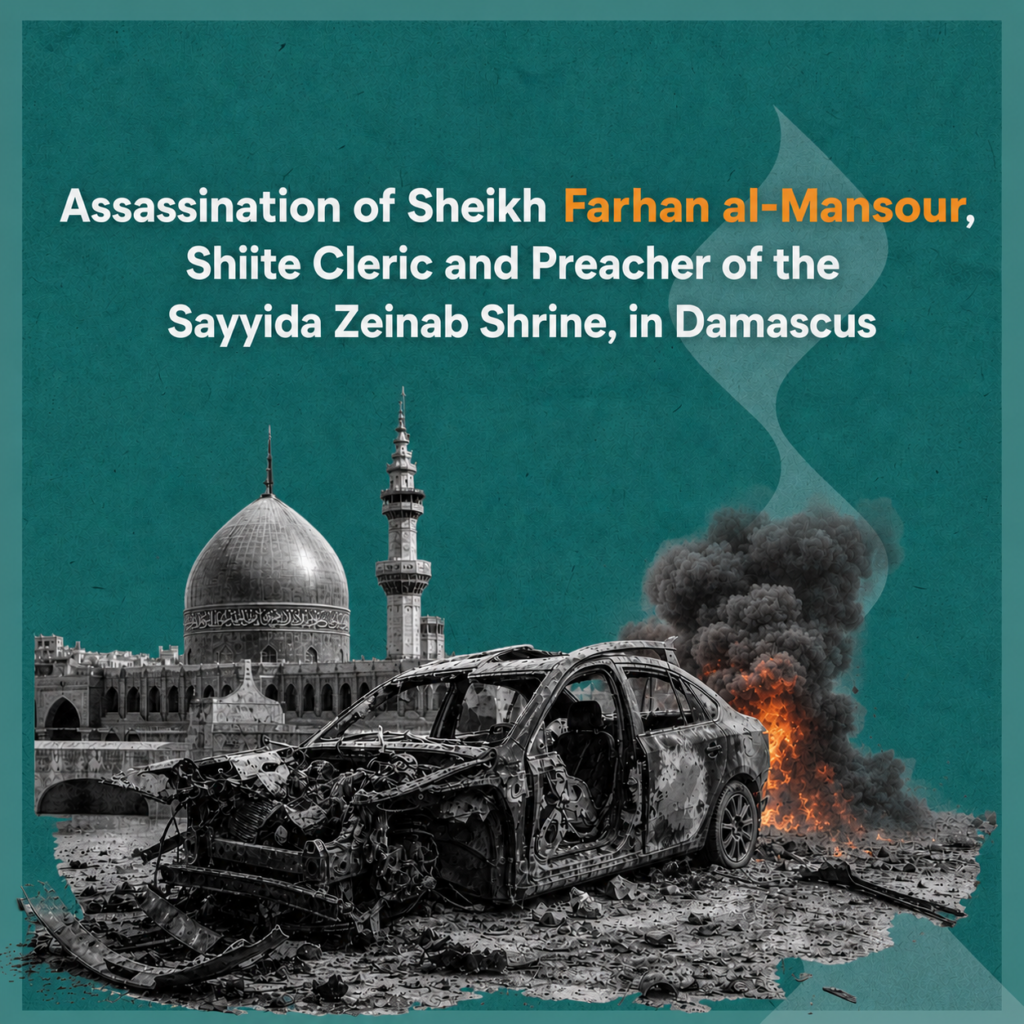
Grief and tension have gripped the Sayyida Zeinab area in the Syrian capital, Damascus, following the assassination of Sheikh Farhan Hassan al-Mansour, a prominent member of the Clerical Body of the Shiite community and a preacher at the Sayyida Zeinab Shrine. The attack, characterized by its boldness and precision, opens the door to troubling questions regarding the future of security and stability in the country.
Details of the Operation
Local sources reported that Sheikh al-Mansour was directly targeted by a hand grenade thrown by unidentified assailants into his vehicle while he was in Damascus. The attack resulted in severe injuries; he was rushed to Al-Kawthar Hospital in Sayyida Zeinab, where he passed away shortly after from his wounds.
An Environment of Violations: Minorities Facing Security Challenges
The assassination of Sheikh al-Mansour comes at a sensitive time as Syria witnesses a significant increase in violations targeting religious minorities. Observers believe these groups are living in a state of security “instability” due to several factors:
-
Rise in Unidentified Targeting: There is growing concern over the escalation of assassinations targeting religious symbols of minorities. This occurs amidst a lack of accountability and an inability to identify the parties seeking to destabilize civil peace by striking figures of social and religious influence.
-
The Syrian Government’s Inability to Protect: The Syrian government faces accusations of failing to provide necessary protection for religious and civil figures, or failing to control the proliferation of unregulated weapons that now threaten lives in the heart of the capital and surrounding areas. That such an assassination occurred in an area under specific security measures reflects the fragility of the current security framework.
Serious Repercussions
Sheikh al-Mansour was considered a significant figure with an active role in religious and social guidance, and his targeting represents a blow to fragile civil peace efforts. Human rights circles fear this incident may lead to:
-
Escalating Sectarian Tensions: The transformation of this assassination into a spark that ignites new rounds of internal societal friction.
-
Targeting of Academic and Religious Cadres: Fears that this assassination marks the beginning of a series of liquidations targeting the cultural and religious elite of minority groups.
-
Erosion of Trust in Institutions: An increased sense among citizens that the state is no longer capable of providing the minimum level of personal safety for both prominent figures and ordinary citizens.
The assassination of Sheikh Farhan al-Mansour remains a dangerous indicator that the Syrian arena continues to simmer with security conflicts. Civilians and religious symbols pay the price in the absence of a clear horizon for protecting religious diversity and ensuring the safety of all Syrian components.