
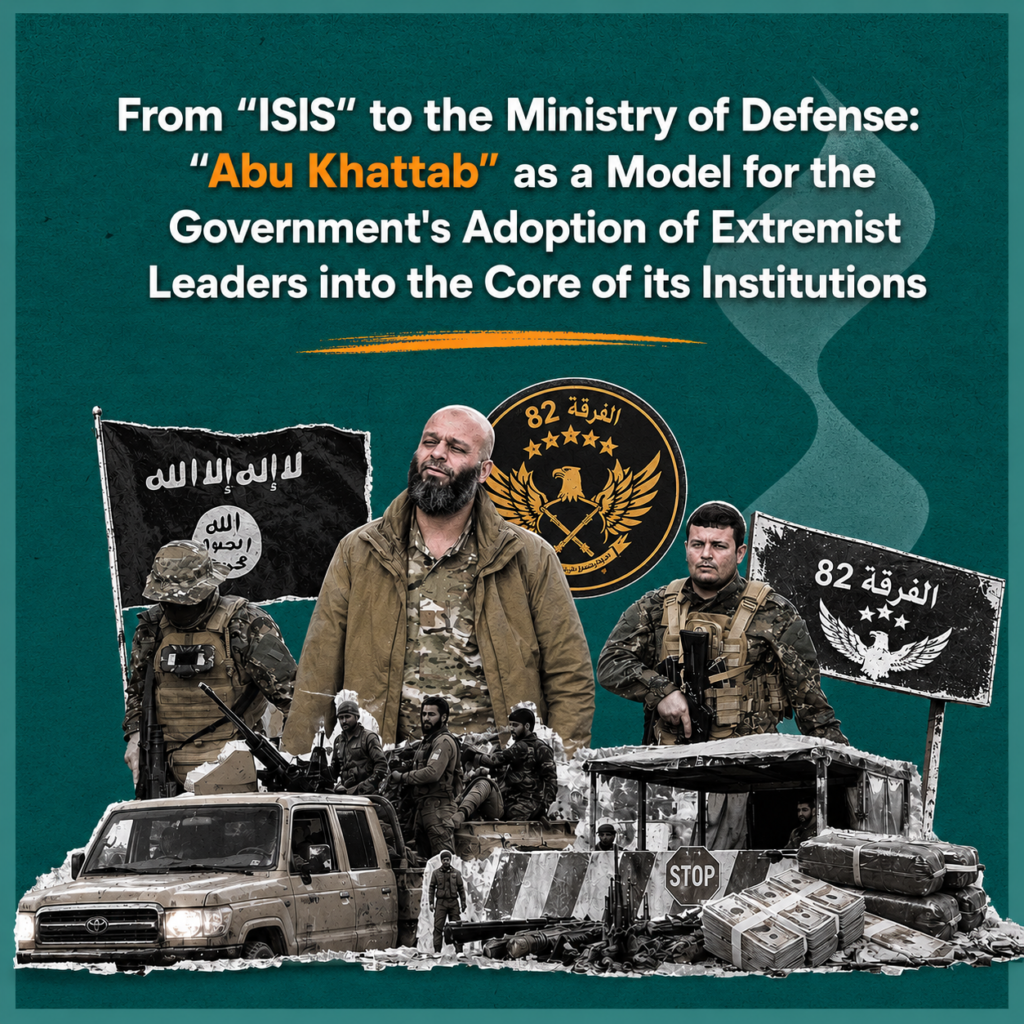
The figure of Brigadier Khaled Muhammad al-Halabi, known as “Abu Khattab,” has become the most controversial face on the Syrian military scene since 2025. He has transitioned from a leader in hardline jihadist environments to the commander of the “82nd Special Forces Division,” affiliated with the Ministry of Defense in the government of Ahmad al-Shara (al-Jolani). This trajectory embodies a dangerous structural dilemma regarding the integration of leaders with extremist ideological backgrounds into the state apparatus, sparking growing international and local fears regarding the reproduction and entrenchment of extremist networks under the cloak of official institutions.
Ideological Roots: An Extension of “Jund al-Aqsa” and ISIS
“Abu Khattab” hails from the environment of the “Jund al-Aqsa” organization, known for its deep intellectual and ideological ties to ISIS. Following a series of internal schisms and purges in northern Syria, al-Halabi moved to lead the “Ansar al-Tawhid” organization, which served as the functional extension of Jund al-Aqsa. Despite the restructuring that followed the fall of the previous regime, the intellectual connection remains unbroken. Field reports indicate that the 82nd Division continues to harbor members holding the same Salafi-Jihadist tendencies, with frequent sightings of ISIS-linked slogans and symbols during field operations, in addition to the presence of foreign fighters from Central Asia and Europe within the division’s ranks.
A Bloody Record: From the Coast to the Suwayda Hospital
Criticism of “Abu Khattab” is not limited to his organizational background but extends to a record rife with documented human rights violations. In July 2025, events in Suwayda revealed the true nature of the 82nd Division’s practices; its elements participated in the storming of the city’s National Hospital, a flagrant violation of the Geneva Conventions protecting medical facilities. Field recordings and testimonies document the execution of field executions, most notably the killing of a young man named Muhammad Abu Hassas. Furthermore, reports from the Syrian coast indicate al-Halabi and his division’s involvement in systematic suppression operations, including extrajudicial killings, the kidnapping of women, and the imposition of a policy of intimidation against local social components.
War Economy: The “82nd Division” as a Parallel State
Economically, the 82nd Division relies on a “parallel military economy” model that reinforces its independence from central state institutions. Al-Halabi’s influence has transformed into a tool for accumulating illicit wealth by imposing tributes on merchants and farmers, exploiting military checkpoints to collect illegal fees, and managing drug and arms smuggling networks. This management style not only weakens institutional oversight but transforms the division into a power center that threatens security stability, as government and logistical resources are utilized for private commercial activities that serve the leaders of these integrated militias.
Strategic Implications: A Military Institution with a Jihadist Identity
The case of “Abu Khattab” and the 82nd Division is not an anomaly; rather, it is an accurate expression of the nature of the military institution being built by the al-Jolani government. Instead of offering an ideology-neutral model, the government has chosen to build its army upon the integration and settlement of jihadist currents within the core of its structures. This makes the presence of leaders with “ISIS-like” backgrounds within the Ministry of Defense a norm rather than an exception. This approach—which relies on recycling extremist factions and transforming them into governing tools—confirms that the current project is merely a reproduction of the security-state model via a jihadist gateway. This leaves Syrian society facing a long-term existential threat, as the military institution becomes the legitimate host for currents that were until recently classified as a threat to stability—meaning that the danger of extremism has now become part of “state policy” rather than merely rebel factions outside its control.