
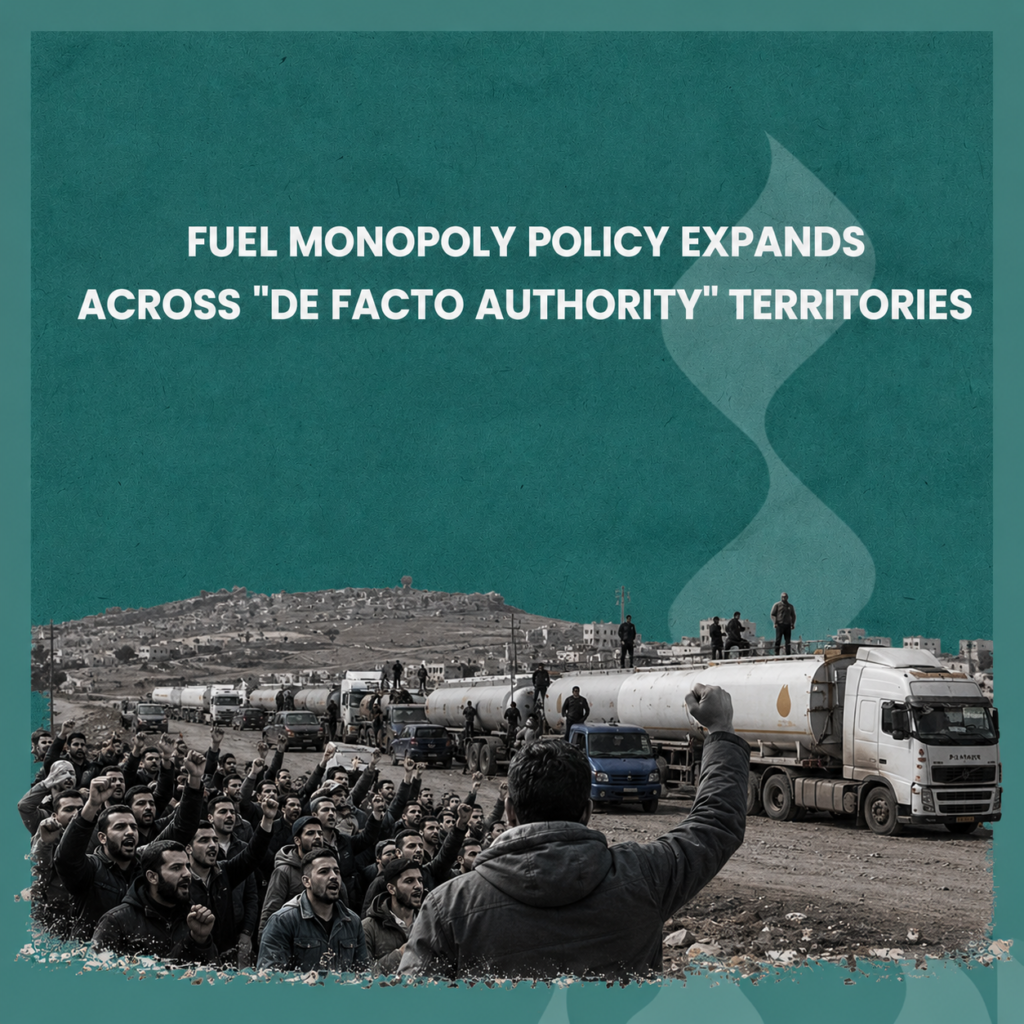
The policy of “centralized monopoly” managed by the “de facto authority” in northern Syria is no longer confined to Idlib; its grip has extended to the Aleppo countryside, where security forces affiliated with this authority have met popular protests with live ammunition. The enforcement of closure orders on artisanal fuel-processing facilities (traditional refineries) in favor of centralized investments is a continuation of the economic hegemony previously documented in Idlib—a model that positions fuel as a tool of control and deprivation rather than a strategic commodity for public service.
Idlib (2021): Field Documentation of the Monopoly Policy
The fuel sector in Idlib has long served as a mirror for the “de facto authority’s” strategy of economic domination. Journalist and researcher Lindsey Snell documented, through her 2021 field reports, the coercive mechanisms implemented at the time through “Watad,” the authority-affiliated company that monopolized the fuel sector. These practices included:
-
Forced Confiscation: Searching vehicles at Idlib’s entrances and seizing any fuel quantities exceeding 10 liters, while imposing heavy financial fines on the owners.
-
Monopolistic Pricing: Forcing residents and suppliers to purchase exclusively from the authority-linked company at prices significantly higher than those in neighboring markets.
-
Intimidation of Suppliers: Burning confiscated fuel as a warning message to anyone attempting to bypass the monopoly on importation and distribution.
Aleppo Countryside: Implementing the Same Model with Bullets
Today, the same scenario is repeating in the Aleppo countryside, where the “de facto authority” has issued orders to shut down artisanal fuel refineries in favor of centralized entities under its control. Although the authority attempts to frame these decisions under the pretext of “regulation,” reality suggests a desire to consolidate resources and liquidity in its own hands, which has prompted residents to stage peaceful protests in rejection of these restrictions.
In response to these popular demands, the authority’s security forces used excessive force and live ammunition to disperse protesters, resulting in injuries among civilians. This violence reflects the authority’s approach to economic grievances as “security rebellions” that warrant repression, disregarding the fact that the closure orders represent a direct assault on the livelihoods of thousands of families.
Fuel as a Tool of Control
The expansion of this policy confirms a clear strategy pursued by the de facto authority in northern Syria:
-
Eliminating Economic Independence: Combating any commercial activity that does not fall under the authority’s institutional umbrella to ensure the population’s dependency on the resources it controls.
-
Draining Purchasing Power: Imposing non-competitive fuel prices, which guarantees revenue flow into the authority’s treasury and results in higher costs for food and basic services.
-
Institutionalized Violence: Responding to popular anger—stemming from economic mismanagement—with a security-first approach, confirming that the authority prioritizes its resource control over the security and safety of civilians.
What Lindsey Snell documented in Idlib in 2021 is now manifesting as a systematic plan implemented by the de facto authority in the Aleppo countryside. This expansion of monopoly policies confirms that civilians in northern Syria are trapped between monopolistic economic policies and relentless security repression. In this context, fuel is no longer a lifeline; it is a tool of control used by the de facto authority to entrench its influence at the expense of the residents’ safety and dignity.