
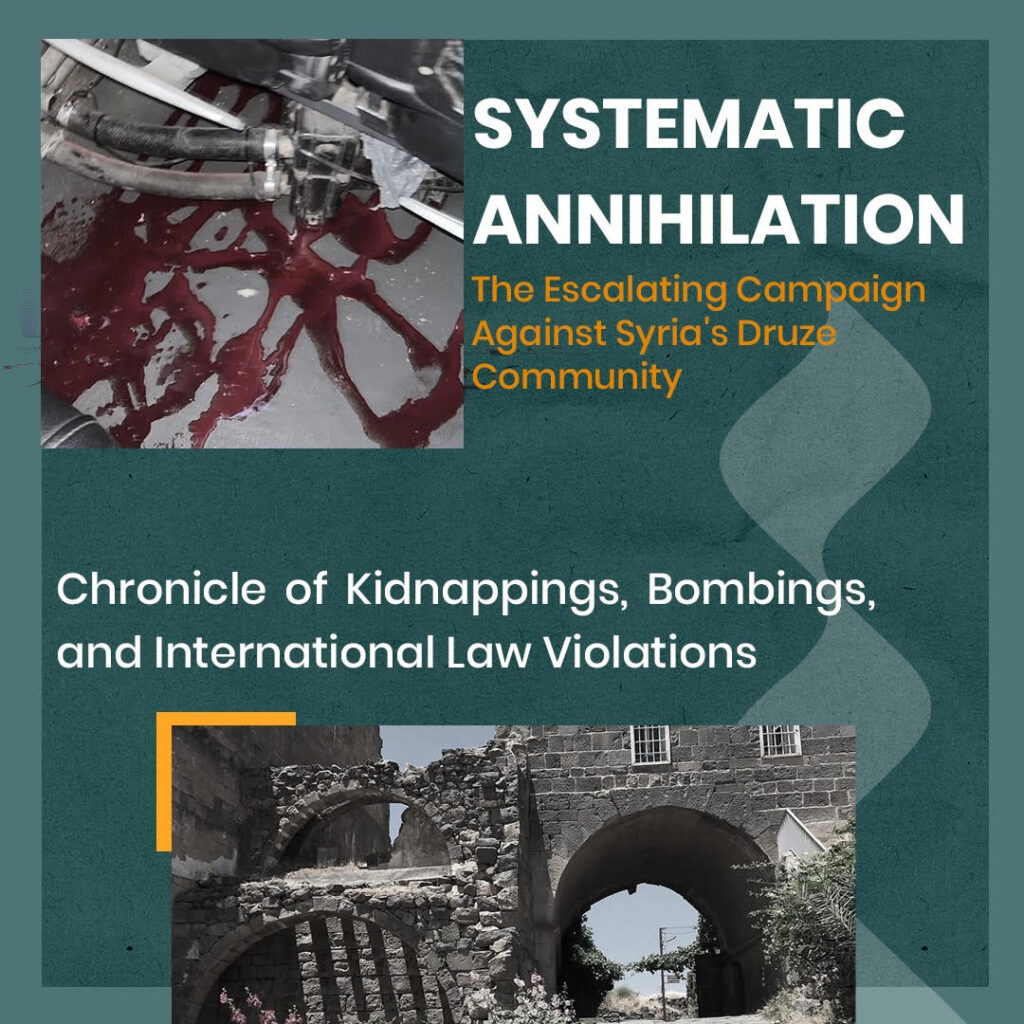
Al-Suwayda Governorate, the heartland of Syria’s Druze community, is witnessing a dangerous escalation and a systematic campaign of targeting, ranging from kidnappings and bombings to airstrikes. This alarming pattern threatens the social fabric of this indigenous community and seeks to impose new demographic realities on the ground. This report documents the most prominent of these events in recent days and their legal and international repercussions.
1. A Systematic Campaign to Break Will:
The Druze community in Syria is currently facing one of the most dangerous phases of its targeting. The events do not appear isolated but rather form part of a calculated campaign involving kidnappings, killings, and bombings, whose primary goal seems to be breaking the will of this resilient community and imposing new demographic and political equations upon it. This targeting blatantly contravenes all international norms and laws protecting civilians during conflicts.
2. Drone Strikes Rock Al-Suwayda:
In a serious military escalation, drones launched an intense bombing campaign yesterday targeting the Al-Naql checkpoint in Al-Suwayda Governorate. The raids began around three in the afternoon, and local sources recorded more than 18 airstrikes, resulting in dozens of casualties among defenseless civilians, adding a new dimension to the tactics of intimidation being employed.
3. The Civilian Bus Massacre: A Crime Against Humanity:
On October 28, 2025, a horrific crime was committed with the targeting of a civilian bus at a military checkpoint affiliated with the so-called “General Security” in the Damascus countryside. According to the testimonies of survivors and wounded who are still receiving treatment, the attack was random and deliberate, making it a war crime under international humanitarian law.
4. The Kidnapping of Dr. Hamza Shahin: A Violation of Human Values:
On the evening of October 27, 2025, a masked armed group of four individuals stormed the home of Dr. Hamza Shahin, a member of the Druze community, in the town of Deir Ali in the Damascus countryside. He was abducted from in front of his clinic, located on the ground floor of his home, amid the screams of his wife and family members, before being taken to an unknown destination. This incident is not isolated but falls within a series of kidnappings targeting prominent Druze figures.
5. International Repercussions and Calls for Protection:
These events have sparked an international wave of condemnation. Dr. Walid Phares, an international affairs expert, commented via platform X (formerly Twitter), describing the bus attack as a “jihadi massacre of Druse.” He called for “protecting Al-Suwayda Governorate with international forces and establishing a land bridge to either Israel or Jordan,” reflecting the severity of the situation and the need for effective intervention from the international community.
6. Media Manipulation: Obscuring Truth and Exonerating Criminals:
In a related context, media outlets affiliated with armed factions, represented by presenter Qutaiba Yassin on “Syria TV,” continue an organized disinformation campaign. Yassin is disseminating false narratives aimed at distorting the facts surrounding the attack on the civilian bus, seeking to exonerate those responsible for the crime through false claims, exploiting political divisions to justify grave human rights violations.
7. A Gross Violation of International Humanitarian Law:
These deliberate attacks against civilians constitute a grave breach of international humanitarian law. Targeting civilians, under the 1949 Geneva Conventions and the First Additional Protocol of 1977, is a war crime. Article 51 of Additional Protocol I clearly states that “the civilian population and individual civilians shall not be the object of attack,” and prohibits “acts or threats of violence the primary purpose of which is to spread terror among the civilian population.” Common Article 3 also affirms that all persons not taking active part in hostilities must be treated humanely.
Conclusion:
What Al-Suwayda and the Druze community are experiencing is but one chapter in the suffering of the Syrian people, yet it is a chapter distinguished by the dangerous, systematic targeting of an indigenous religious component. This situation requires a serious stance from the international community to pressure for an end to these violations, hold those responsible accountable, and compel all parties to respect international humanitarian law. The events also highlight the urgent need for professional and impartial media that conveys the truth without falsification, for in times of war, the word can sometimes be harsher than the bullet.