
Date: November 25, 2025
In a significant development with potential to transform Syria’s complex social fabric, cities and towns across central and western Syria witnessed large-scale peaceful demonstrations on November 25, 2025. Dubbed the “Peaceful Alawite Uprising,” these protests, centered in the governorates of Homs, Tartus, Lattakia, and Hama, represent a pivotal moment stemming from calls within the Alawite community itself to end the violence perpetrated by the de facto authority against religious minorities and to pursue radical political restructuring.
Sheikh Ghazal Ghazal’s Call for a Peaceful Protest Movement
The demonstrations were a direct response to a public appeal from Sheikh Ghazal Ghazal, head of the Supreme Alawite Islamic Council in Syria. He spoke out demanding an end to the ongoing violations and abuses, particularly following the barbaric attack by the Mujahideen of Bani Khalid on unarmed civilians from the Alawite , Christian and Murshidi communities. This attack is seen as an extension of the organized massacres and consecutive violations since March 2025, which have included field executions, kidnappings, forced displacement, land burning, and property theft. Most importantly, Sheikh Ghazal presented national dialogue on federalism as a political solution to the country’s intractable crisis. His demands also included the immediate release of arbitrary detainees, a grave injustice affecting many Syrian families.
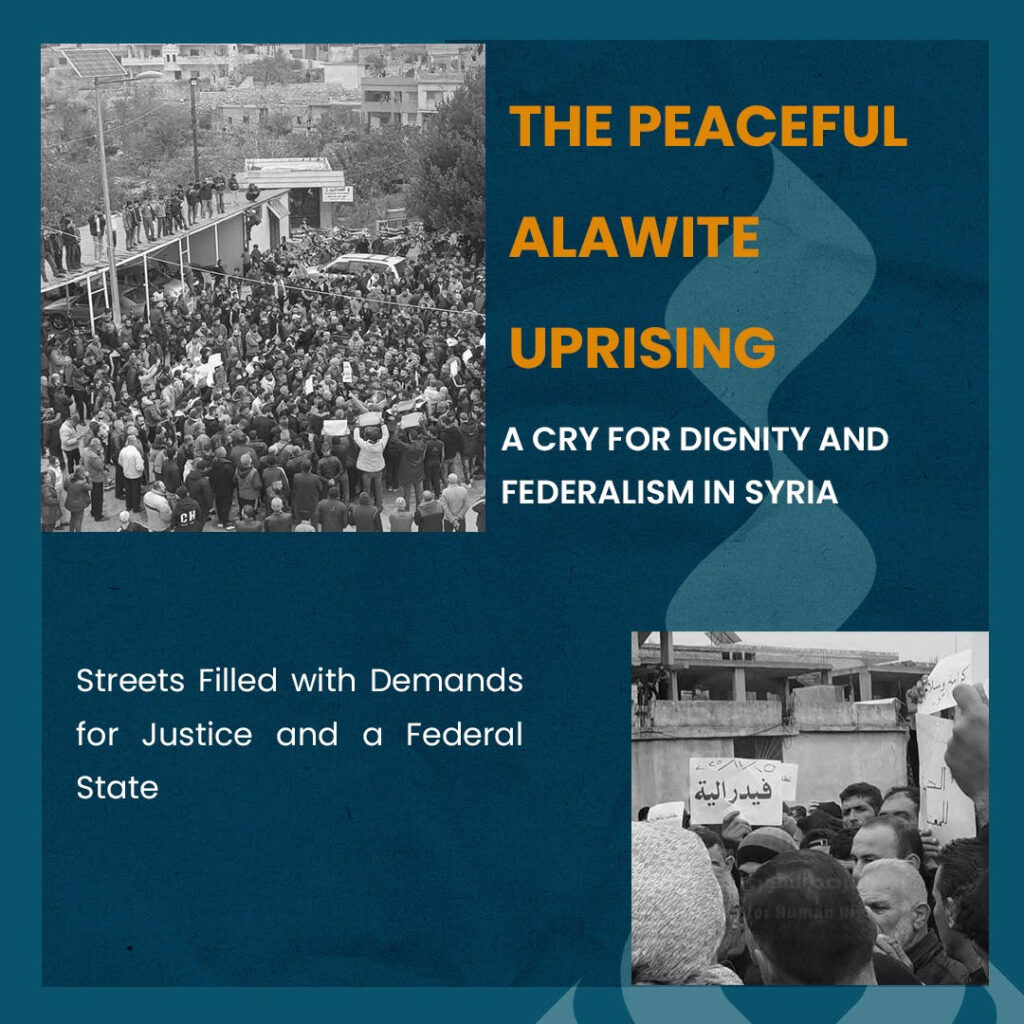
Streets Filled with Demands for Justice and a Federal State
Thousands of citizens heeded this call, taking to the streets in a remarkable display of civil disobedience. The protests were characterized by their peaceful nature and clear, targeted messaging. Protesters raised banners and chanted slogans explicitly denouncing sectarian killings and demanding an end to the policy of incitement and discrimination sponsored by the de facto authority led by “al-Golani.” A central and unifying theme was the explicit support for establishing a federal state in Syria—a system they believe can transcend the deep sectarian divisions imposed on society since “al-Golani” assumed power and guarantee justice and equality for all citizens.
Clashes and a Divided Societal Scene
However, the burgeoning protest movement did not go unchallenged. According to sources from the Syrian Observatory for Human Rights, counter-demonstrations emerged in support of the regime, often described by participants as rallies “supporting Ahmed al-Sharia.” This led to direct friction and violent clashes between the two opposing groups, resulting in a number of injuries among the protesters demanding justice and dignity. This conflict highlights the depth of internal divisions within Syrian society, even within communities traditionally seen as monolithic.
“Not a Quest for Power, But a Reaction to Marginalization”
Participants in the protests were keen to clarify the nature of their movement. In statements to observers, they insisted that their actions are not a bid for power or an attempt to restore a previous regime. Instead, they describe the uprising as a desperate reaction to years of marginalization, sectarian violations, and recent massacres that have severely impacted their communities. They emphasized that they have been among the biggest victims of the authority’s practices.
Their fundamental demand, they state, is simply to live within a federal state governed by laws—a political entity that would guarantee justice and equality and protect everyone from abuse, far from sectarian hatred and the increasing pressure on Alawites within their own regions. Thus, the “Peaceful Alawite Uprising” emerges not merely as a political statement, but as a profound plea for a future defined by citizenship, not sectarianism.