
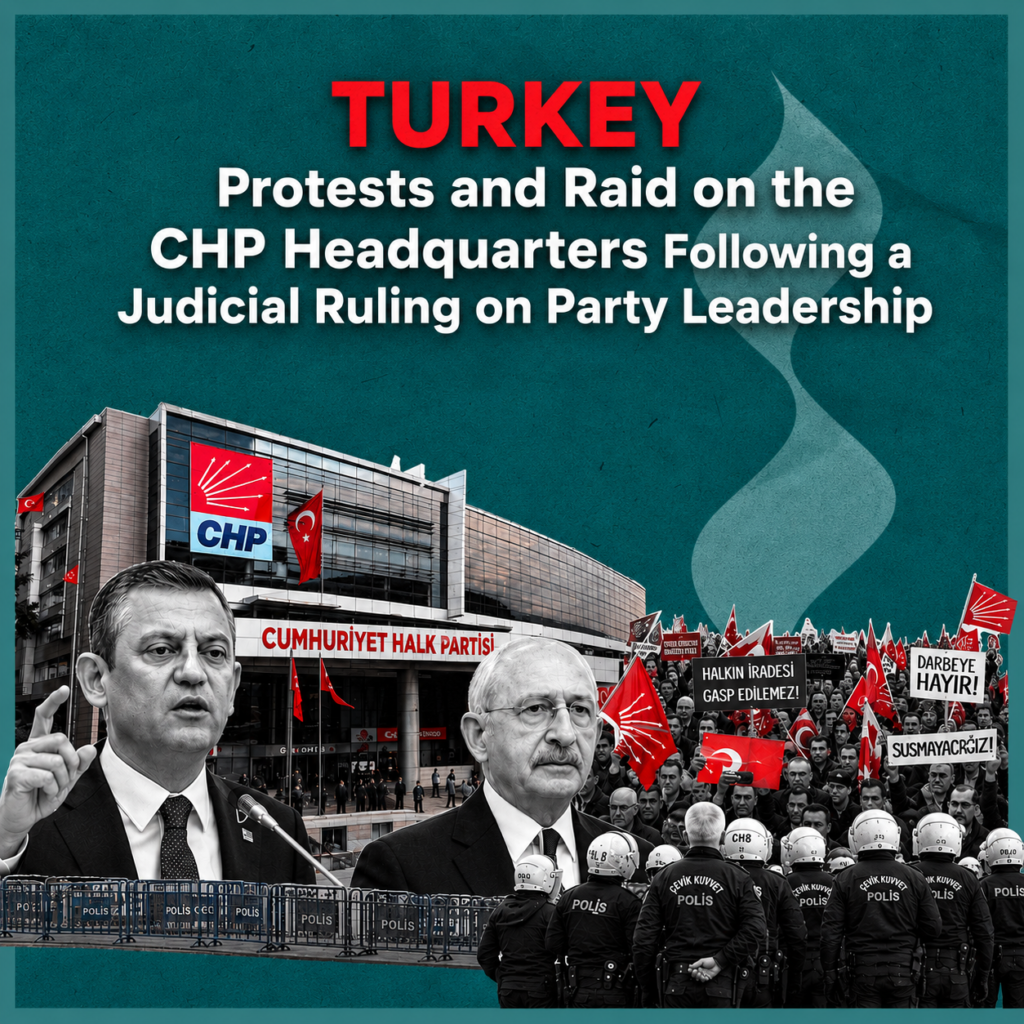
Ankara – May 24, 2026
In a dramatic development reflecting the depth of political polarization in Turkey, the capital, Ankara, witnessed a state of political and field turmoil today following a controversial judicial ruling that canceled the election of Özgür Özel as leader of the Republican People’s Party (CHP) and reinstated Kemal Kılıçdaroğlu as party chairman, a move the opposition described as a blatant “judicial coup.”
Following the announcement of the decision, the corridors and surroundings of the party headquarters turned into a scene of widespread protests, punctuated by a raid on the headquarters by Turkish security forces. This is a rare and unprecedented scene in the history of Turkish partisan activity, raising serious concerns about the erosion of democratic institutions and the use of state apparatuses to resolve internal party conflicts.
Dismantling the Turkish Interior
Observers and political activists in Turkey believe that this action is not merely an internal legal dispute, but rather a systematic strategy led by Erdoğan’s government to undermine the rising trend within the opposition, led by Özgür Özel and Ekrem İmamoğlu. They point out that the authority has moved from the stage of traditional political competition to an attempt at “control from within” by utilizing the judiciary and security services to dismantle any entity that possesses a popular base and influence on the street.
This security approach has brought back to mind a wide debate surrounding “Erdoğan’s doctrine” in managing conflicts. Today, many observers are drawing connections between what is happening within the Republican People’s Party and the approach Turkey has followed in Syria over the past years.
Projecting the “Syrian Model” onto the Turkish Reality
Over the past decade, Ankara has been accused of employing tactics based on the “management of divisions,” where it has worked to dismantle opponents’ structures from within, support factions at the expense of others, and use security services to re-engineer the areas it controls to serve its strategic interests, rather than seeking comprehensive political solutions.
Critics argue that the Turkish government, which has succeeded in creating a “conflicting mosaic” in northern Syria to ensure the continuation of its influence, is now seeking to apply the same “political engineering” within Turkey itself. Instead of confronting the opposition at the ballot box, judicial and security tools are being used to ensure the political scene remains fragmented and weak, which reminds many of Kemal Kılıçdaroğlu’s previous statements in which he accused Erdoğan of “tearing Syria apart,” warning at the time that the mentality of managing chaos as a tool of governance would one day find its way to the Turkish interior.
Concerns over the “Institutionalization” of Intervention
The raid on the headquarters of the largest opposition party in Turkey today represents a turning point whose repercussions may not be limited to the party itself. The direct interference in the internal affairs of parties through judicial rulings places the Turkish political system before the challenge of the “legitimacy of institutions.”
While the voices of the opposition calling for an end to the “judicial coup” are escalating, the current scene raises questions about the ability of the Turkish opposition to withstand the “dismantling of opponents” strategy, which appears to have moved from military and regional operational theaters to the depths of the state and its institutions, signaling a new phase of political instability in the country.