
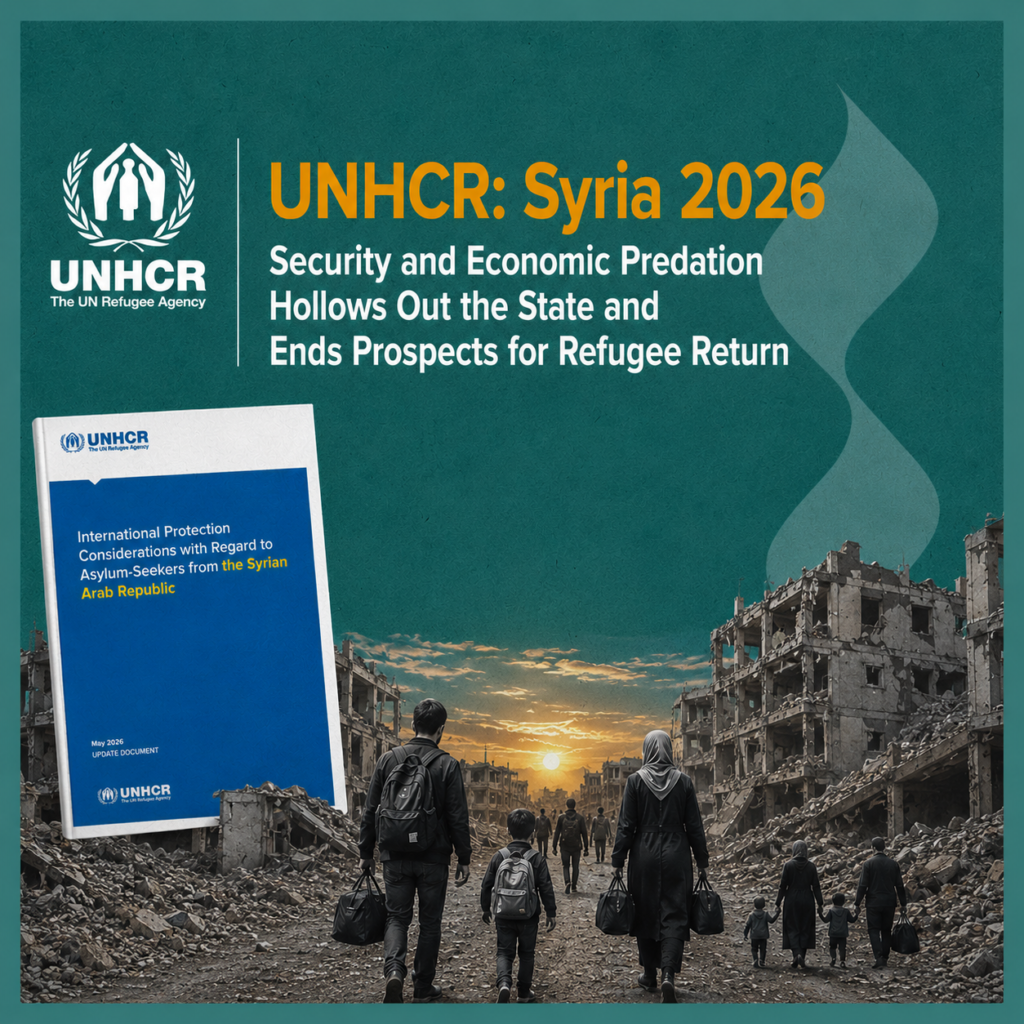
In May 2026, the Office of the United Nations High Commissioner for Refugees (UNHCR) released its updated document titled “International Protection Considerations with regard to People Fleeing the Syrian Arab Republic.” This report provides a rigorous legal assessment of the security and human rights situation in Syria, confirming that the current conditions do not permit any safe or sustainable return. It emphasizes that international obligations strictly prohibit any forced return of Syrian asylum seekers under the current circumstances.
1. Structural Collapse: The Erosion of Institutions and the Absence of “Legal Certainty”
The UNHCR report documents the absence of “legal certainty” in Syria, noting that administrative procedures—particularly in the land registry and public services—operate in an environment lacking transparency and characterized by the interference of security apparatuses in civil decisions. The report concludes that the absence of “due process” and the discrimination in service delivery based on non-professional criteria render the state a system that lacks institutionalization. The exclusion of professional cadres and reliance on non-administrative criteria for employment and service delivery have led to functional paralysis within state institutions. This deprives citizens of their most basic rights, exposes them to the risks of legal and administrative loss, and renders return a risk that extends beyond mere “security threats” to include the total loss of legal protection.
2. Invalidity of the “Internal Flight Alternative” (IFA) in Syria
The UNHCR confirms in its report that no area within Syria can be considered a safe haven for civilians. This legal conclusion is based on:
- State Inability to Provide Protection: The report documents that violations are not isolated incidents but occur with the direct or indirect responsibility of security apparatuses, militias, and controlling factions, stripping any geographic area of the “safe” status.
- Collapse of Sustainability Standards: The report notes that the humanitarian crisis affects 16.5 million Syrians (two-thirds of the population), with 90% living below the poverty line. This reality, combined with the widespread destruction of infrastructure, makes the stabilization of returnees inside the country an impossibility, rendering the “reasonableness test” for return non-existent.
- Security Instability in Governorates: The report documents a systematic failure of the State to maintain order. In As-Suwayda, the State deliberately creates an environment of insecurity through intentional neglect or direct provocation, leaving the governorate vulnerable to violations by both local groups and security apparatuses that collude to undermine citizens’ safety for political extortion. In the coastal region, residents—particularly women—suffer from systematic exploitation and extortion by security forces and local militia elements, which restricts their mobility and confirms that the absence of security has become a general policy that excludes no one. In the context of escalating identity-based killings and violations against women, the State has become a source of threat rather than protection. Faced with this collapse, both the Druze and Alawite communities find themselves confronting existential choices; the report warns that: “If their grievances remain unaddressed, they may turn toward self-defense groups, foreign support, or increased calls for autonomous governance.”
3. Systematic Violations Against Vulnerable Groups
The report allocates a dedicated section to systematic human rights violations targeting specific groups:
- Targeting Individuals of Diverse SOGIESC: The report confirms that this group faces “systematic hunting” via dating applications, with legal provisions (such as Article 520) used as a pretext for arbitrary arrests, amid a total lack of judicial protection.
- Violence Against Women: The report links gender-based violence to legal provisions (Articles 192 and 242 of the Penal Code) that allow for mitigated sentences in “honor” crimes, entrenching impunity and turning domestic violence into a normalized social policy.
- Religious Converts: The report highlights the legal vacuum that leaves individuals who change their religious beliefs at the mercy of “tribal customs and traditions,” exposing them to ostracization or extrajudicial killing without any judicial intervention to protect them.
4. Security and Human Rights Situation in Afrin
The report asserts that the Afrin region serves as a vivid example of the absence of legal security, documenting the oppressive practices of armed factions, which include:
- Pillage of Property: Continued forced control over agricultural lands (olive groves), depriving owners of their harvest.
- Real Estate Seizure: The appropriation of homes and properties through armed force.
- Arbitrary Detention: The exploitation of military influence to conduct detention campaigns, with the report confirming the failure of “controlling authorities” to address these violations or provide any mechanism for restitution, making it an entirely exclusionary environment.
5. Legal Obligation to the Principle of “Non-Refoulement”
The report reaffirms that international obligations are “peremptory norms” (jus cogens) that include:
- Non-refoulement: An absolute obligation that covers all asylum seekers, even those whose claims have not yet been processed.
- Separation of Responsibilities: The UNHCR clarifies that any limited technical assistance it provides for voluntary returns does not constitute an assessment that Syria is a “safe country,” and it does not exempt states from their legal protection obligations.
- Right to Family Reunification: The UNHCR demands maximum flexibility in family reunification procedures, urging states to overcome bureaucratic obstacles caused by the impossibility of obtaining official documents from within Syria.
6. Assessment of International Protection Needs (Risk Profiles)
The UNHCR considers that asylum seekers who fall into the following “risk profiles” are in urgent need of international protection under the 1951 Refugee Convention, given their exposure to systematic persecution or the total lack of protection by the controlling forces:
- Minorities: Individuals belonging to religious or ethnic minorities.
- Actual or Perceived Opponents: Individuals perceived as opposing the de facto authorities in their respective areas of control, or those suspected of opposing the armed actors and extremist groups active on the ground.
- Individuals Associated with the Former Authorities: Those perceived as being linked to the former government or its institutions.
- Vulnerable Groups: Women, girls, and children who face heightened risks of exploitation.
- Individuals with Diverse SOGIESC: Individuals with diverse sexual orientations and gender identities (SOGIESC) who face direct and systematic threats to their lives and liberty.
7. Rejection of “Mass Returns” and UNHCR Recommendations
The UNHCR warns against the dangers of being drawn into calls for “mass returns,” emphasizing that:
- Such calls are irresponsible and could exacerbate humanitarian crises and trigger new conflicts in regions already suffering from the effects of war.
- The international community must expand resettlement opportunities and open complementary legal pathways.
- The situation in Syria remains “volatile and uncertain,” mandating continuous monitoring and assessment of protection needs.
The 2026 UNHCR report stands as a formal indictment of the Syrian reality. It reveals a failed state that is not merely complicit in oppressing its citizens but has become an exclusionary system due to its institutions’ failure to provide security, justice, or services. The authorities’ continued cover-up of factional violations in Afrin, their turning a blind eye to abuses by their own elements in the Coastal region, their orchestrated insecurity in As-Suwayda, and their collusion in systemic violence against women all confirm that Syria is not merely a country at war, but an environment fundamentally hostile to human dignity. Any talk of “return” in light of this dilapidated reality is a willful disregard for an ongoing tragedy and an attempt to whitewash a regime that experience has proven lacks both the will and the capacity to serve as a guarantor of safety for any Syrian citizen.