
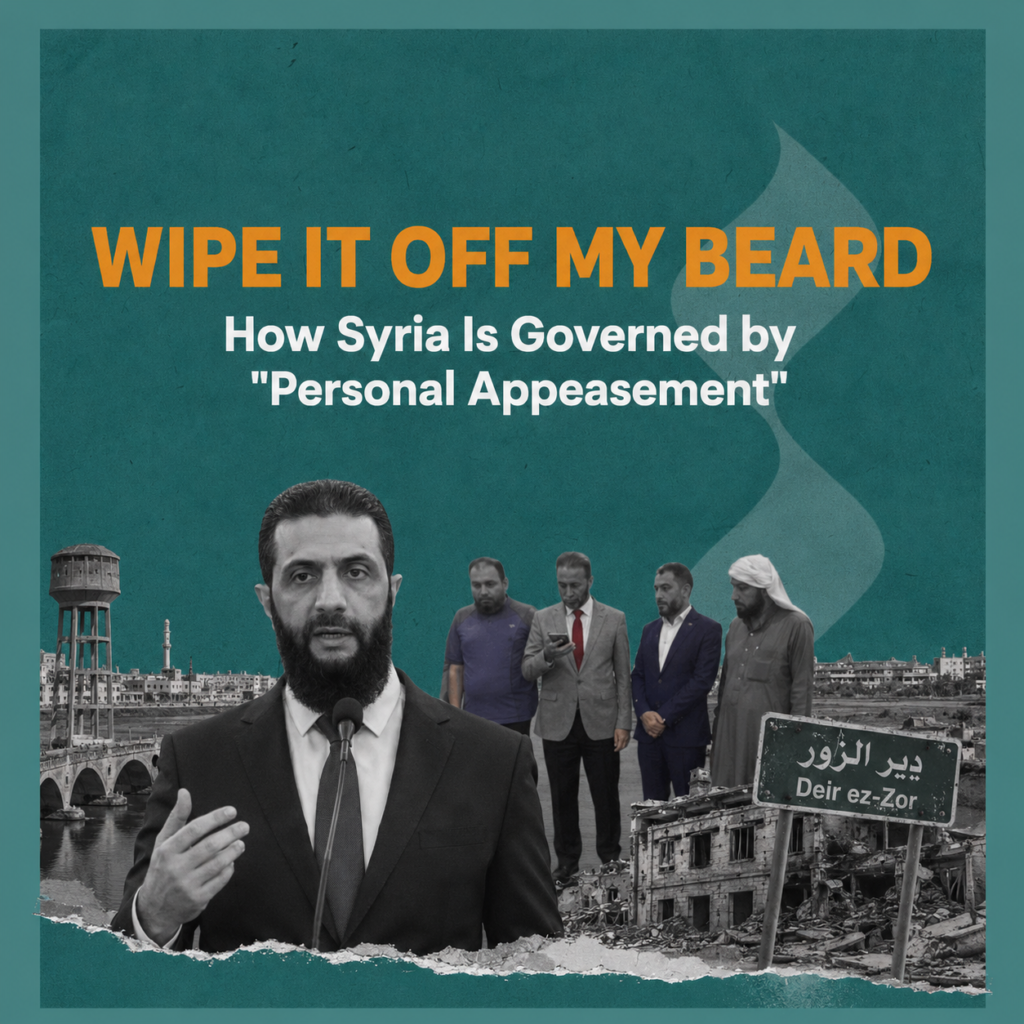
The statements made by Hussein al-Sharaa, father of “Abu Mohammad al-Jolani,” were not a mere slip of the tongue, but rather a reflection of an elitist mentality that views Syrians as nothing more than “subjects” in a private fiefdom. His description of the people of Deir ez-Zor as “savages” is merely a manifestation of the class-based contempt this authority holds toward Syrian society, in a practice that reveals the core of its exclusionary agenda.
The State of “Beards,” Not the State of Law
In light of the popular protests, “al-Jolani” emerged to apologize with a sarcastic phrase: “Wipe it off my beard.” This expression represents an official declaration of the burial of the concept of a “state of law and institutions” in its infancy; instead of resorting to the judiciary for accountability, the dignity of Syrian components is perpetually auctioned off in a “marketplace of personal appeasement.” This authority does not grasp the meaning of sovereignty or citizenship; rather, it treats protests as “unrest” to be pacified by the “leader’s” promises, not by rights protected by a constitution. This apology was intended as a lifeline to absorb the anger of Deir ez-Zor, out of fear that the scope of popular rejection—which has become increasingly intolerant of authoritarianism—would widen.
The Duality of Blood
The contradiction within the “de facto authority” exposes the fragility of its claims; it practices a policy of “selectivity” in dealing with the rights and dignity of citizens. While “al-Jolani” rushes to offer his apology “on his beard” to the people of Deir ez-Zor to contain popular anger, he remains silent and a mere spectator to the continuous violations that tear at the body of As-Suwayda and the coast. This deliberate turning of a blind eye is not helplessness; it is the entrenchment of a method that divides Syrians, as if the blood of the people in those regions is expendable and holds no value, or as if they are not part of the social fabric that the authority claims to represent. At the same time the regime rushes to absorb tension in one region through appeasement, it turns a blind eye to systematic violations in other areas, confirming that the authority sees these violations only as a means to impose control and entrench regional discrimination.
We are facing an entity that manages its affairs with the logic of “tribal appeasement,” signaling the absence of any hope for the establishment of institutions that protect everyone. The mentality that holds people’s dignity hostage to personal promises, and believes that anger is extinguished by “provisions,” reflects an authoritarian ideology that rejects the principle of citizenship. The mask of “institutions” behind which “al-Jolani” hides has fallen; a state managed by “promises” rather than the judiciary can only be an authority built on the violation of dignity. Today, Syrians realize that rights confiscated by “barbarism” and reclaimed by “beards” are deficient rights, and that a homeland where justice is absent cannot be built by “maneuvers,” but rather must be reclaimed through the institutions that this authority has deliberately sidelined to keep the decision held hostage to its grip.