
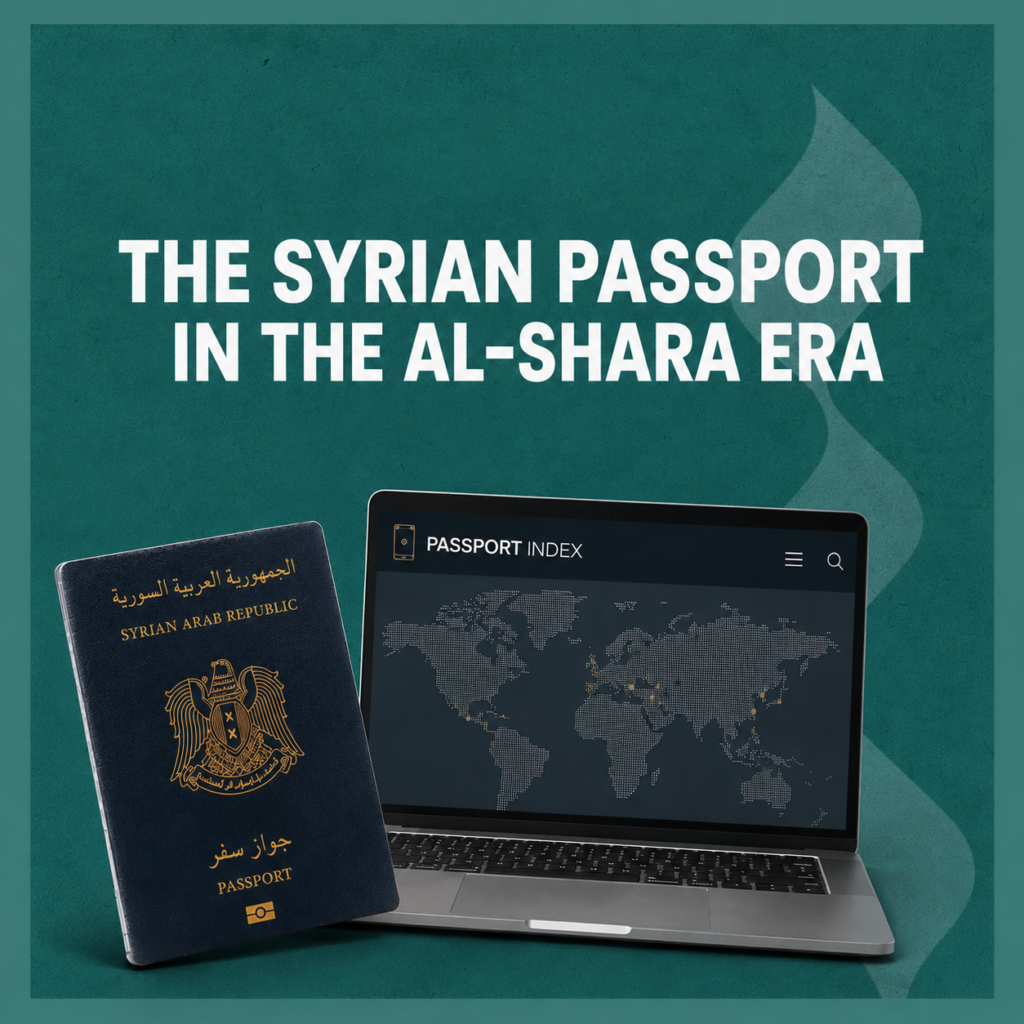
The Syrian passport continues to languish at the bottom of the “Passport Index 2026,” remaining among the weakest globally. It stays trapped in the same category as countries suffering from structural and security upheavals, such as Afghanistan, Iraq, and Yemen. This ranking refutes the promises made by Ahmad al-Shara (al-Jolani) upon assuming power, when he pledged that the Syrian passport would gain international “weight and influence,” restoring dignity to citizens in their travels.
Misleading Official Rhetoric
Nearly 17 months after taking power, the Syrian travel document remains unable to open doors for its holders. The index, which assesses the number of destinations accessible visa-free and the strength of diplomatic agreements, clearly shows that the current authority has failed to make any significant breakthrough in the wall of international isolation.
The promises promoted by the authority regarding “restoring prestige” have remained confined to populist rhetoric, while Syrians in reality face complex security procedures and continuous rejection from most countries worldwide. This failure to improve the passport’s ranking is not merely a technical issue; it is a direct result of the current authority’s policies, which have failed to build the minimum level of international trust.
The Impact of Repressive Policies on National Document Status
A passport ranking is not just a set of numbers; it is a reflection of a state’s record. Systematic violations, documented massacres, and the security-first approach that continues to dominate the joints of the state in the “Al-Shara era” have categorized Syrians in the eyes of the international community as a “high-risk” group.
Instead of establishing the rule of law, repressive practices have continued, stripping the state of its institutional integrity. This has negatively impacted the strength of the Syrian passport. Countries do not grant travel facilitation to regimes that do not respect the rights of their citizens or lack institutional stability; instead, they impose strict security restrictions that exacerbate the suffering of Syrian citizens seeking an exit from their reality.
Disappointment in the “Era of Promises”
The reality of 2026 is that the “prestige” promised by Ahmad al-Shara was nothing more than a tool for political deception. While citizens were waiting for travel facilitation and greater freedom of movement, they found themselves trapped by security policies that kept the Syrian passport at the bottom of global rankings.
Today, the Syrian citizen faces twofold disappointment: disappointment from an internal reality that lacks security, and disappointment from an international isolation that denies them their most basic human rights. The continued decline of the Syrian passport’s ranking is a clear international acknowledgement that the current authority—despite changing its names and rhetoric—has failed to present a model of a “respectable” state that opens doors for its citizens, instead cementing a reality that has made the Syrian passport a document of isolation rather than a document of passage.