
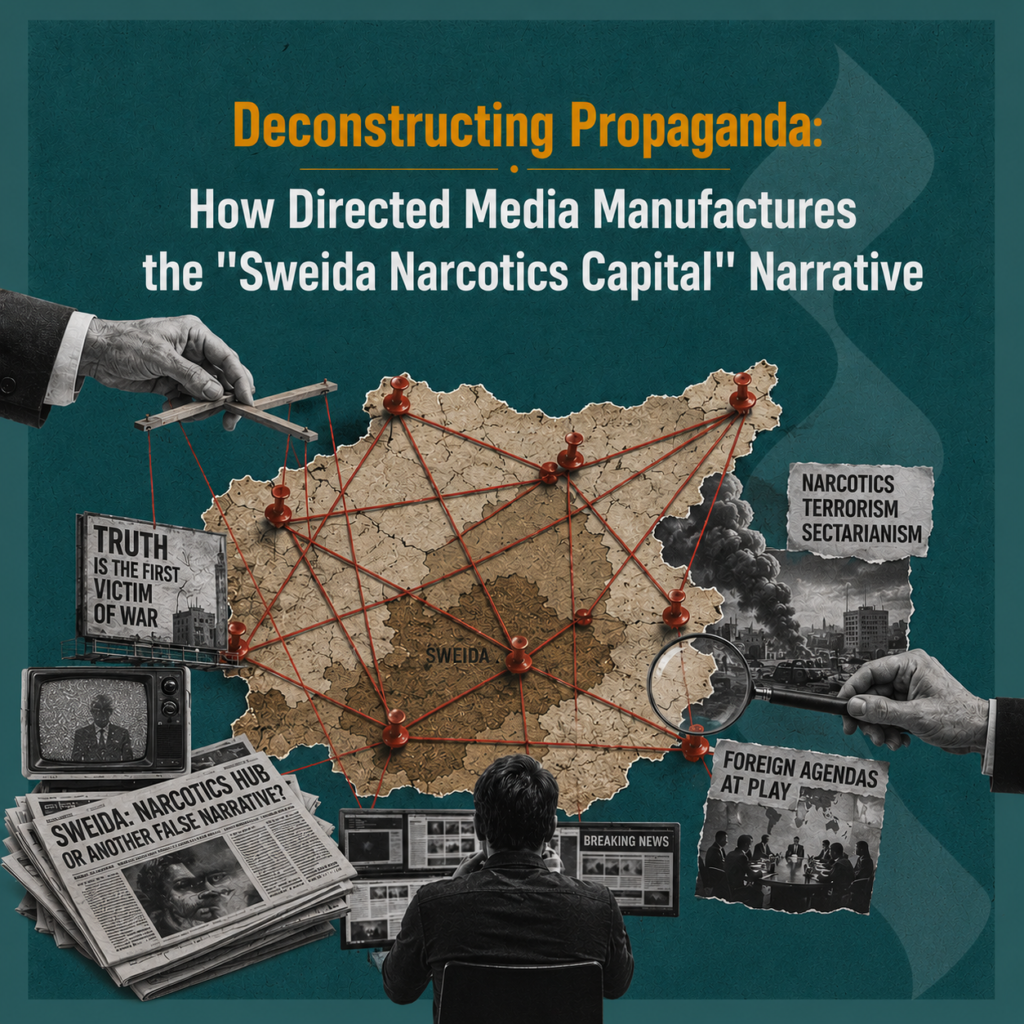
A recent article published in New Lines Magazine by Charles Lister, titled “How Israel-Backed Sweida Became Syria’s Narcotics Capital,” has raised significant concerns regarding its timing, accuracy, and geopolitical motives. While framed as an independent investigation, a closer look at the ground realities in southern Syria—and the networks behind the dissemination of this report—reveals a calculated effort to distort reality and serve specific political agendas.
The Claims: What the Report Alleges
Lister’s report claims that the Sweida governorate has transformed into a primary hub for the manufacturing, trading, and smuggling of Captagon. It alleges that these operations have surged by over 325% since mid-2025, utilizing advanced smuggling methods such as drones and balloons to cross into Jordan. Most provocatively, the piece attempts to link local factions and social figures in Sweida to alleged external backing from Israel, while accusing local spiritual leadership of failing to manage the region, thereby creating a vacuum of chaos.
The Reality: Refuting the Claims
1. A Besieged Province with Zero Infrastructure The claim that Sweida acts as a manufacturing “capital” for narcotics flies in the face of basic logistics. Sweida is an economically, geographically, and logistically besieged province. It completely lacks the industrial infrastructure, chemical laboratories, and raw materials required to produce Captagon on a mass scale. Furthermore, every major entry and exit point connecting Sweida to the rest of Syria is heavily monitored and controlled by de facto authorities and central security apparatuses. In such a restricted environment, establishing local, independent narcotic supply chains is a physical impossibility.
2. The True Geography of Smuggling: Tribal Networks The ultimate truth deliberately omitted from Lister’s report is that the drug trade in southern Syria is inherently trans-border and managed by specific tribal clans. These smuggling routes span the vast, open, and rugged geography of the Syrian Badia (desert) directly into Jordan. Traffickers exploit these remote desert terrains precisely because they bypass urban centers. Blaming the besieged local population or the localized factions of Sweida is a geographical and tactical fabrication designed to deflect attention from the actual cross-border networks operating in the open desert.
Behind the Scenes: The Media Recycling Machine
To understand why such a narrative is being pushed now, one must look at the mechanics of its production. This report is a prime example of “media recycling” funded and directed by specific regional agendas, notably Qatar.
The mechanism operates through a well-documented cycle:
-
Co-opting Voices: Writers, researchers, and media figures with well-known histories of affiliation with the Muslim Brotherhood axis and Turkish-backed factions (particularly between 2013 and 2016) are integrated into Western-facing think tanks and publications.
-
Dictated Narratives: These figures are tasked with drafting reports disguised as “independent Western research,” injecting specific buzzwords—such as “Israel-backed”—to instantly sensationalize the story.
-
The Single-Headed Echo Chamber: Once published, a unified media apparatus managed by a single administrative head immediately seizes the article. It is heavily amplified, translated, and broadcasted across mainstream and social media platforms as if it were an objective, groundbreaking revelation.
The Ultimate Goal
The weaponization of the narcotics issue in this report has very little to do with drug enforcement. Instead, it is a textbook case of political demonization. By fabricating an astronomical “325% increase” and inventing ties to Israel, the narrative aims to strip Sweida of its local legitimacy. The ultimate goal is to lay the public relations groundwork to justify future military or security campaigns against the province, framing any aggressive measures not as political suppression, but as a righteous crusade against “terror and drug trafficking.”
Visual Documentation: Political Engagement and Diplomatic Networking

Visual Documentation: Professional Background and Institutional Affiliations
.jpg)
Visual Documentation: Critical Commentary on Narrative Impartiality
.jpg)