
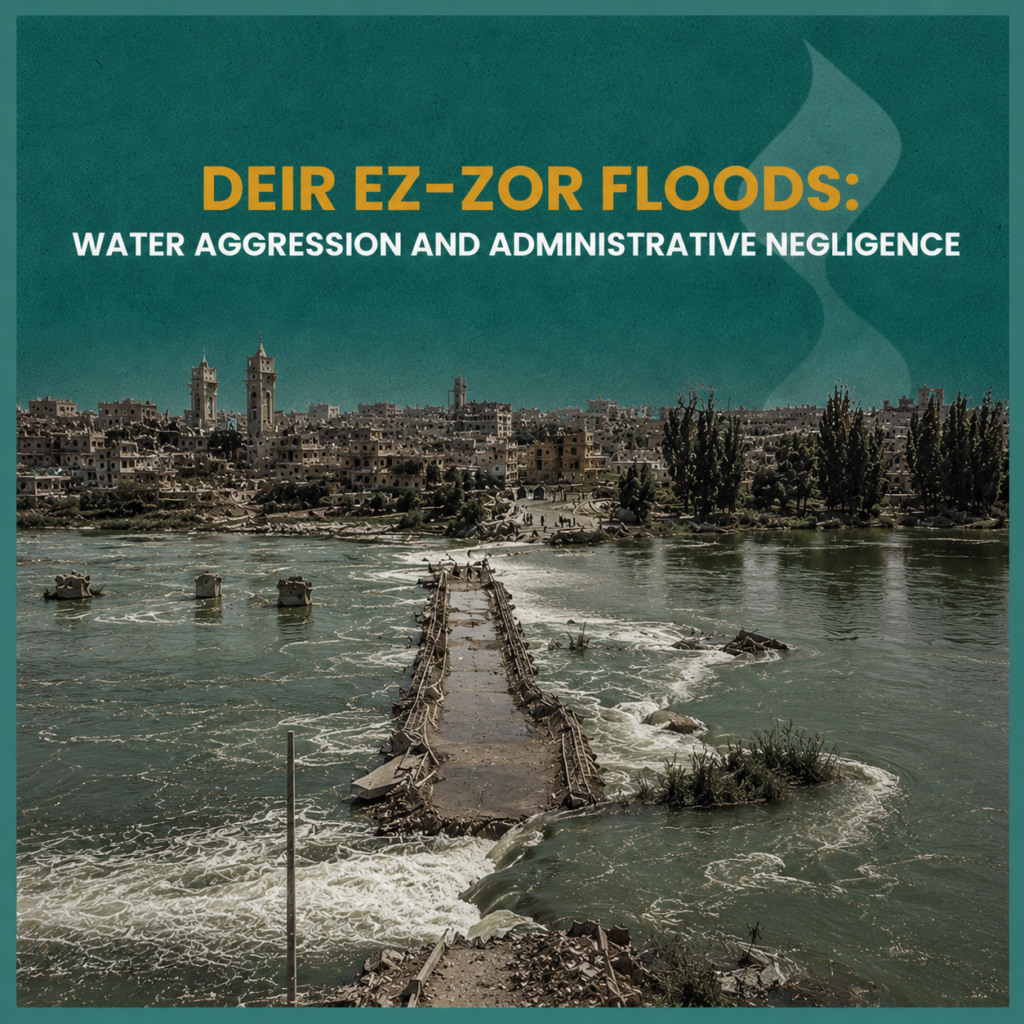
Since May 26, 2026, the countryside of Raqqa and Deir ez-Zor has been subjected to severe flooding caused by the rise in Euphrates River water levels. This crisis highlights a convergence of external factors—specifically Turkish water management policies—and a profound institutional failure by Syrian authorities to manage the crisis, turning the water surge into a humanitarian disaster that has resulted in casualties and extensive material damage.
Casualties and Field Damage
The flood has caused a humanitarian tragedy, with four children drowning in the village of “Al-Saghir” in the Deir ez-Zor countryside as water inundated residential areas. Regarding infrastructure, the collapse of three earthen bridges and a pontoon bridge has severed connectivity within the governorate, isolating both banks of the river. Furthermore, over 50 water stations have been taken out of service, including four primary stations, threatening a severe drinking water crisis. The flood also destroyed vast areas of wheat crops, with harvesting becoming impossible due to the authorities’ failure to provide logistical support or secure access for agricultural machinery.
Legal Responsibility of the Turkish Side
The Turkish action of opening the spillway gates of the Atatürk Dam without considering safety standards for populations downstream constitutes a clear violation of international norms governing transboundary rivers. Managing water flows without precise coordination that protects lives places Ankara under direct legal and moral responsibility for all human and material damages incurred in Syrian villages—a practice that ignores the most basic standards of the right to life and water security.
Systematic Negligence by Syrian Authorities
This administrative negligence is a direct reflection of the absence of functional state institutions. In this regard, journalist Youssef Al-Sharif clarifies that blaming Turkey alone for the situation is unjust; Ankara has been opening dam spillways for decades in accordance with established formal notification protocols. The core dilemma, however, lies in the fact that there is no qualified counterparty on the Syrian side to receive these alerts or address their implications. Al-Sharif sarcastically observes the reality of this management, noting: ‘If the official in charge of Syrian government ministries is a “Sheikh” or an “Imam” who lacks the most rudimentary understanding of life sciences, how can they possibly be expected to manage such a crisis?’ This systematic replacement of technical experts and qualified personnel with figures defined by religious and sectarian loyalties has effectively hollowed out the state’s administrative capacity, rendering a professional response to the disaster an impossibility. The manifestations of this total institutional collapse are evident in the absence of evacuation plans, the lack of shelters, and the authorities’ abandonment of their duties, forcing residents to face the flood through individual efforts alone—a scenario that underscores the failure of the ‘New Syria’ to uphold its most basic institutional responsibilities.
Lack of Administrative Preparedness
Treating the Euphrates flood as an unexpected emergency reveals the deep-seated infrastructure crisis in Deir ez-Zor. The absence of rapid response teams and the lack of projects to reinforce embankments and bridges confirm that the relevant authorities did not include these seasonal risks in their strategic planning, merely watching the disaster expand without taking any precautionary measures to protect the lives and property of citizens.
What is currently happening in the Euphrates basin reflects a comprehensive collapse in resource and crisis management. This disaster is not a predetermined fate; rather, it is the direct result of external policies that attach no value to the lives of Syrians and a local administration that has abandoned its fundamental duty to protect its citizens. The recurring nature of these repercussions and the worsening damage, coupled with the absence of radical solutions and preventive mechanisms, place the governorate under constant existential threats. This necessitates a comprehensive review of mechanisms for dealing with transboundary rivers and an urgent shift in the local administration’s approach to emergency response before the scope of the collapse expands further.