
A year and a half after the political and military shifts in Syria, Ahmed al-Sharaa (widely known as Abu Mohammad al-Jolani) is attempting to market himself internationally as a statesman, replacing his military fatigues with tuxedo suits and luxury watches. However, security reports and field observations confirm that this diplomatic facade has failed to erase his history tied to Al-Qaeda, nor has it hidden the dismal failure of Hay’at Tahrir al-Sham (HTS) in managing state institutions and providing a minimum level of stability.
A Continuous Extremist Identity
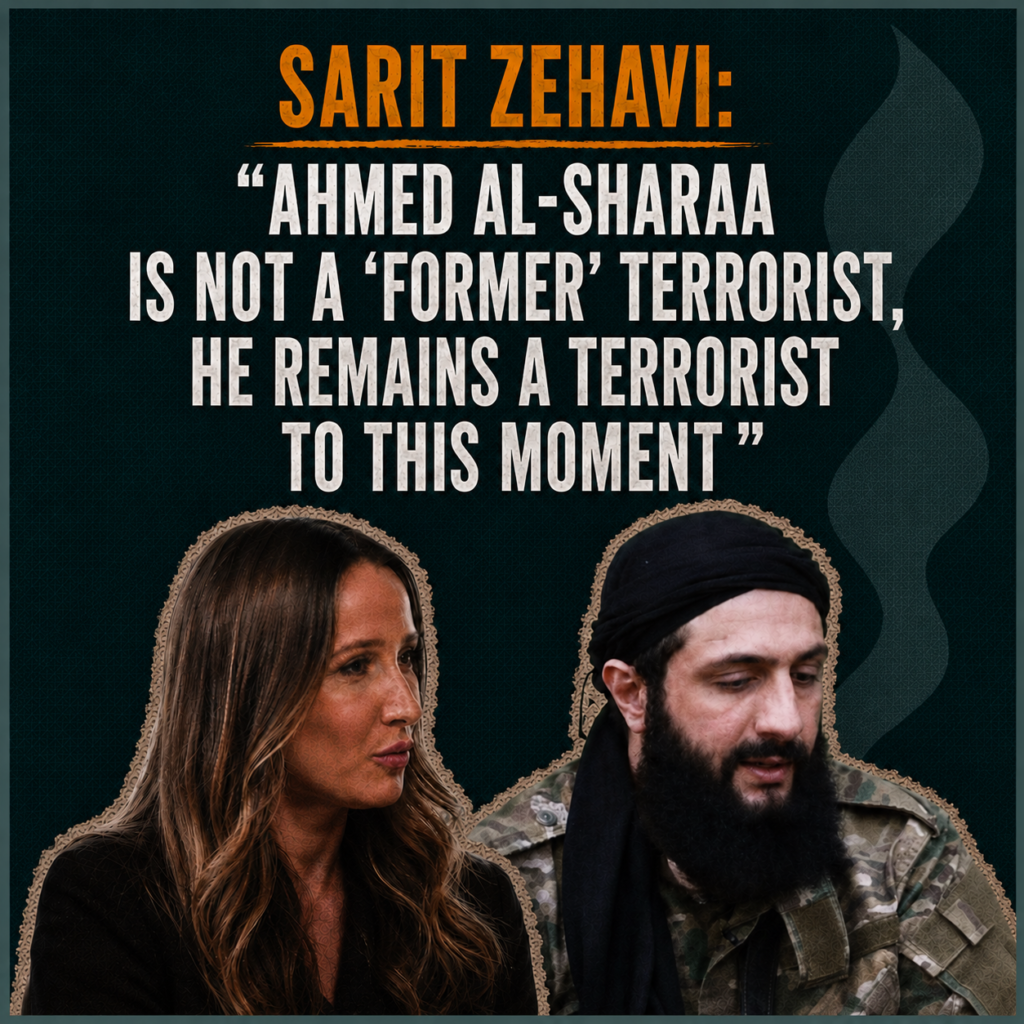
In the context of the international assessment of Sharaa’s status, Sarit Zehavi, founder and president of the Alma Research and Education Center, asserts that Ahmed al-Sharaa is not a “former” terrorist, but rather remains steadfast in his extremist approach to this moment. During her remarks to the ILTV network on the sidelines of the Israeli-American Council (IAC) conference, Zehavi warned against the Western tendency to ignore Jolani’s past, considering it a strategic error when compared to previous international counter-terrorism efforts in Iraq and Afghanistan.
These warnings are backed by numerical data; Alma Center reports indicate that HTS is responsible for more than 600 terrorist attacks. Even more alarming is the ideological expansion of the group in the education sector, having established 35 new primary schools in the past year alone. This brings the total to 70 schools dedicated to teaching children Al-Qaeda’s ideology, threatening the upbringing of a new generation carrying extremist ideas under an institutional cover.
Security Breaches
On the ground, these warnings align with the deteriorating reality in Damascus. Hugo Micheron, a French expert on jihadist groups who recently accompanied the official delegation of French President Emmanuel Macron to the Syrian capital, conveyed a picture in an article published by the French magazine Le Point documenting the absence of basic stability and state presence.
The signs of this absence began at Damascus Airport, where the protocol official was a former HTS fighter. It extended to the capital’s streets, plunged in total darkness due to power and service outages, affecting even sovereign locations and the luxury Four Seasons Hotel. The security failure manifested clearly and shockingly; despite the state being on maximum alert and readiness to host a foreign head of state, explosive devices detonated just meters away from the French President’s residence at the hotel. This severe security breach, which resulted in 18 injuries and was attributed to a group called “Fighters of 11,” shatters any claims of control and proves the incompetence of the government’s security apparatus even at its highest levels of alert.
Managing the State with a Factional Mentality
Inside the corridors of the presidential palace, Sharaa appears isolated and lacks trust in those around him. Micheron points out that the HTS leader relies exclusively on a tight circle of loyalists from Idlib, who still address him by his religious title, “The Sheikh.”
This isolation and security paranoia have directly reflected on the daily administration, and even on the details of official visits. The traditional, professional hospitality personnel in the palace were replaced by trusted elements from Sharaa’s followers to ensure his personal safety. This resulted in the serving of an official state dinner described as poor, with service lacking basic diplomatic standards.
Current data suggests that Ahmed al-Sharaa’s attempts to don the cloak of politics are merely cosmetic changes. The government in Damascus suffers from suffocating isolation, relies on an incredibly narrow support base, and manages the country with a security and militia-driven mentality. With the continuous spread of schools with extremist curricula and the severe deterioration in services and security, the course of events proves that extremist ideology cannot be masked by diplomatic appearances. It also demonstrates that the priority in Syria today no longer revolves around democratic transitions, but centers directly on the immediate failure to provide basic security and stability for a country ruled by a leadership that has not yet shed its Al-Qaeda cloak.