
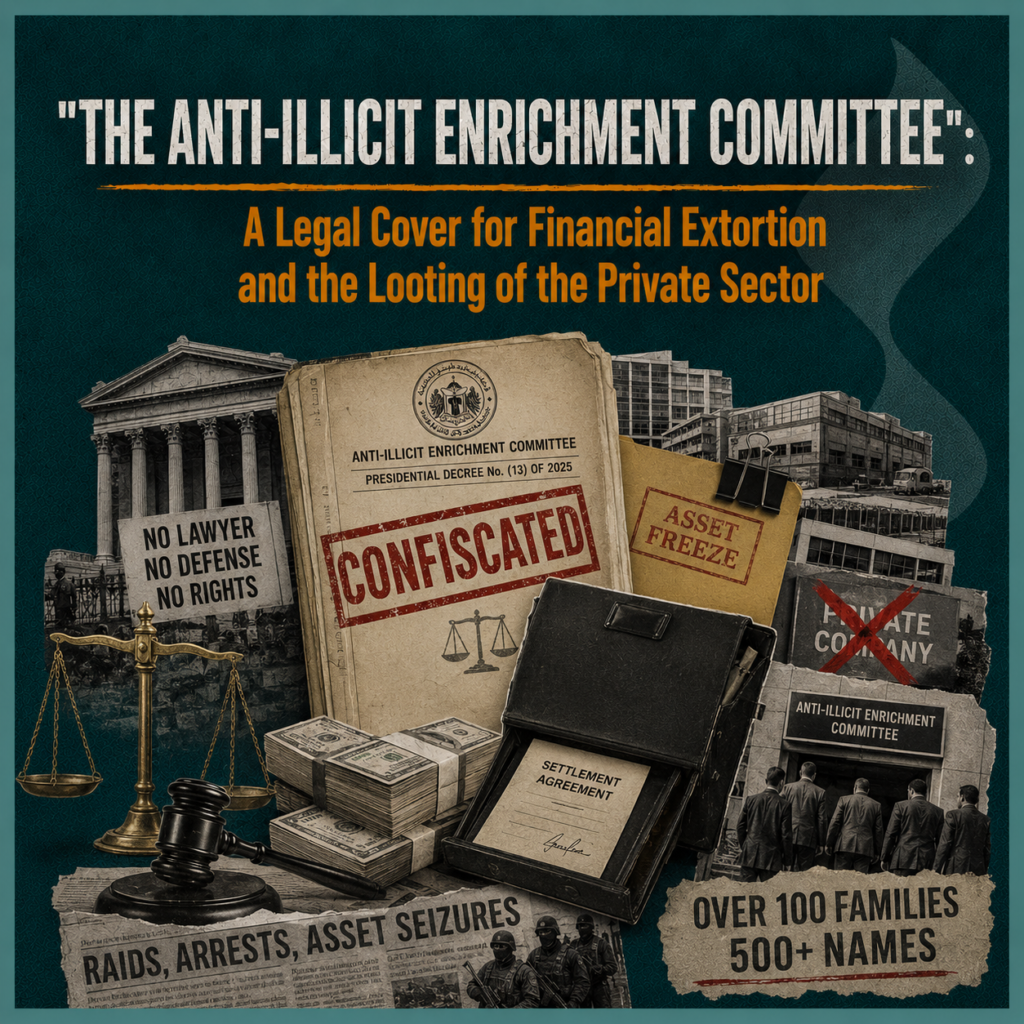
Under Presidential Decree No. (13) of 2025, the establishment of the so-called “Anti-Illicit Enrichment Committee” was announced in Syria as an independent national body enjoying legal personality and financial and administrative independence. Despite the resounding slogans that accompanied its establishment regarding the protection of public funds, the recovery of suspicious funds, and the promotion of integrity and transparency, the true intentions of this committee soon became clear, turning into a tool to legitimize financial extortion and practice systematic intimidation against families and capital owners under the cover of the law.
Raids, Enforced Disappearance, and Arbitrary Detention The committee’s procedures were not limited to financial and administrative audits but turned into what resembles security operations. Teams affiliated with the committee, accompanied by personnel from the Syrian Ministries of Interior and Finance and representatives of the “Syrian Sovereign Wealth Fund,” carried out extensive raids on the headquarters of private institutions and companies to investigate the existence of violations.
These raids resulted in the arrest of a number of the owners of these institutions without specific charges or clear reasons being announced, with their places of detention left undisclosed. Circulated documents online have shown the confiscation of properties and the detention of individuals belonging to more than 100 Syrian families (the lists include more than 500 names), accompanied by travel bans and the complete freezing of assets.
Complete Isolation and Deprivation of the Most Basic Legal Rights In a flagrant violation of the right to defense, the detainees were deprived of appointing lawyers to represent them in administrative and civil cases. The local website “Enab Baladi” quoted legal experts affirming that depriving a person whose funds are seized of appointing a lawyer is a violation of an inherent right, especially since the seizure of funds fundamentally differs from the restriction of freedom in managing daily and legal life affairs.
The committee did not stop there; it issued warnings to the families of the detainees to prevent them from appointing lawyers or making statements to the media regarding the detention of their relatives or the freezing of their properties, aiming to impose a complete blackout on these procedures.
“Financial Settlements”.. Extortion Under a Legal Cover The committee’s actions raise serious concerns about attempts at institutional financial extortion, as data indicates that the goal of this campaign is to acquire market shares. Remarkably, the confiscated institutions—which included pharmaceutical factories, vital distribution centers, and a group of economic and educational facilities in the governorates of Damascus, Aleppo, Rural Damascus, Latakia, and Daraa—did not stop providing their services or producing normally. What actually changed was the transfer of administrative and financial decision-making to direct supervision by figures delegated by the committee.
Estimates suggest that these procedures usually culminate in concluding “financial settlements,” during which the owners of these institutions are forced to “relinquish” shares within them or pay massive sums of money in favor of the “Syrian Sovereign Wealth Fund.”
Targeting Historic Syrian Capital.. and Favoritism Towards Assad’s Allies! While some parties attempted to promote a narrative that this campaign exclusively targets former regime partners, facts on the ground expose the falsity of these claims and lay bare the double standards of the transitional authority. On the one hand, lists reveal that some of the confiscated institutions date back to before the establishment of the Syrian “Ba’ath Party” and the Assad regime, confirming that the actual target is independent Syrian private capital.
On the other hand, in a glaring paradox, the transitional authority’s behavior refutes this hypothesis by allowing some figures affiliated with the former regime to continue their business after concluding “deals and settlements” with them. At the forefront of these is businessman “Mohammad Hamsho,” despite multiple reports of his direct involvement in the Assad regime’s violations, and his name already being on US and European sanctions lists for his economic support of the regime. This contradiction proves that the campaign is being used as a smokescreen to redistribute wealth and favor former regime partners at the expense of Syrian families and their historic institutions.
Contradictions and Admission of No Conviction Contradictions surface to expose these practices; while the committee’s official website states that the confiscated funds and shares go to the “Syrian Sovereign Wealth Fund,” this completely contradicts the statement of the Minister of Finance, “Mohammad Yasser Barnieh,” who pointed out that the fund was established to be an “engine for economic development” and not a competitor to the private sector.
Furthermore, the committee’s head, “Bassel Al-Suwaidan,” says that addressing this file cannot succeed without a genuine partnership with the local community, the media, and oversight institutions, while his committee withholds details from the media and places them under the excuse of a lack of transparency, which reinforces fears of practicing “persecution in the name of the law.”
Finally, the committee indirectly admitted its weak legal position when it warned against defamation, stressing that “the decisions of confiscation or precautionary seizure are non-final decisions, and investigations may prove otherwise,” noting that the “precautionary seizure” is merely a preventive measure. This statement is a definitive confirmation of the lack of conviction for any of the owners of the confiscated institutions, and raises fundamental questions about the standards of a committee that now confiscates properties and terrorizes individuals based on unproven suspicions.