
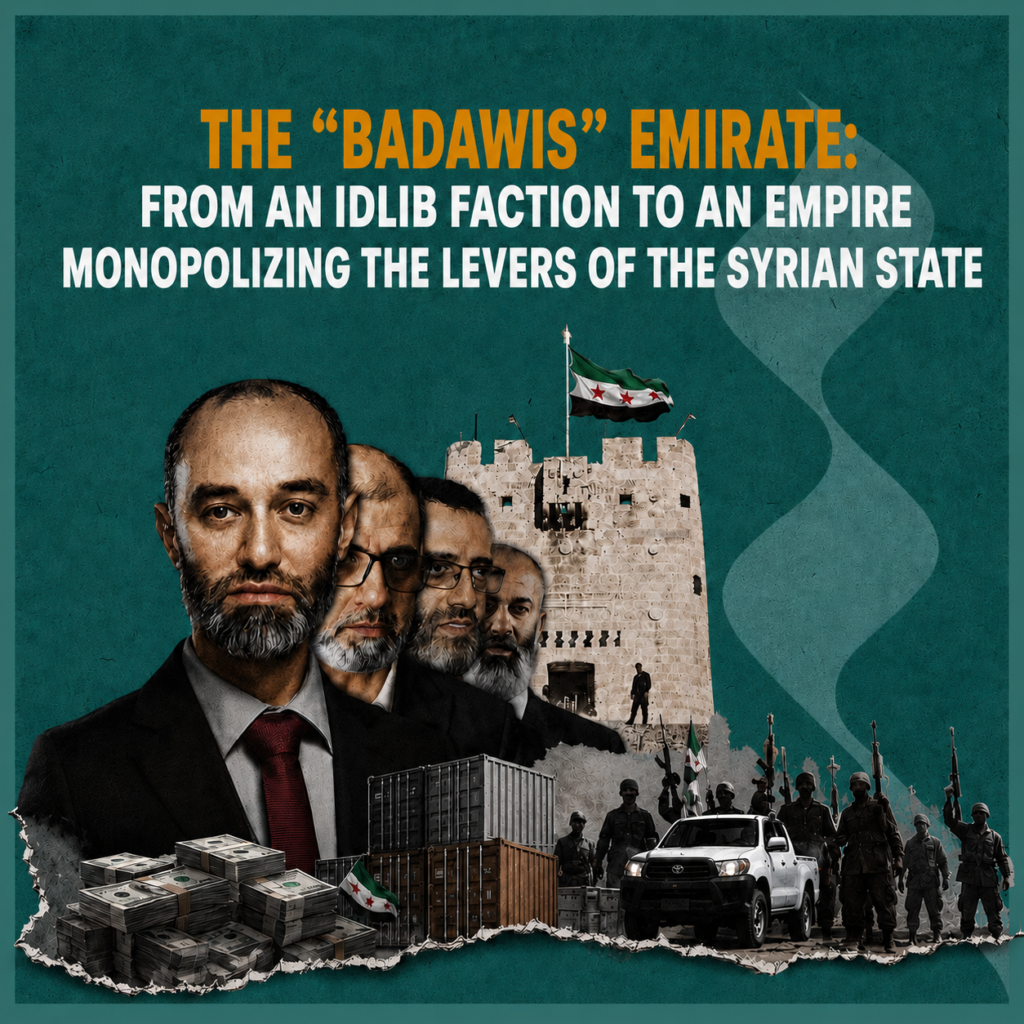
The Rise of the “Al-Badawi Family”: Is the Transitional Administration Reproducing Financial Despotism with New Faces?
Under the new transitional leadership of Ahmed Al-Sharaa, Damascus is witnessing the accelerated rise of a revamped monopolistic regime. Mounting scrutiny is now focused on the meteoric ascent of the “Al-Badawi Network”—a family hailing from the Idlib town of Binnish, whose patriarch (Ahmed Badawi) worked as a simple driver providing for a family of four sons and two daughters. In record time, this family network has transformed from a local faction into a sprawling octopus extending its tentacles deep into the economic, security, and legislative pillars of the Syrian state.
This radical shift, which has drawn the attention of Western media outlets such as Germany’s Deutsche Welle (DW), raises existential questions about the concept of “State Capture” in the new Syria, and sparks profound concerns over whether the transitional administration is merely reproducing financial despotism with a new cast of characters.
The Organizational Trajectory: From Northern Factionalism to Damascus Centralization
The arrival of the Badawi family at the top of the authority pyramid in Damascus was no coincidence. This trajectory began from the womb of “Al-Nusra Front” (later Hayat Tahrir al-Sham – HTS) in the Syrian north, where the brothers realized early on that real power lies in controlling money and supply lines.
The early journey of ascent began with the two brothers joining the organization in Idlib. Qutaiba, who was studying sociology at Aleppo University and working in a perfume shop, managed early on to get close to the organization’s founder, “Abu Mohammad al-Julani.” This proximity paved the way for him to climb the ranks in the north; he first assumed the position of “Emir of the Idlib Sector,” before being assigned the command of the “Special Tasks Unit.” This was a highly secretive security formation established by al-Julani in Idlib, completely separate from the “General Security Service” (the organizational security arm of HTS at the time), to carry out sensitive and special missions under his direct command.
Later, Qutaiba leveraged this high military and security influence to control the financial artery in the north. He was appointed director of the strategic “Bab al-Hawa” border crossing with Turkey, and then climbed to become the general official for crossing management in “Hayat Tahrir al-Sham,” culminating his path in that phase with the title of the “Economic Whale.”
As for his older brother Hudhaifa (who does not hold a university degree and worked as a porter in the Binnish market), he followed in his brother’s footsteps in Idlib, starting as a military commander in Al-Nusra Front, only to gradually become a prominent security and financial official in HTS.
Through their joint management of the strategic “Bab al-Hawa” crossing and its financial flows between 2017 and 2024, the family accumulated immense wealth. This was used as a political and military lever enabling the “Binnish Wing” to wage an existential struggle within the organization that led to the elimination of their rivals in the “Eastern Wing” (led by Abu Maria Al-Qahtani). Following the fall of Damascus and the establishment of the transitional administration, the Al-Badawis moved as a solid, cohesive bloc to swallow the empty state institutions.
The Administrative Structure: Comprehensive Functional Division and Conflict of Interest
The danger of the Al-Badawi network goes beyond traditional influence into what can be termed “comprehensive functional division,” where the tasks of controlling the vital joints of the new Syrian state were distributed among the four brothers, forming a closed monopolistic circle:
-
Qutaiba Badawi (The Legislator and Overseer of Energy and Customs): He represents the ultimate embodiment of a “conflict of interest” in the new era. He combines membership in the “Supreme Council for Economic Development” (planning), the presidency of the “General Authority for Border Crossings and Customs” with the rank of minister—enjoying full administrative/financial independence and a direct link to the Presidency (oversight)—and membership in the board of directors of the “Syrian Petroleum Company” (implementation). This centralization makes him the legislator, the executor, and the observer all at once, opening the door wide to the monopolization of sovereign resources and international tenders.
-
Brigadier General Hudhaifa Badawi (The Military and Border Grip): He capitalized on his factional security background to be directly promoted to the rank of “Brigadier General” in the new army, becoming the commander of the “Supply and Logistics Authority” in the Ministry of Defense. To tighten the loop tied to his brother Qutaiba, he was appointed head of the “Jdeidet Yabous” border center (the primary land crossing with Lebanon), which effectively and authoritatively falls under the Customs Authority managed by Qutaiba.
-
Musab Badawi (The Facade of Planning and Local Administration): The youngest brother, who started as a media operative in HTS and founded the “Dar Naqsh” printing press in Idlib, before directing the Higher Institute of Administration in the “Salvation Government.” Today, he represents the family’s technocratic face in Damascus, taking over the presidency of the “Planning and Statistics Commission” (formerly International Cooperation), and currently holds the position of “Deputy Governor of Damascus.” Musab handles engineering negotiations with Western delegations and investors to ensure that reconstruction funds are channeled to serve the family network.
-
Maad Badawi (Food Security and the Exposed Cycle of Corruption): A veterinarian who previously worked in Idlib’s poultry farms and managed the Binnish Hospital and the “Ghiras Al-Ataa” charity. Maad distances himself from direct sovereign positions to manage the ground economically; he has become the head of the “Syrian Poultry Association,” is active in the “Al-Yamama Fodder” company, and works as a consultant at the “Rayan Food” company. The danger here lies in the fact that “Rayan Food” (owned by his cousin Saadallah Badawi) is currently supplying the Syrian Ministry of Defense with foodstuffs through the “Supply and Logistics Authority” headed by his older brother, Brigadier General Hudhaifa. This monopolization of livelihoods, mixed with relief work to absorb resentment, represents a closed financial cycle that Syrian economic researcher Karam Shaar described as “terrifying.”
Economic Policies and the Repercussions of Regional Marginalization
This family system operates as a vicious circle: Musab attracts investments, Qutaiba and Hudhaifa pass them through the crossings with special customs facilities, Maad monopolizes the market and supplies goods to the army making massive profits, and then Qutaiba returns to legislate laws that protect this exploitative cycle from his economic position.
Observers have warned that the concentration of power in this manner represents “fertile ground for despotism.” This despotism manifests in its most dangerous form through regional marginalization; Decree No. (18) of 2026 regarding the Syrian Petroleum Company sparked widespread anger, as it entirely excluded the people of the eastern governorates (Deir ez-Zor, Al-Hasakah, Raqqa)—the country’s oil reservoir—from managing their wealth, in favor of elites arriving from the northwest. This exclusion threatens to fuel historical grievances that could turn into local rebellions striking the fragile civil peace.
Institutionalizing Hegemony: The Birth of the “Deep State”
The scene painted by the movements of the Badawi family today goes beyond the idea of temporarily exploiting a fragile transitional circumstance; rather, it establishes a tightly closed structural reality. While this network relied in the past on the language of weapons and factionalism to impose its control in the north, today in Damascus it has shifted to a much more dangerous strategy represented by the “institutionalization of monopoly.” Instead of breaking the law, the family now relies on presidential decrees, sovereign appointments, and ministerial decisions to protect its interests, making the process of dismantling its influence highly complex as it hides behind an official bureaucratic and legal cover.
Ultimately, the real dilemma does not lie merely in convincing the outside world to fund early recovery projects, but in answering the most important existential question inside the country: For whom is the new Syria being built? If this organic merging between sovereign decision-making centers and clientelist networks continues, the transitional administration will empty political change of its actual substance. Without a genuine will to cut the umbilical cord between public administration and narrow family interests, Damascus might wake up to the birth of a new “deep state,” where national institutions turn into mere guards of the Syrians’ wealth, but in favor of a closed circle that accepts neither competition nor accountability.