
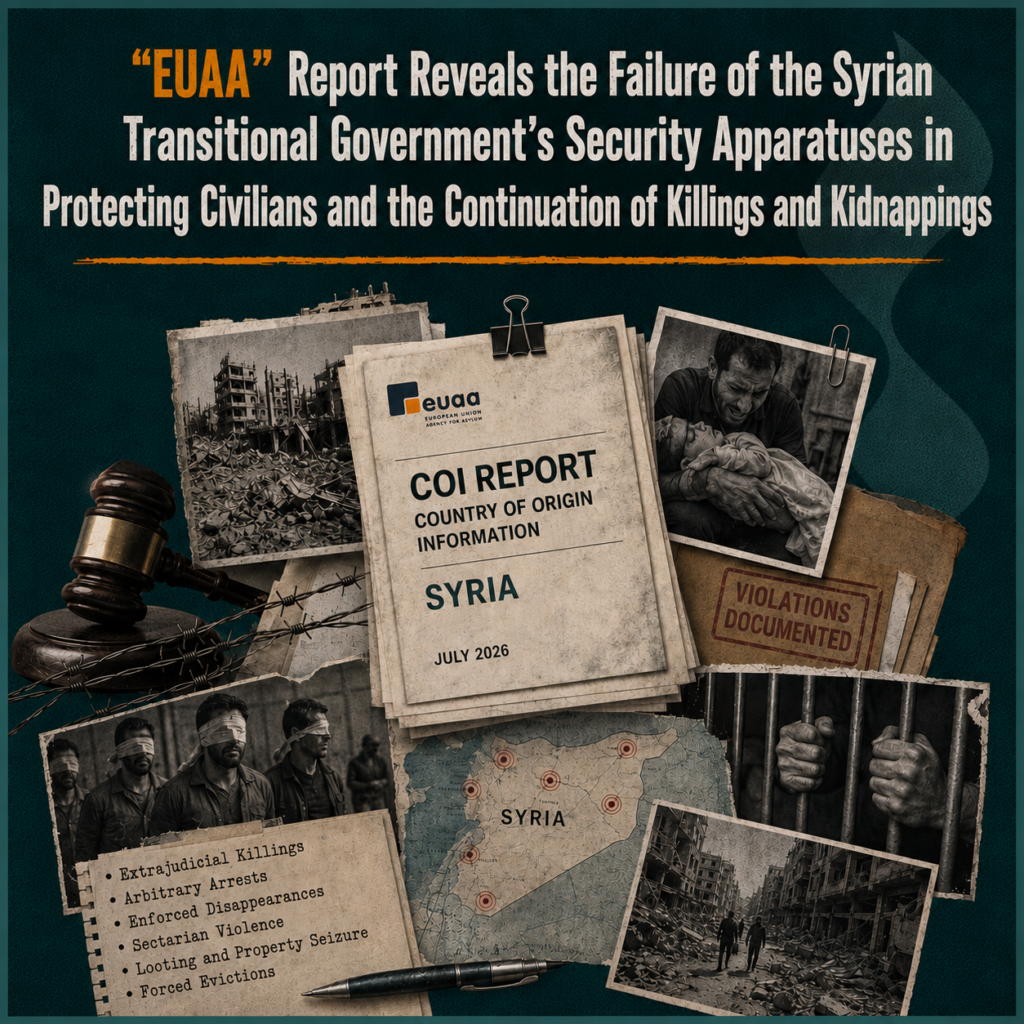
The “Country of Origin Information” (COI) report issued by the European Union Agency for Asylum (EUAA) in July 2026 reveals the continuation of systematic violations and the absence of the rule of law in areas under the control of the Syrian transitional government. Documented data demonstrates the failure of the current government’s military and security apparatuses to secure civilian lives, as well as their direct involvement in a series of abuses including extrajudicial killings, arbitrary arrests, and looting.
Sectarian Violence and Kidnapping Incidents
The European report confirms the involvement of government forces and their allied factions in the killing of more than 1,400 people, mostly Alawite civilians, during operations that took place in the coastal and central regions of Syria in March 2025. This was accompanied by systematic kidnappings targeting Alawite women and girls in the governorates of Latakia, Tartous, Homs, and Hama. Government security agencies failed to intervene to protect minorities, while official authorities deliberately marginalized these incidents. In Homs, security forces registered a complete absence in controlling reciprocal attacks and killings targeting residential neighborhoods.
Lack of Military Discipline and Extrajudicial Killings
The report clearly indicates the limited control of the transitional president, Ahmed Al-Sharaa, over the former “Syrian National Army” (SNA) factions, which have been integrated into the new structure of the Ministry of Defense. The “62nd Division” (formerly known as the Suleiman Shah Division, stationed in Hama) stands out as one of the factions subject to prior sanctions, and the report has proven the direct involvement of its members in violence against civilians, as well as in ongoing crimes of looting and killing.
Furthermore, the Internal Security Command carries out arrests without legal warrants and detains civilians in undisclosed locations. In one of the individual incidents documented, two young men—Mahmoud Hamdan Hejji and another young man—were subjected to abuses that ended in their liquidation, reflecting a bloody approach to dealing with detainees far outside any judicial framework.
Escalation of ISIL Activity and Expansion of Attacks
Alongside the abuses attributed to government forces and factions, the European report indicates that ISIL has exploited local instability, sectarian rifts, and weak state control to regroup and mount attacks. Although its operations were primarily concentrated in Deir Ez-Zor, the group’s activities expanded to include Raqqa, Idlib, Aleppo, and Palmyra, while maintaining sleeper cells in other urban areas, including the capital, Damascus. In late 2025, ISIL underwent a strategic shift, expanding the scope of its operations to increasingly target the transitional government’s military forces. In late February 2026, the group explicitly announced a “new phase of operations” to confront the transitional government, employing tactics that included IEDs, VBIEDs, ambushes, and targeted killings. The group has also infiltrated the security apparatus at mid and lower levels, further complicating the security landscape and exacerbating the ongoing threat to civilian lives.
Violations Against Kurds in Raqqa and Looting in Aleppo
In the northeast of the country, reports document that the Kurdish population in Raqqa governorate has been subjected to a series of violations at the hands of the transitional government authorities. These included arbitrary arrests on charges of “dealing with the SDF,” which in some cases led to death under torture in prisons. The government also applied policies targeting residents’ properties by confiscating vehicles and issuing instructions to evict and demolish the homes of Kurdish families.
In Aleppo, during the battles that broke out in January 2026, government forces were involved in using sniper fire and unguided munitions in densely populated areas, followed by the execution of widespread looting of the homes and shops of civilians fleeing the Sheikh Maqsoud and Ashrafieh neighborhoods.
Property Seizure and Forced Evictions
The current Syrian government continues the policy of seizing civilians’ private properties based on their backgrounds. In Homs governorate, authorities are carrying out forced evictions targeting former military personnel and members of minority groups, alongside the direct seizure of homes belonging to individuals classified as loyalists to the previous administration, thereby depriving civilians of their fundamental property rights.
The assessment of the situation based on the European report shows that the transitional government has not succeeded in establishing a security apparatus that respects human rights; rather, its current military and security structures, coupled with the inability to contain terrorist threats, constitute a primary component of the ongoing deterioration of the security situation and the continuous violations against civilians across various Syrian governorates.