
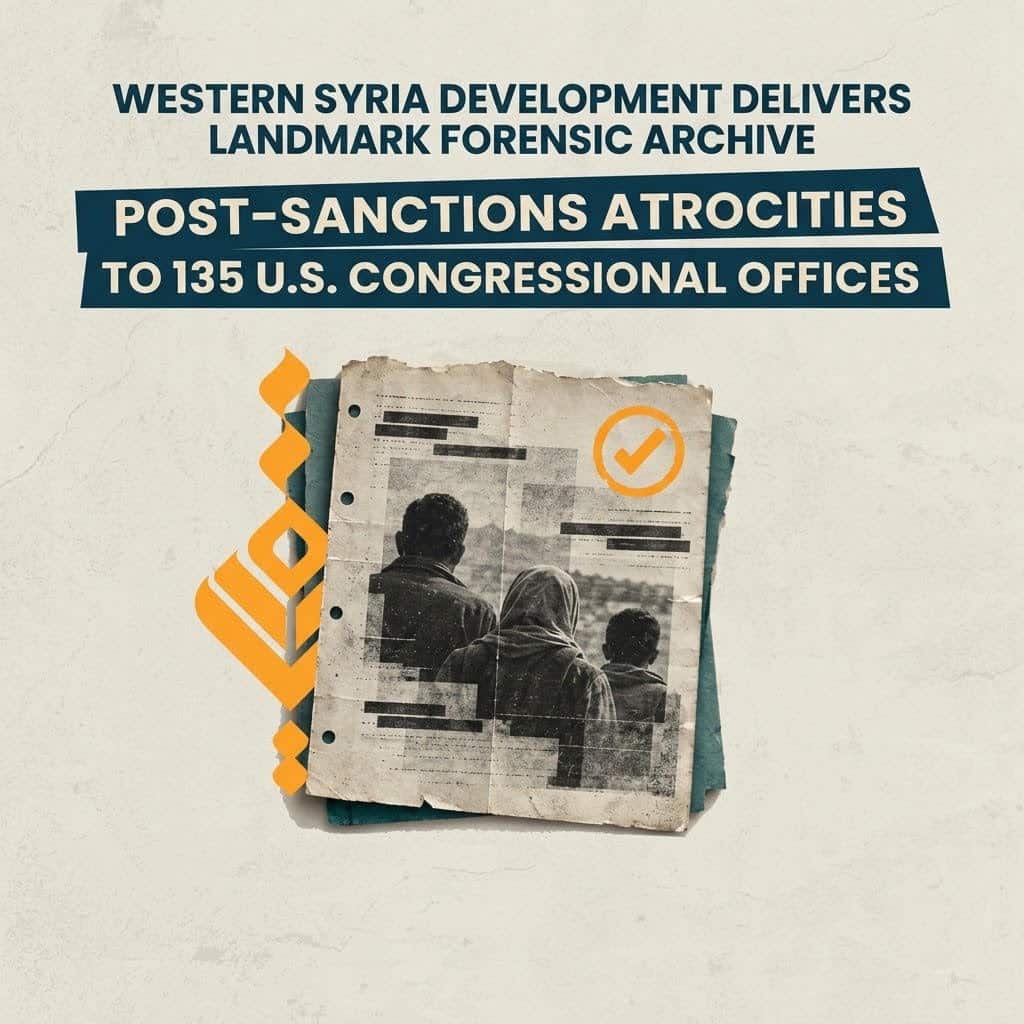
WASHINGTON — September 30, 2026
In an expanded human rights initiative aimed at providing direct evidentiary resources to international stakeholders, Western Syria Development (WSD) announced the delivery of a comprehensive forensic documentation package directly to 135 Members of the United States Congress, engaging foreign policy advisors, legislative teams, and staff across the House Foreign Affairs Committee (HFAC) and Senate Foreign Relations Committee (SFRC).
During this outreach, the organization transmitted verified field records exceeding 1,000 pages, corroborated by satellite geolocation coordinates, verifiable chains of custody, medical logs, and eyewitness testimonies. The submission addresses the empirical reality following the international economic sanctions relief and general commercial licenses enacted in July 2025. The findings demonstrate that trade deregulation and financial reintegration coincided with an acute breakdown of civilian protection, sustained structural violence, and identity-based persecution involving state apparatuses and affiliated armed actors.
The documentation package submitted to Congressional offices comprises dedicated thematic dossiers and an actionable policy brief, structured as follows:
Thematic Dossier on the Alawite Community (306 Pages): Details systematic targeted assassinations and silenced handgun killings directed against farmers, healthcare professionals, and civilian commuters. The dossier records transit abductions of women and minors and their subsequent transfer to clandestine facilities—locally termed “Dar Al-Akhwat” (The Sisters’ Home) in Jableh—for coercive ideological indoctrination, accompanied by forced televised statements. It also documents custodial deaths under torture in Hama and Hasiya facilities, attacks on places of worship such as the bombing of the Imam Ali Mosque in Homs, and institutional exclusion through mass arbitrary employment terminations of hundreds of doctors, engineers, and public energy sector personnel.
Thematic Dossier on the Kurdish Community (131 Pages): Focuses on the impact of heavy artillery, rocket, and loitering suicide drone strikes on densely populated residential quarters in Aleppo (Sheikh Maqsoud, Al-Ashrafiyah, and Bani Zaid) and resulting forced displacement. It documents direct armed incursions into civilian medical facilities (Khaled Fajr, Yassin, and Othman hospitals) and the killing of healthcare workers on duty, alongside recorded cases of corpse mutilation, checkpoint killings of fleeing families in rural Raqqa and Deir ez-Zor, child abductions for ransom under torture, and documented public threats regarding the trafficking and sexual exploitation of female detainees.
General Dossier on Religious & Communal Groups (July 2025 – August 2026): Compiles 53 verified felony case files across diverse communities:
13 documented cases targeting Christians: Encompassing targeted killings, transit kidnappings for ransom, the vandalization and desecration of historic churches including Al-Zaytoun Church in Damascus and shrines in Al-Suqaylabiyah, destruction of cemetery crosses, IED attacks on funeral vehicles, and arbitrary detentions of clergy.
9 documented cases targeting Druze (Muwahhidun): Covering residential mortar shelling, deaths under torture in local police stations such as Jaramana, sniper fire targeting emergency medical teams, highway ambushes, and administrative decrees barring students from exam access as collective punishment.
Annexed Special Investigative Dossier on the 2025 As-Suwayda Massacres (397 Pages): An extensive record of the April–July 2025 campaign across As-Suwayda and Rural Damascus, documenting nearly 4,000 fatalities, the destruction of 35 villages, the displacement of over 155,000 residents, the storming of the National Hospital resulting in the execution of 18 medical personnel and patients, the enforced disappearance of over 80 women, and documented summary family executions.
16 documented cases targeting the Sunni civic space: Including assassinations of mosque imams, fatal torture in Deir ez-Zor and Hama central prisons, documented physical abuse inside Quneitra Prison, child abductions, and the violent suppression of peaceful assemblies.
10 documented cases targeting Shiites: Recording the desecration and exhumation of historic cemeteries in Al-Ashrafiyah and Tal Dahab, targeted assassinations of clerics, and the demolition of 10 homes accompanied by forced evictions in Al-Mazraa village, Homs.
5 documented cases targeting the Murshidi community: Involving drive-by motorcycle shootings, armed incursions, and grenade attacks on civilian gatherings carried out in the presence of security patrols in Nabaa Al-Tayeb, Al-Jid, and Al-Rasif.
3 documented cases targeting the Ismaili community: Covering dynamite demolitions of historic shrines such as Sheikh Faraj Abu Hayya, retail shop liquidations, and the arbitrary detention of 30 civic protesters in Salamiyah.
Executive Policy Briefing: Outlines concrete statutory mechanisms utilizing Congressional oversight, including:
1. Mandating a comprehensive human rights compliance review of OFAC general licenses and commercial authorizations issued since July 2025, incorporating automated snapback provisions upon verified evidence of identity-based persecution or forced displacement.
2. Expanding targeted designations under the Global Magnitsky Human Rights Accountability Act against identified division commanders, detention directors, checkpoint supervisors, and public figures implicated in documented abuses.
3. Convening bipartisan Congressional hearings to evaluate civilian protection mechanisms and support forensic evidence preservation for universal jurisdiction proceedings.
Western Syria Development affirms that providing these verified case files to 135 Congressional offices serves to establish a factual, documented baseline for international policymakers, reiterating its ongoing commitment to sharing authenticated documentation with universal jurisdiction courts and international investigative mechanisms to ensure accountability.