
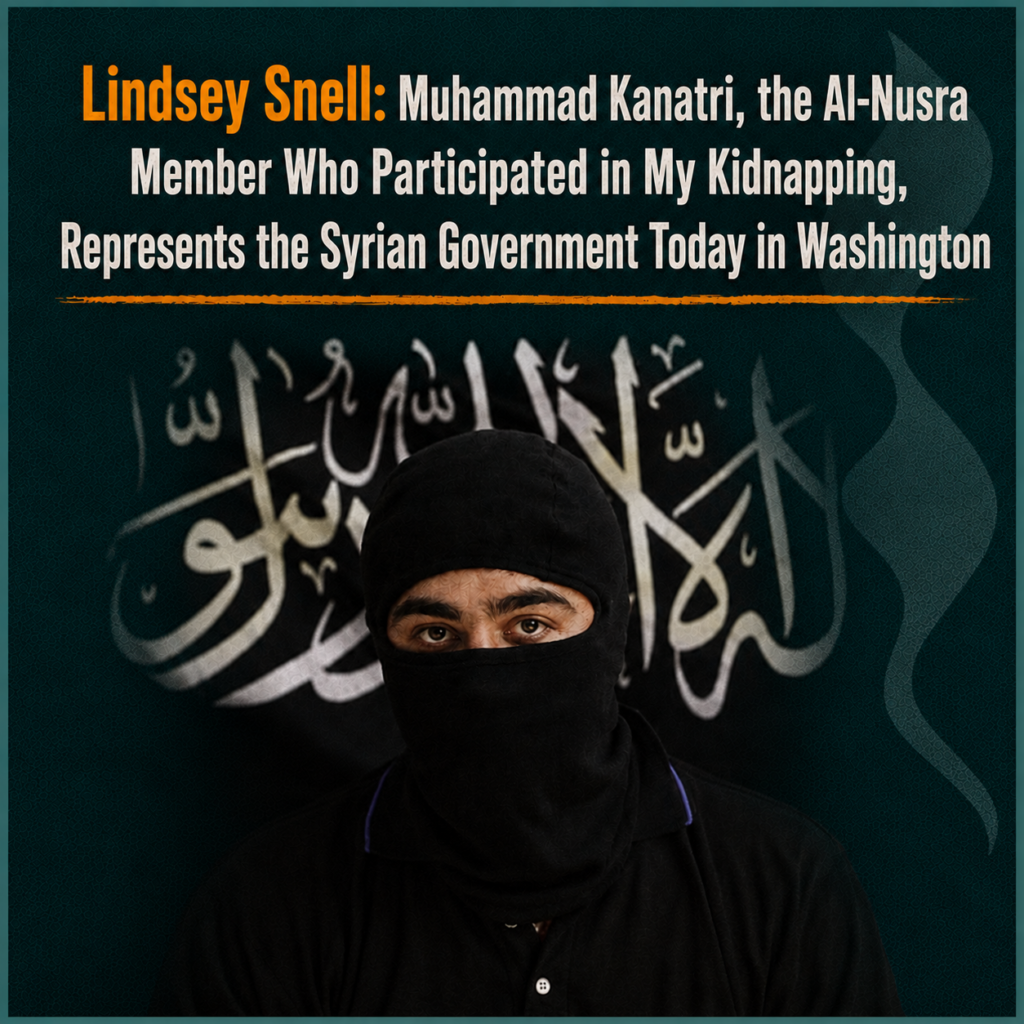
In a new confirmation of the Syrian government’s continued adoption of a radical approach by recycling figures with extremist jihadist backgrounds, American journalist and researcher Lindsey Snell revealed the involvement of the Syrian Chargé d’Affaires in Washington, Muhammad Kanatri, in her kidnapping and detention in 2016, during his active field work within the ranks of the “Al-Nusra Front.”
These revelations represent a direct blow to Damascus’s diplomatic facade and raise serious questions about the current political structure that provides official cover for individuals involved in severe violations, putting the international community before a real test regarding accountability mechanisms.
Recycling Radical Figures
Snell based her report on video footage from July 2016, showing Kanatri masked in front of an Al-Nusra Front flag. During the interview, Kanatri detailed the group’s project to establish a state governed by Sharia law, explaining the radical ideological differences between his faction and ISIS. The researcher confirmed his identity conclusively through visual and audio documentation of his eyes and speaking style.
Kanatri’s transition between these entities reveals the mechanism of rehabilitating extremist leaders to launder their radical past; he moved from armed action within the ranks of the Al-Nusra Front to managing political affairs in Hayat Tahrir al-Sham (HTS), and subsequently to its civilian front represented by the “Salvation Government” and its Ministry of Foreign Affairs, ultimately leading to his appointment as Chargé d’Affaires in Washington in early 2026.
Breaching Security Guarantees and Arrest
The events began in mid-July 2016, when Snell entered Syria to document the aftermath of airstrikes on medical facilities and rescue teams in the rural areas of Aleppo and Idlib. Despite her escorts from the “Thuwar al-Sham” faction obtaining a security clearance from the Al-Nusra Front to work in the town of Kafr Halab—an area under the group’s absolute security control—this clearance was subsequently revoked.
Three days after documenting and conducting the interview with Kanatri, the group arrested Snell’s press fixer on the night of July 20. Despite attempts by Thuwar al-Sham members to hide her in a nearby house, the group’s checkpoints prevented her from leaving the town. About an hour later, an armed group of ten members led by a man known as “Abu Taroub” raided her location, and she was forcibly taken for interrogation on charges of espionage for American institutions.
Conditions of Detention and Escape Details
Snell was subjected to interrogations about her journalistic work and religion in an isolated house, before being transferred a week later to a prison she described as “cave-like,” where she was placed in solitary confinement for two days. As battles escalated around Aleppo, she was moved again to a headquarters housing the families of the group’s fighters.
The researcher took advantage of her presence there to use phones belonging to some of the women to contact her husband. In coordination with an individual linked to the “Ahrar al-Sham” faction, she executed an escape plan by using the pretext of looking for her cat to mislead the guards. She then walked through an olive grove for about ten minutes to reach a meeting point with a motorcycle.
Arrest in Turkey and Deportation
After hiding for two days near the Syrian-Turkish border, Turkish authorities arrested Snell on August 6, 2016, on charges of entering a military zone. She spent 67 days in Turkish prisons, including 17 days in solitary confinement, before being deported to the United States on October 12, 2016.
Official Silence and Lack of Accountability
No comment has been issued by the Syrian Embassy in Washington or by Muhammad Kanatri regarding these facts. With the researcher announcing her intention to publish a second part of the recording, this case presents the international community with a legal imperative. Appointing figures with a radical past to the diplomatic corps undermines accountability efforts and turns official institutions into a cover that protects individuals involved in human rights violations from legal prosecution.