
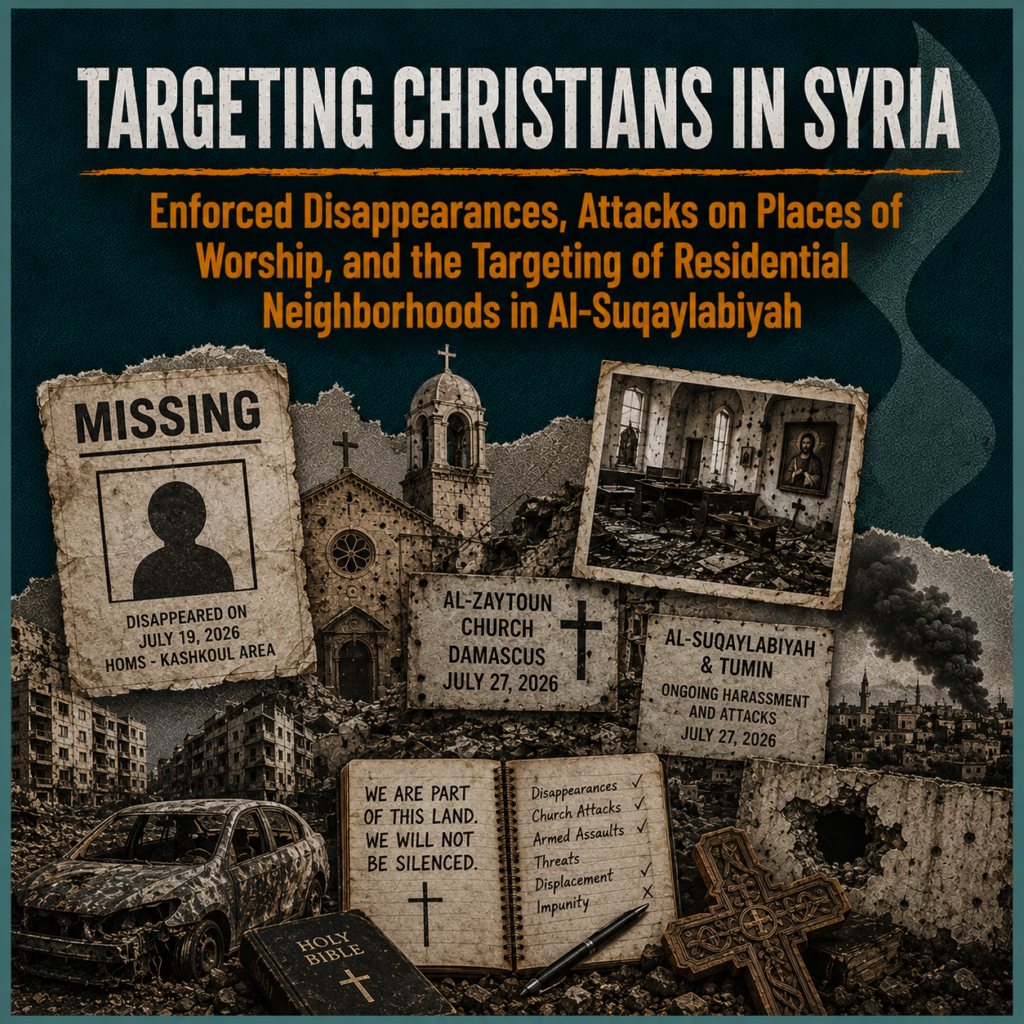
The growing fears regarding the future of Syrian Christians are no longer mere theoretical warnings or purely academic debates. Rather, they represent a direct existential threat to one of the oldest continuous communities in the Middle East. Amidst a rising wave of enforced disappearances, systematic vandalism of places of worship, and months of relentless harassment, Christians in Syria today face a terrifying security crisis fueled by impunity and the complete collapse of the rule of law.
The Disappearance of Samia Al-Nasser (July 19, 2026): An Alarm Bell Met with Silence
On July 19, 2026, a horrific incident thrust the reality of personal safety back into the spotlight. Samia Munther Al-Nasser, a 24-year-old young woman originating from the village of Baseer in Daraa and residing in Homs, disappeared without a trace. She left her family’s home in the Kashkoul area near Damascus around 9:00 PM during a family visit, after which her phone was abruptly turned off.
This disappearance was met with complete laxity and negligence by local security authorities. Equally alarming is the incomprehensible silence from religious leadership, including the Melkite Greek Catholic Patriarchate. Despite Patriarch Youssef Absi being fully aware of the details, no official statement has been issued—raising urgent questions about the existence of political and security pressures aimed at burying the case and obscuring the truth.
Al-Zaytoun Church in Damascus (July 27, 2026): Systematic Desecration of Holy Heritage
These violations extend beyond individual targeting to strike at the core of religious identity. On July 27, 2026, historic Old Damascus witnessed a grave assault on the Al-Zaytoun Church and the headquarters of the Melkite Patriarchate. Early that morning, extremist elements stormed the complex, looted and vandalized the director’s office, and deliberately defaced the surrounding sanctuary.
This attack highlights an environment devoid of the rule of law, where sacred sites are left without any protection. In a bitter irony, this vandalism occurred on the very same day that United Nations officials visited the area, while international observers continued to ignore the harsh reality faced by religious minorities on the ground.
Al-Suqaylabiyah and Tumin (July 27, 2026): Months of Harassment and Escalating Attacks
Field reports confirm that the crisis in the Christian-majority town of Al-Suqaylabiyah and the village of Tumin is neither accidental nor isolated. Patterns of harassment and intimidation against local residents have persisted for months and continue unabated:
-
Systematic Harassment and the July 27 Escalation: Extremist groups have repeatedly targeted women and families in Al-Suqaylabiyah and Tumin. When local residents stood their ground to defend their dignity, these aggressors escalated the violence on July 27, 2026, opening fire on civilian homes and detonating a hand grenade.
-
Weaponizing Family Safety to Force Displacement: Turning daily harassment into a sustained campaign serves a clear purpose: psychological warfare aimed at shattering family stability and driving indigenous communities out through forced displacement.
-
A Historical Pattern of Targeted Violence: This latest crisis aligns with a long, documented history of attacks on Al-Suqaylabiyah. On May 12, 2019, a rocket strike hit a school and the St. Peter Monastery, killing five children and their teacher. On July 24, 2022, an armed drone targeted the opening ceremony of the Hagia Sophia Church. Together, these events reflect a relentless effort to erase the historical Christian presence in the region.
Christian Activists Confront Church Leadership
This security collapse and official silence have sparked widespread outrage among Syrian Christian human rights activists and political advocates, who accuse church leaders of abandoning their flock to protect political interests:
-
Human Rights Activist Ahad Al-Hindi: Al-Hindi spoke out forcefully against the desecration of the Al-Zaytoun Church, condemning the “appalling silence and inaction” of the church hierarchy in the face of enforced disappearances and property destruction. He emphasized that the Christian community rejects official cover-ups, calling on the international community and policymakers in Washington to intervene and hold the perpetrators accountable.
-
Writer and Political Activist George Barchini: Barchini warned that Syrian Christians are suffering an “existential hemorrhage and a desperate battle for survival.” He criticized the reliance of some church leaders on authoritarian guarantees, arguing that true protection cannot be achieved by turning a blind eye to armed extremists, but only through a democratic, secular state that ensures equal citizenship and the rule of law.
The Point of No Return
Highlighting the severity of this crisis, the Syriac Catholic Archbishop of Homs, Jacques Yacoub Mourad, provided a grim assessment, describing the security and economic reality in Syria as “catastrophic,” and noting that authorities are either unable or unwilling to curb the violence.
The Archbishop revealed that the Christian population in Syria has plummeted sharply from about two million to roughly 300,000 to 350,000 today. He warned that if daily harassment, enforced disappearances, and international indifference persist, Christianity in Syria will face the threat of total extinction from its historical homeland.